The biggest problem in decentralized storage is a painful tradeoff:
If you want high security, you usually need huge replication.
If you want efficiency, you usually lose safety.
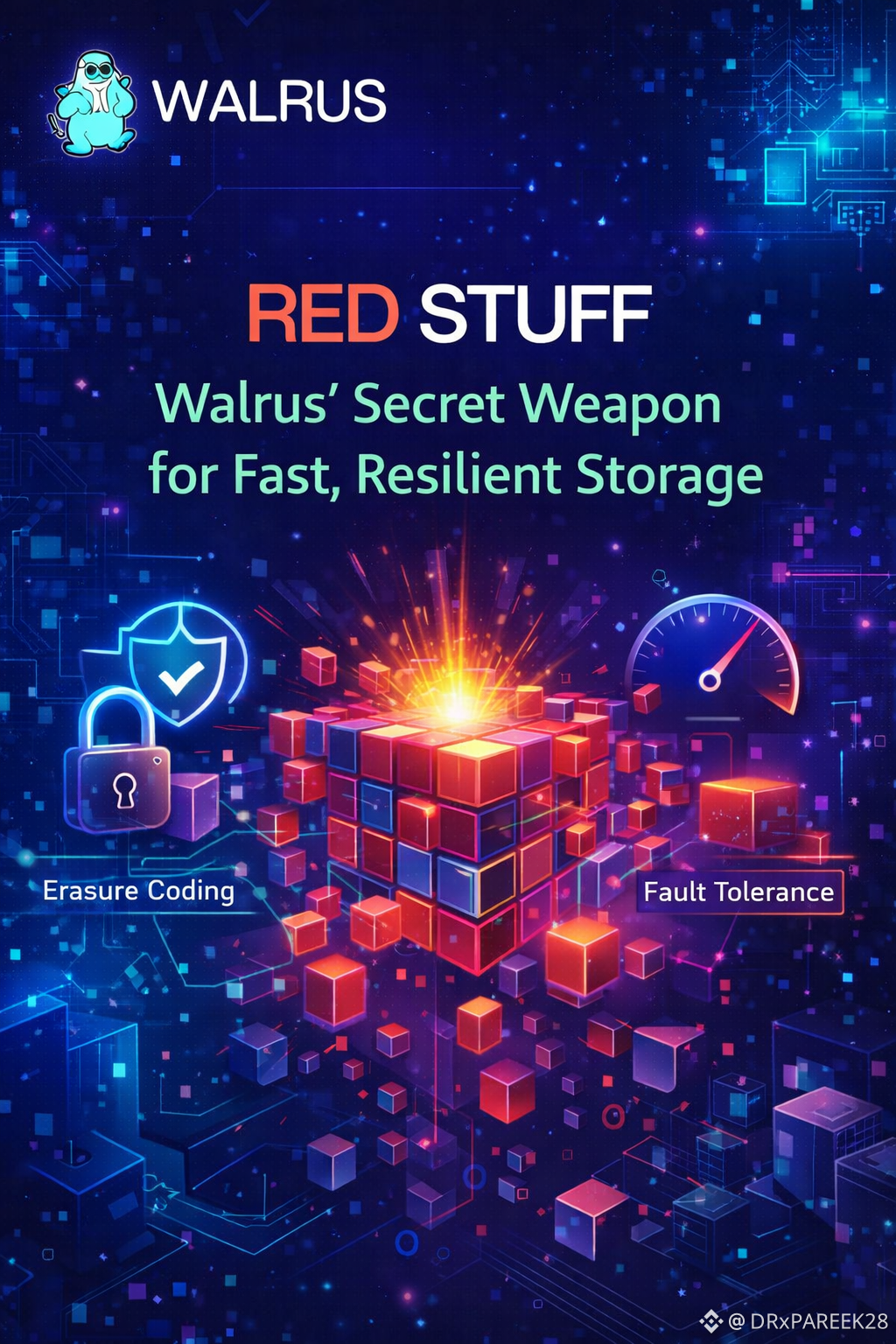
Walrus changes this game with something called Red Stuff.
Red Stuff is Walrus’ 2D erasure coding system, designed to break a large file into smaller pieces (slivers) and distribute them across storage nodes in a way that remains retrievable even when many nodes are offline or malicious. That means Walrus doesn’t rely on “just store 10 copies everywhere” like older designs. Instead, it encodes data smartly so recovery is efficient.
Think of it like this:
In normal storage, you protect a file by duplicating it again and again.
In Walrus, you protect a file by intelligent encoding — so even partial data can restore the full blob.
What makes this even more exciting is that Red Stuff isn’t just a theory. Walrus openly highlights it as the core innovation driving scalable decentralized storage. It improves:
availability (data stays accessible)
security (Byzantine fault tolerance)
recovery speed (fast healing)
overhead control (lower replication factor)
For AI-era applications, this is huge. AI apps produce massive datasets, media, and training content. Web3 needs a storage layer that doesn’t collapse under the weight of large data. Red Stuff is that engine.
So when people say Walrus is “next-gen”, Red Stuff is the exact reason why. It’s not only storage it’s storage engineered for high-demand future apps.