Every AI conversation eventually lands in the same place: data. Who owns it, who controls it, who can access it, and who profits from it. And right now, most of the world’s AI future is built on centralized storage assumptions — one platform, one cloud, one permission system, one set of rules you don’t control.
That’s where Walrus becomes interesting to me. Not as “another storage protocol,” but as a way to rebuild the data layer into something teams can trust without asking permission.
AI Doesn’t Need More Hype — It Needs Better Rails
AI models are hungry. Training data, retrieval datasets, embeddings, media libraries, logs, user interactions, private corp docs… it’s all fuel. But the moment your data lives in a centralized bucket, you inherit centralized risk: access can be changed, pricing can spike, datasets can be audited or removed, and ownership becomes blurry.
Walrus points at a different approach: decentralized storage that’s designed for heavy data and meant to be used as infrastructure — not a side feature.
The Real Issue: Sharing Data Without Losing Control
A lot of people talk about “monetizing datasets,” but most teams can’t even share data safely. Either they keep it private and siloed (slow progress), or they share it on centralized platforms (loss of control).
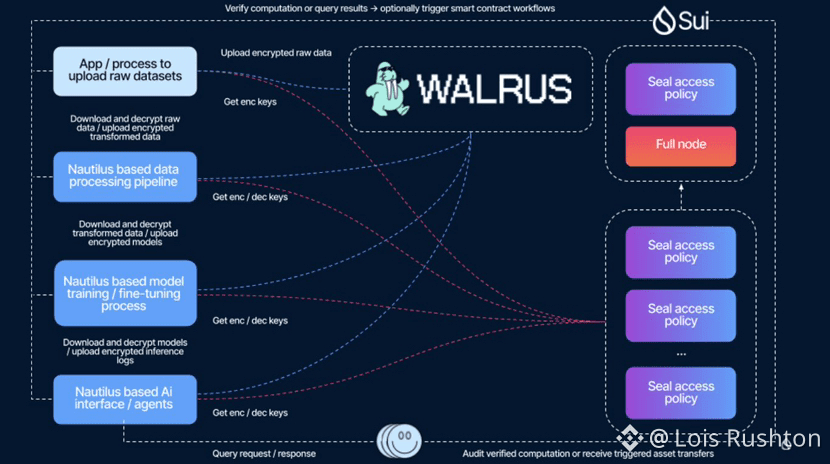
Walrus becomes compelling when you combine two ideas: storing big data across a decentralized network, and controlling access through encryption and programmable permissions. That’s the kind of structure that lets creators and teams collaborate without handing their entire future to a single gatekeeper.
Programmable Access Is the Difference
Storage alone isn’t enough. If storage is public by default, then privacy has to be intentional. The way I think about Walrus is: it gives you the “where,” and the encryption layer gives you the “who.”
That separation matters. You can store encrypted data openly across a network, and then decide who can actually decrypt it. That means the network can provide availability and resilience, while you keep control of the value.
For AI teams, that’s huge. You don’t just need storage. You need policy you can trust.
Why Decentralized Data Availability Changes the Game
When AI systems become embedded into products, downtime isn’t just inconvenient. It breaks behavior. It breaks agent workflows. It breaks user trust. A decentralized network that’s built around availability — and that structures participation through predictable cycles — creates a different kind of reliability than “one provider promises uptime.”
It’s not that nothing can ever fail. It’s that the system is designed to keep working even when pieces of it fail.
That’s what resilience is supposed to mean.
WAL as a Coordination Token, Not a Decoration
The moment a storage network becomes real, incentives become everything. Nodes need to show up consistently. They need to store correctly. They need to serve data when requested. They need to behave like infrastructure, not like opportunists.
$WAL in this frame, is how the network coordinates behavior. It’s the asset that links participation to reward and links governance to community direction. It also gives the protocol a way to evolve rules without becoming centralized “product policy.”
Data Sovereignty Is Becoming a Consumer Demand
People assume only institutions care about privacy. I don’t think that’s true anymore. Everyday users are learning, slowly, that their data is their leverage — and centralized platforms are built to extract it.
In a world where AI is everywhere, data sovereignty becomes emotional. People want the freedom to store, share, and revoke access without begging a platform to respect them. And builders want to create products that don’t collapse under a single platform’s control.
Walrus sits in that intersection.
The Future Looks Like This
I think the long-term direction is clear: AI + Web3 products will require storage that is scalable, programmable, and resistant to censorship and single-point failures. The teams that succeed won’t only be the teams with the best models. They’ll be the teams with the best data infrastructure.
That’s why I don’t treat Walrus as “a storage play.” I treat it as part of the coming fight over who owns the AI era’s raw material.
It is what it is
When data becomes the economy, storage becomes power. @Walrus 🦭/acc is building a way for that power to be distributed instead of concentrated. And if that direction holds, $WAL isn’t just another token — it’s a participation key in the infrastructure layer that AI-native apps will need.