


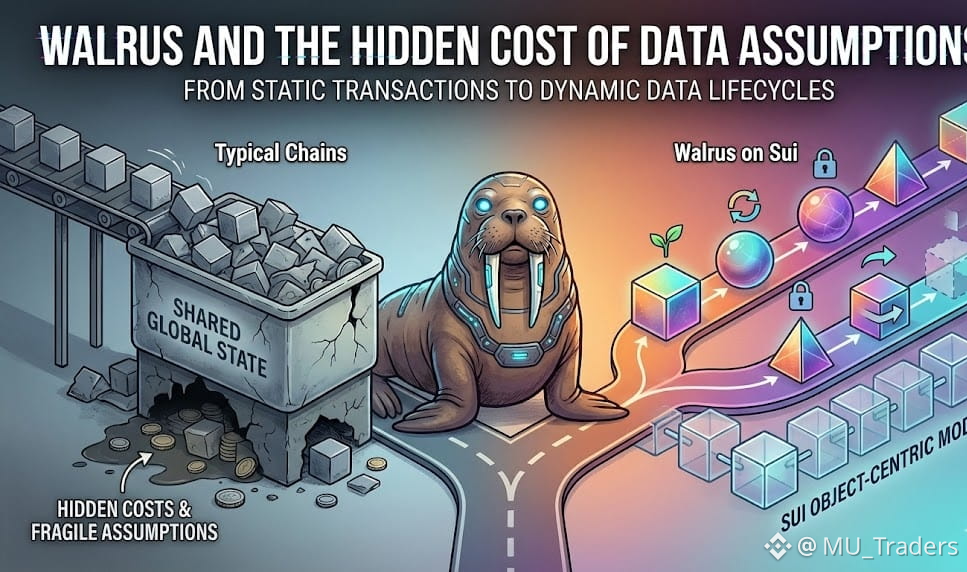
you may be spending time analyzing protocols, narratives, and on-chain activity, but there is a deeper layer most people rarely question. It is the assumption that data will somehow behave itself once it leaves a smart contract. In crypto, that assumption has survived longer than it should have. Walrus challenges it in a way that feels subtle but consequential.
The Problem Nobody Models Properly
Most decentralized systems are designed around transactions, not data lifecycles. They assume data is small, static, and easy to reference. That works until applications start resembling real products. User profiles evolve. Game states change. Records accumulate history. At that point, data stops being passive and starts shaping behavior.
Walrus approaches storage with the idea that data has a lifecycle just like assets do. It can be created, updated, restricted, transferred, and eventually retired. This framing is important because it removes the illusion that storage is neutral. How data moves directly affects trust, privacy, and user experience.
Why Typical Chains Struggle With This
On many blockchains, all data competes for a shared global state. That design forces trade-offs. Either data is simplified to fit, or it is pushed off-chain with loose guarantees. In both cases, ownership becomes theoretical rather than enforceable. Users may hold keys, but systems still depend on assumptions they cannot verify.
Walrus avoids this by aligning storage with application logic rather than fighting it. Data is not treated as an external attachment. It is structured in a way that allows applications to reason about who controls it and how it can change over time.
How Sui Quietly Changes the Math
Sui’s object-centric model is what makes this practical. Instead of forcing all data into a single shared space, it allows objects to exist independently. Each object has clear ownership rules and can evolve without blocking the rest of the system. Walrus builds directly on this idea.
This means data can scale horizontally. Updates do not create unnecessary contention. Permissions are enforced by design rather than convention. For developers, this reduces complexity. For users, it turns ownership into something observable rather than assumed.
Implications Beyond Finance
Once data lifecycles are treated seriously, new categories of applications become viable. Identity systems that evolve without leaking history. Games where state persists without central servers. Social layers where users retain control without sacrificing usability. These are not extensions of DeFi. They are systems DeFi was never designed to support.
This is where Walrus quietly expands what crypto infrastructure can be used for. It shifts the conversation from moving value to managing state responsibly. That distinction matters as applications grow closer to everyday software.
A Different Direction for the Stack
Walrus suggests that the next phase of infrastructure will not be defined by speed alone. It will be defined by how well systems handle long-lived, evolving data. By pairing storage with ownership and lifecycle awareness, it challenges the industry’s habit of treating data as an afterthought.
In the broader cryptocurrency ecosystem, this approach signals a move toward maturity. Applications built on these assumptions are less fragile and less dependent on trust shortcuts. That may not be obvious at first glance, but over time, it is the kind of foundation that quietly shapes everything built on top of it.
@Walrus 🦭/acc $WAL #Walrus


