


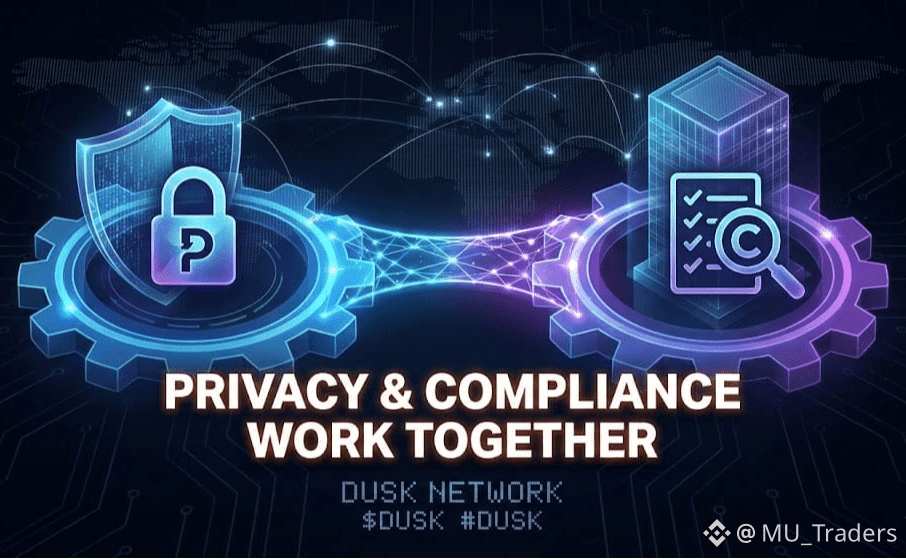
you may have noticed a lot of talk about privacy in crypto lately, but what few projects are actively solving is the real tension between confidentiality and auditability in regulated environments. Dusk Network has camly been advancing in this space with developments around DuskEVM and Hedger, and the implications stretch far beyond a simple privacy feature. (Dusk Forum)
Why the Conventional Model Falls Short
In most blockchain systems, privacy means hiding data, which usually comes at the cost of built it hard for auditors, regulators, or institutional partners to verify transactions. That’s an acceptable trade for purely decentralized, permissionless applications, but it becomes a blocker when dealing with regulated financial products like tokenized securities or institutional money markets. Traditional chains force developers to choose: full transparency that exposes sensitive information or off‑chain reporting that reintroduces trust assumptions and manual processes.
Dusk approaches the problem differently by embedding privacy into the stack while retaining the ability to prove compliance. Their modular architecture positions DuskEVM as an EVM‑compatible application layer that inherits settlement and data availability from DuskDS, the Layer‑1 privacy and compliance engine. (Dusk Forum)
What Hedger Really Means
The real non‑obvious advancement is Hedger, Dusk’s confidential transaction engine for DuskEVM. Instead of simply hiding balances, Hedger leverages homomorphic encryption and zero‑knowledge proofs so that transactions are private yet provably valid. Auditors can verify that rules were followed without ever seeing the underlying data. This shifts privacy from being a binary choice to being a verifiable condition. (hozk.io)
That matters because it resolves a practical tension: financial institutions require transparency for compliance, while counterparties and clients often require confidentiality for commercial reasons. On most EVM chains, compliance is layered on afterward through off‑chain controls and reporting tools. On Dusk, the privacy‑preserving compliance mechanisms are part of the execution environment. That means system‑level proofs replace trust in third parties.
Beyond Privacy: Implications for Regulated Crypto
This approach unlocks use cases that have lagged in adoption. Consider regulated real‑world assets (RWAs). Tokenizing a bond or a fund isn’t just about putting an asset on a blockchain. It’s about ensuring that:
• Transfers respect regulatory constraints.
• Auditors can validate compliance without mass data exposure.
• Confidential investment strategies remain confidential.
Most chains struggle with these simultaneous requirements. On Dusk, privacy‑preserving proofs and compliant execution logic make these obligations native to the protocol, reducing operational friction and aligning on‑chain activity with regulatory expectations. (Dusk Network)
Why This Isn’t Just a Feature
It’s easy to dismiss privacy engines as niche. But the real challenge has been building infrastructure where compliance doesn’t undercut decentralization or confidentiality. Dusk’s stack — modular, EVM‑compatible, and proof‑oriented — shows a path forward. It means institutions could potentially issue, trade, and settle regulated assets directly on chain with compliance assured by cryptography, not manual reporting.
That subtle shift could influence where regulated finance experiments with on‑chain models. Not because it’s louder, but because it solves a practical integration problem: reconcile auditability with confidentiality.
