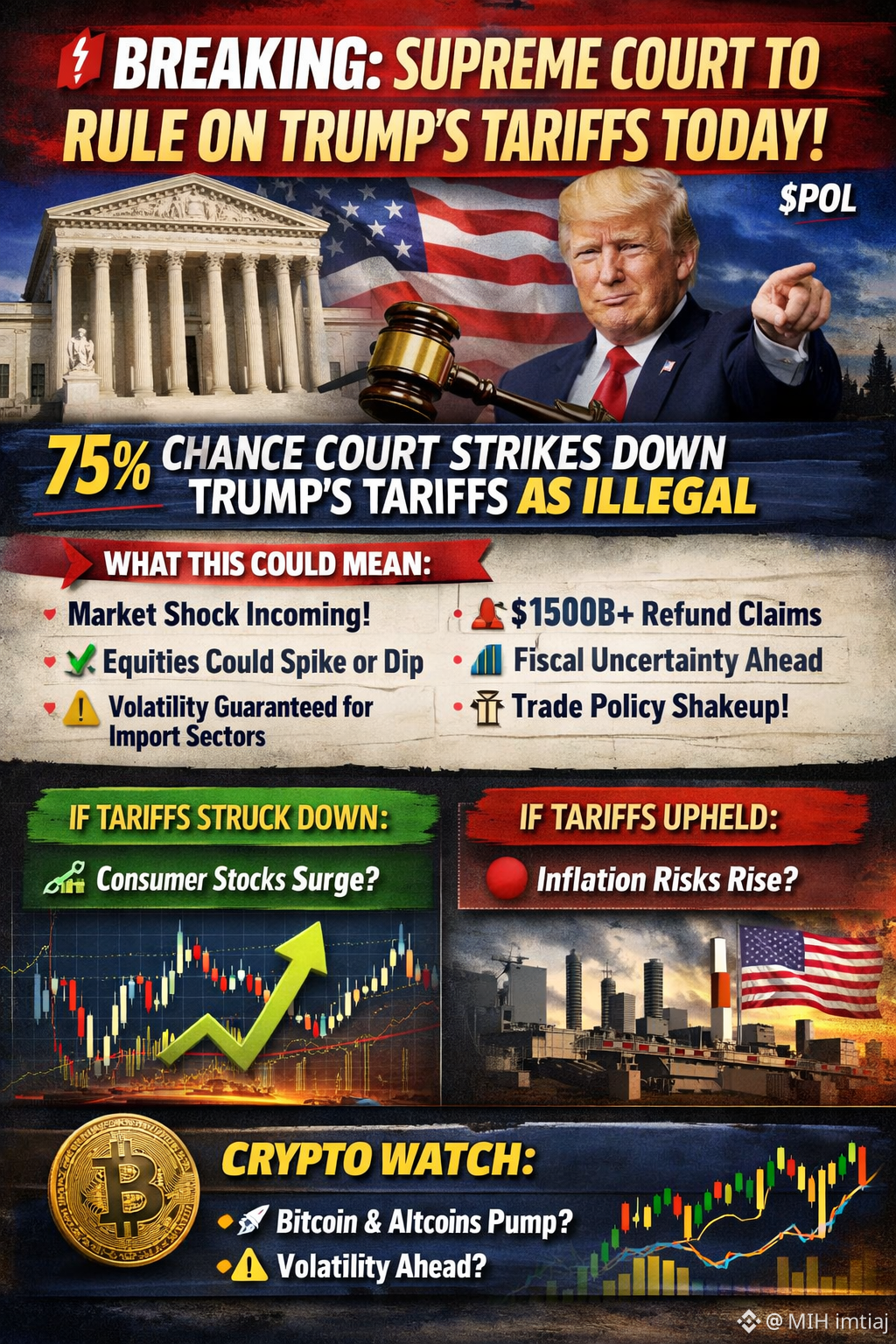
Prediction markets are now pricing in roughly a 75% chance that the U.S. Supreme Court will declare President Trump’s sweeping tariff regime unlawful — a decision that could rock markets and reshape U.S. trade policy. �
Barron's
Here’s what you need to know — and what it could mean across markets and beyond:
🔥 What’s at Stake
Trump’s tariffs, imposed under emergency powers (IEEPA), hit hundreds of billions in imports from the EU, China, Mexico, India and more. Lower courts have already ruled that the president exceeded his legal authority, and the Supreme Court has signaled serious skepticism during oral arguments. �
Reuters +1
If the Court strikes these tariffs down, it won’t just be a legal win — it could trigger:
💸 Refund claims worth up to $150–$200 billion from importers already hit by tariffs. �
Reuters
📉 Pressure on U.S. government revenue and federal budget forecasts. �
⚖️ A legal precedent curbing broad executive trade authority.
🔄 Immediate volatility in equities, bonds and FX markets.
📊 Markets Are on Edge
Equity markets have already shown heightened risk pricing — especially in sectors dependent on global supply chains. Analysts warn that a ruling against the tariffs could spark a big initial rally in import-heavy stocks like retailers and consumer goods, while lifting pressure off companies previously dealing with high input costs. �
The Economic Times
But there’s a catch:
Even a ruling against the current framework could spur trade policy uncertainty, as the administration may pivot to alternative legal tools to maintain duties, meaning volatility won’t disappear overnight. �
The Economic Times
📉 Possible Scenarios (Short-Term)
If tariffs are ruled illegal:
📈 Consumer and retail stocks could jump as cost pressures ease.
💵 Importers may seek large refunds — potentially dragging on government cash flows.
📊 Treasury yields could rise on fiscal uncertainty. �
The Economic Times
If tariffs are upheld:
🛡️ U.S. onshoring narratives strengthen.
📈 Some domestic manufacturers could see gains.
⚠️ Markets might interpret it as hawkish trade policy — raising inflation concerns. �
Business Today
🚀 Crypto Angle: Risk-On or Risk-Off?
From a crypto perspective, the ruling — whichever way it goes — is a volatility booster:
📈 Risk-On Bias (if tariffs struck down): With equities stabilizing and trade costs falling, risk assets like Bitcoin and major altcoins could benefit from renewed risk appetite in the short term.
📉 Risk-Off Moves (if upheld or delayed): Policy uncertainty often drives flows into safe havens and short-term volatility spikes — which can push crypto prices into choppy territory before any directional trend emerges.
Given how thin and sentiment-driven crypto markets are, big swings around this macro event are very likely.