Introduction: Why Storage Must Become Programmable
For most of blockchain history, storage has been treated as a passive layer. Blockchains excel at computation, consensus, and value transfer, but when it comes to storing real-world data—videos, documents, models, AI datasets, game assets—they rely on external systems that operate with limited flexibility. Traditional decentralized storage solutions focus on durability and availability, but they largely stop there.
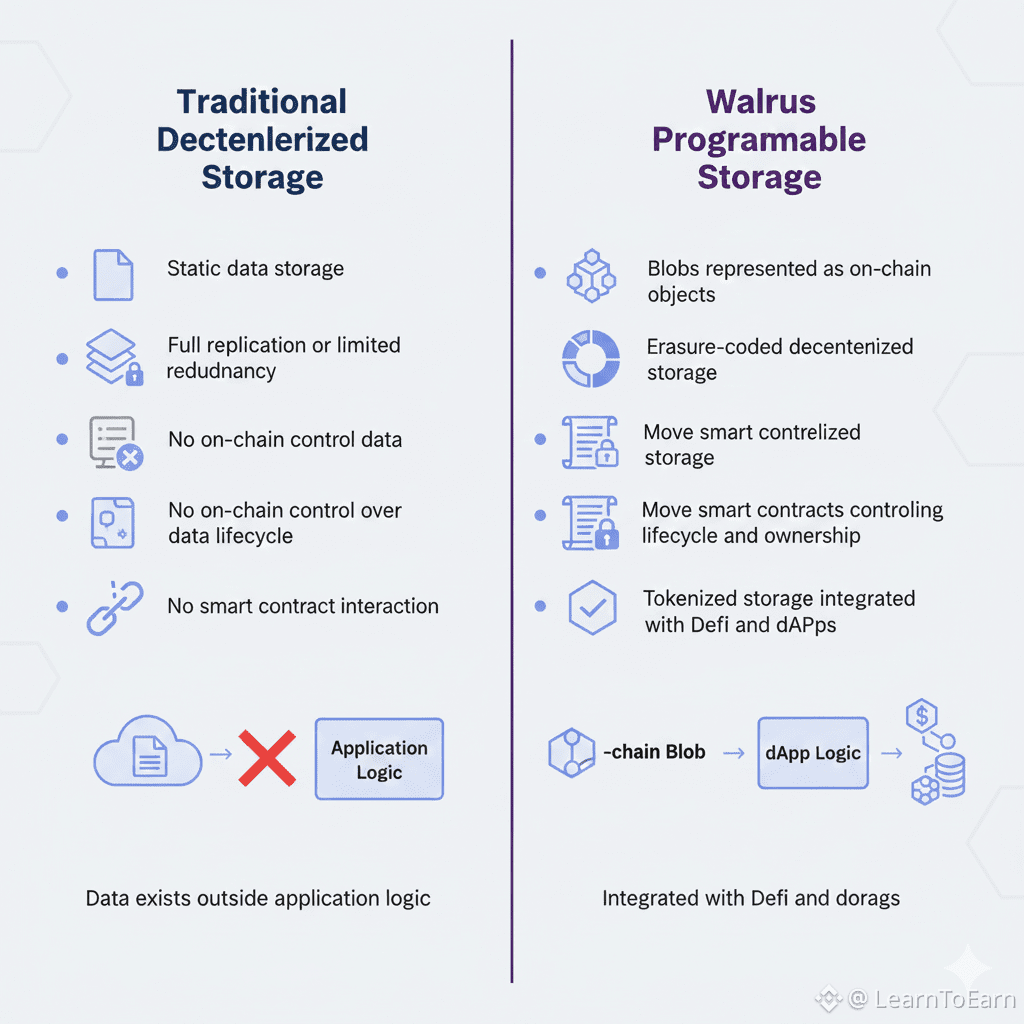
Walrus introduces a fundamental shift in this paradigm by turning storage into a programmable, composable, and controllable resource. Rather than being a static location where data is placed and forgotten, stored data in Walrus becomes an active object that can participate in smart contract logic, ownership rules, economic incentives, and application workflows.
At the heart of this innovation is Walrus’ tight integration with the Sui blockchain. By representing stored blobs as on-chain objects, Walrus enables developers to build logic directly around data itself—its availability, lifetime, ownership, metadata, and access patterns. This is what Walrus refers to as programmable storage.

Understanding Walrus at a High Level
Walrus is a decentralized storage and data availability protocol purpose-built for large binary objects, commonly referred to as blobs. These blobs can represent any unstructured data: media files, 3D models, datasets, encrypted archives, or application assets.
The protocol is designed with three core objectives:
1. High availability, even under severe network failures or malicious behavior
2. Cost efficiency, avoiding wasteful full replication
3. Deep programmability, allowing applications to reason about stored data on-chain
Walrus achieves these goals by combining advanced erasure coding, a rotating committee of storage nodes, and coordination via smart contracts on the Sui blockchain.
Unlike general-purpose blockchains, Walrus does not attempt to execute application logic or enforce consensus over state transitions. Instead, it focuses exclusively on storing and serving data reliably, while delegating control, verification, and economic logic to Sui.
---
The Concept of Blobs in Walrus
In Walrus, all stored data is treated as a blob. A blob is a large binary object that is:
Content-addressed
Publicly discoverable
Verifiable for availability
Reconstructible even under partial node failure
When a user uploads a blob, Walrus does not simply replicate it across nodes. Instead, it applies a specialized erasure coding technique—designed to tolerate Byzantine faults—and distributes encoded fragments across a committee of storage nodes.
The critical insight is that the blob itself does not live on-chain, but its existence, availability proofs, ownership, and lifecycle metadata do.
This separation between data storage and data control is what enables programmability without sacrificing scalability.
---
Blobs as On-Chain Objects: The Foundation of Programmable Storage
Representing Storage on Sui
When a blob is stored on Walrus, a corresponding object is created on the Sui blockchain. This object acts as the canonical on-chain representation of the stored data.
The object includes:
A cryptographic reference to the blob
Proofs that the blob has been successfully encoded and distributed
Metadata describing the blob’s size, lifetime, and storage parameters
Ownership information
Payment and expiration data
Because Sui treats objects as first-class resources, these blob objects can be referenced, transferred, queried, and modified by Move smart contracts.
This design transforms storage from an opaque backend service into a programmable asset.
---
Move Smart Contracts and Storage Logic
Why Move Matters
Move is a resource-oriented programming language designed to model ownership, access control, and scarcity at the language level. This makes it uniquely suited for programmable storage.
In Walrus, storage capacity, blob references, and availability attestations are all modeled as Move resources. This ensures that:
Storage cannot be duplicated or forged
Ownership rules are strictly enforced
Access patterns are explicit and auditable
Interacting with Stored Data
Developers can write Move smart contracts that interact with blob objects in multiple ways:
Checking whether a blob is still available
Verifying that storage fees are paid
Extending or reducing a blob’s storage lifetime
Attaching application-specific metadata
Enforcing access conditions
Deleting blobs when conditions are met
Crucially, these operations do not require modifying the blob itself. The data remains immutable, but the logic surrounding it is dynamic.
---
Blob Lifecycle Management as Code
One of the most powerful aspects of programmable storage is automated lifecycle control.
Storage Duration and Expiry
In Walrus, blobs are not stored indefinitely by default. Each blob has a defined storage period, enforced by smart contracts. Developers can build logic that:
Automatically extends storage if certain conditions are met
Expires blobs when subscriptions lapse
Deletes data after a usage threshold
Preserves critical data indefinitely while pruning less important assets
This is particularly useful for applications like media platforms, datasets, or ephemeral messaging systems.
Deletion with Ownership Guarantees
Unlike many decentralized storage systems, Walrus explicitly allows data owners to delete their blobs.
Deletion does not mean retroactively erasing data from the internet, but it does mean:
Storage nodes are no longer incentivized to serve the blob
Availability proofs cease
Applications relying on the blob can detect its removal
This restores a critical aspect of data sovereignty that is often missing in decentralized systems.
---
Attaching Metadata and Policies
Because blob objects live on-chain, developers can attach arbitrary metadata and policies to them.
Examples include:
Content descriptors (file type, version, schema)
Licensing terms
Token-gated access rules
Application-specific identifiers
Usage statistics or counters
This metadata can be read by other smart contracts, allowing storage to integrate seamlessly into DeFi, NFT platforms, gaming logic, and governance systems.
---
Tokenized Storage: Making Data an Economic Asset
Storage as a Resource
In Walrus, storage capacity itself is tokenized and represented as Sui resources. This means storage is not just consumed—it is allocated, owned, and managed.
Users acquire storage capacity by paying with the WAL token. That capacity can then be used to store blobs, transferred, or integrated into higher-level application logic.
WAL and FROST
Walrus uses a native token called WAL, with a subunit called FROST (1 WAL = 1 billion FROST). These units are used for:
Paying for storage
Staking by storage nodes
Reward distribution
Penalty enforcement
All of this logic is enforced on-chain, making storage economics transparent and verifiable.
---
Availability Proofs and Trustless Verification
One of the defining features of Walrus is its ability to prove that data is available.
Why Availability Matters
In decentralized systems, it is not enough to claim that data exists. Applications need cryptographic assurance that data can be retrieved when needed.
Walrus achieves this by:
Requiring storage nodes to periodically attest to availability
Recording these attestations on-chain
Allowing anyone to verify that a blob remains reconstructible
Smart contracts can check these proofs and react accordingly—for example, halting an application feature if required data becomes unavailable.
---
Red Stuff Encoding and Fault Tolerance
Walrus uses a modern erasure coding approach known as fast linear fountain codes, often referred to in Walrus documentation as Red Stuff encoding.
This system allows blobs to be reconstructed even if up to two-thirds of storage nodes fail or behave maliciously.
Compared to traditional replication:
Storage overhead is significantly lower
Fault tolerance is dramatically higher
Recovery is faster and more flexible
This makes Walrus particularly suitable for long-term storage of critical data.
---
Public Data and Security Considerations
All blobs stored on Walrus are public by design. Anyone can discover and retrieve them if they know the reference.
This is an intentional design choice that prioritizes:
Transparency
Verifiability
Simplicity
Applications that require privacy must handle encryption at the application layer. Walrus works seamlessly with encrypted data, but it does not manage keys or access secrets.
This separation of concerns keeps the protocol minimal while allowing sophisticated privacy-preserving applications to be built on top.
---
Integration with Web2 Infrastructure
Despite being decentralized, Walrus is designed to integrate smoothly with existing web infrastructure.
Users and applications can interact with Walrus through:
Command-line tools
SDKs
HTTP APIs
Local nodes
Data can be cached by traditional CDNs, improving performance without sacrificing decentralization. For applications transitioning from Web2 to Web3, this lowers the barrier to adoption.
---
Real-World Projects Using Walrus
Programmable storage is not a theoretical concept. Multiple projects are already building on Walrus.
Tusky
Tusky is a privacy-focused file storage platform offering both public and encrypted vaults. It uses Walrus for flexible storage durations, NFT-based file ownership, and token-gated access.
3DOS
A decentralized manufacturing network storing 3D models securely while ensuring availability across global nodes.
Claynosaurz
A Web3 entertainment brand using Walrus to store high-quality media assets tied to digital collectibles.
Decrypt Media
A Web3 media company leveraging Walrus for content storage and distribution.
Linera
A Layer 1 blockchain for real-time applications that uses Walrus for scalable data storage.
Talus
An on-chain AI agent platform storing AI-related datasets and artifacts.
Hackathon Applications
Projects like Hyvve, OpenGraph, Galliun, DemoDock, SuiSQL, Darkshore Fishing Club, Archimeters, and Chatiwal demonstrate how programmable storage enables AI marketplaces, games, creator platforms, databases, and secure messaging.
---
Why Programmable Storage Changes Everything
Traditional storage systems treat data as inert. Walrus treats data as a participant.
By making storage programmable:
Data can enforce its own rules
Applications can react to data availability
Ownership becomes explicit and enforceable
Economic incentives align around data quality and reliability
This transforms storage from infrastructure into a foundational application layer.
---
Conclusion: Walrus as the Data Layer of Web3
Walrus’ programmable storage represents a major step forward for decentralized systems. By combining robust, cost-efficient storage with on-chain control and programmability, it bridges a long-standing gap between computation and data.
For developers, it unlocks new design patterns. For users, it restores ownership and control. For the broader ecosystem, it lays the groundwork for a future where data is not just stored—but governed, verified, and integrated into the fabric of decentralized applications.
As Web3 continues to evolve, programmable storage is no longer optional. Walrus shows what it looks like when storage finally becomes a first-class citizen of the blockchain world.@Walrus 🦭/acc #Walrus $WAL