

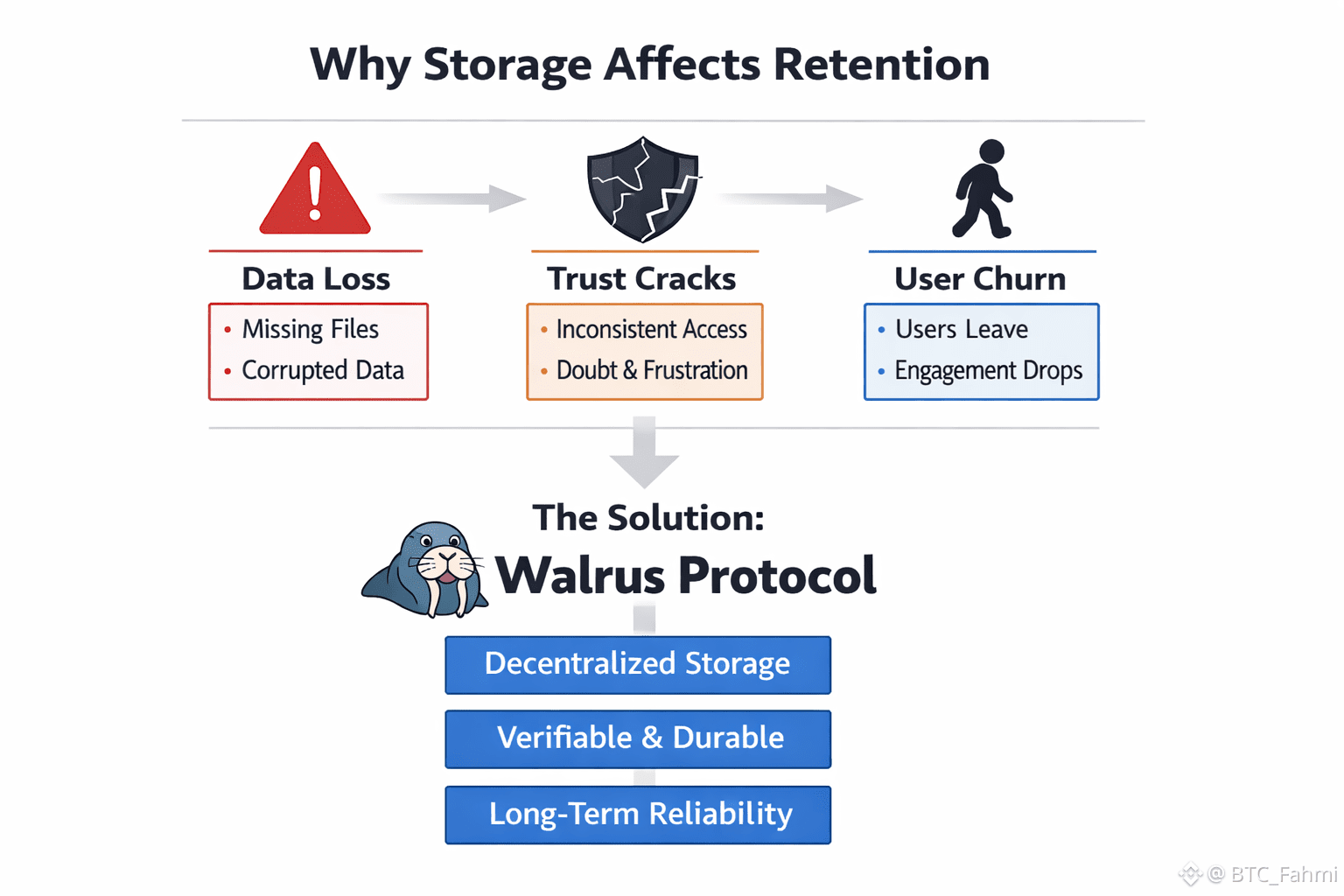
The first time you lose data, you stop treating storage as a background detail. It might be an NFT where the image link dies, a trading dashboard that cannot reproduce yesterday’s chart, or an AI agent that suddenly “forgets” because the dataset it depended on was never actually durable. In crypto, these failures rarely look dramatic at the moment they happen. They show up as small cracks in trust, and then users quietly stop coming back. That is why storage is not a side quest anymore. It is becoming one of the main determinants of whether applications keep their users, and whether ecosystems keep their liquidity.
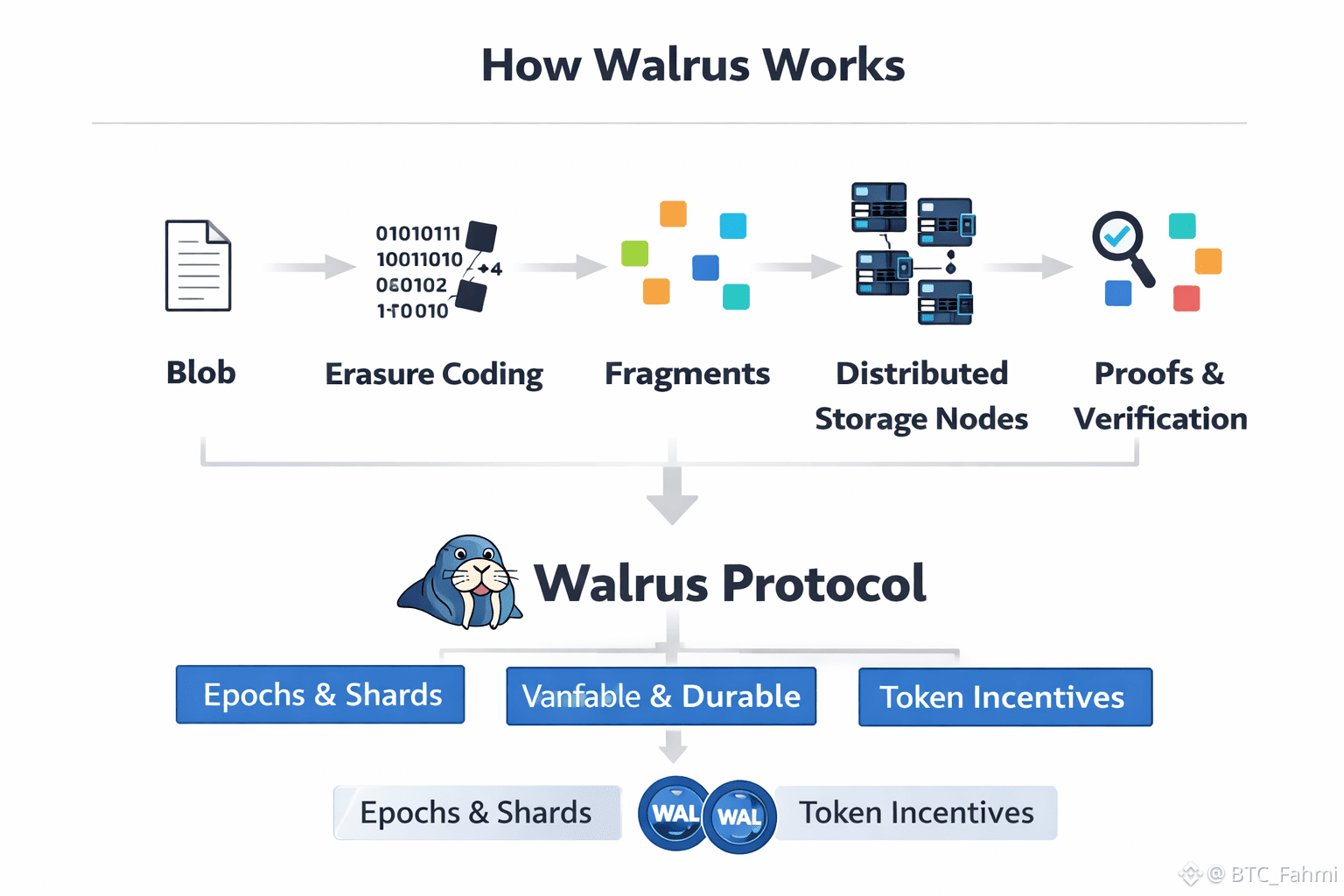
Walrus Protocol is a direct response to that shift. Its mission is straightforward: provide a decentralized network for storing large, unstructured data blobs in a way that remains available, verifiable, and economically sustainable over time. Rather than forcing every application to push heavy data onto an execution layer that was optimized for computation, Walrus treats storage as specialized infrastructure with its own incentive model and its own engineering priorities. Mysten Labs, the team behind Sui, introduced Walrus as a dedicated decentralized storage and data availability protocol, positioning it as a second major protocol effort alongside Sui.
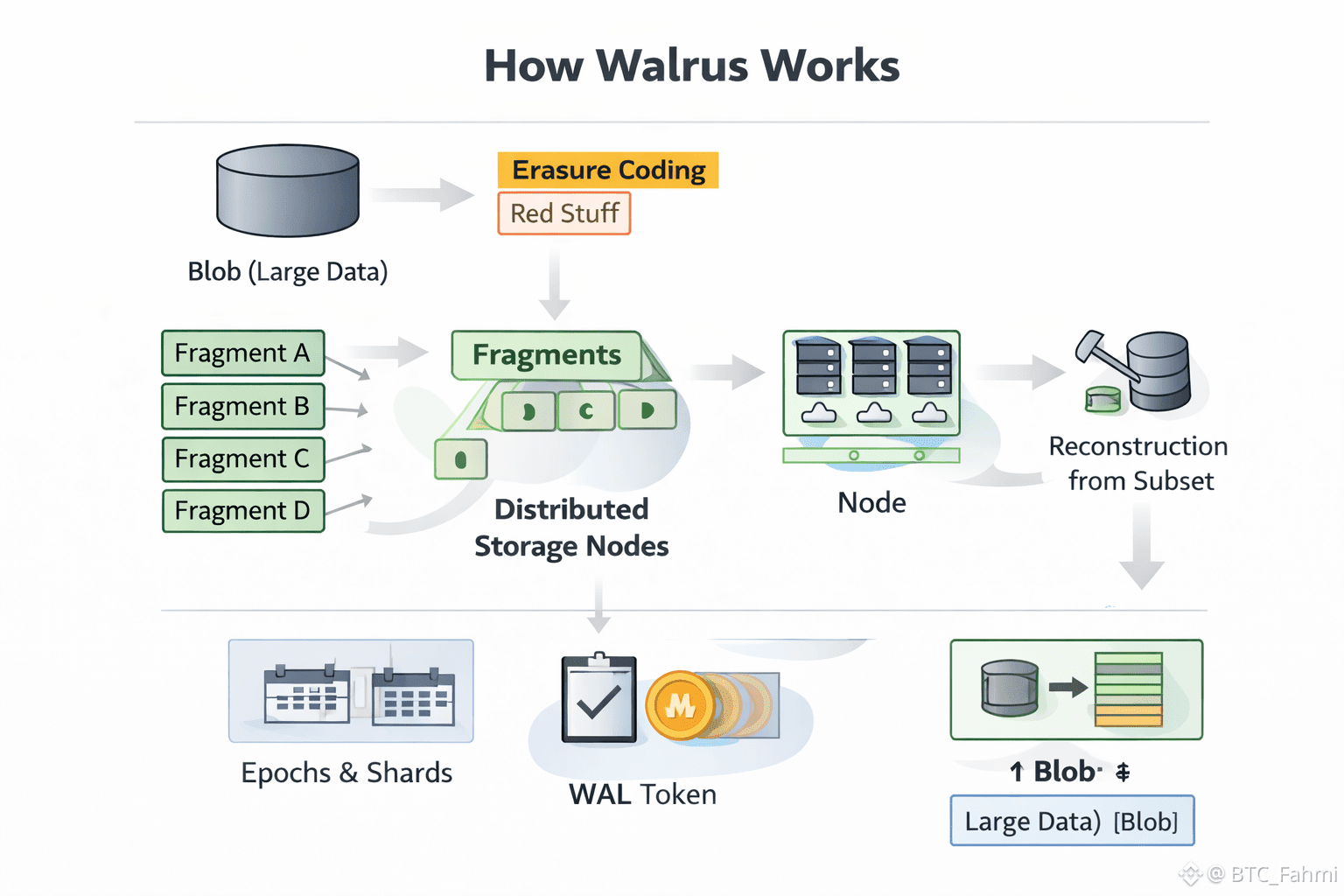
The design centers on how data is stored and proven, not on how fast a chain can execute transactions. Walrus takes a blob, encodes it into smaller fragments, and distributes those fragments across a network of storage nodes. The key is resilience without waste. In the Mysten Labs description, a subset of fragments is sufficient to reconstruct the original blob, even if a large portion of fragments are missing, and the system targets robustness with a relatively low overhead compared with blunt full replication. Researchers describing Walrus publicly also highlight its use of advanced erasure coding, including a scheme referred to as Red Stuff, and an architecture that runs in epochs and shards operations by identifiers to scale handling of many blobs.
For traders and investors, the technical details matter mainly because they translate into operational reliability and cost structure. If storage is too expensive, teams compromise and centralize it. If it is cheap but fragile, the first serious growth wave breaks it. Walrus aims to sit in the middle: decentralized and verifiable, but engineered to avoid the spiraling costs that have historically pushed projects back toward centralized CDNs and cloud buckets. Mysten Labs has described Walrus as achieving strong availability and robustness with a minimal replication factor in the range of roughly four to five times, rather than the far higher multiples many people assume are inevitable in decentralized storage.
Token economics are part of that durability story, not an accessory. Walrus uses a native token, WAL, as the anchor for payments for storage, incentives for node operators, staking, and governance parameters. The project’s own token documentation frames WAL as the mechanism to allocate resources efficiently while reducing adversarial behavior by nodes, which is another way of saying the protocol is designed to keep working even when participants are financially motivated to cut corners. A separate Mysten Labs post about the official whitepaper points to epoch based operation, reconfiguration of storage nodes across epochs, and tokenomics tied to staking and rewards, which are all design choices aimed at long term availability rather than short bursts of performance.
This is the right place to bring in market data, because it should be treated as context rather than the story. As of January 26, 2026, major trackers show WAL trading around twelve cents, with reported 24 hour volume in the tens of millions of dollars, and a market cap in the high one hundreds of millions, with circulating supply around 1.57 billion and a stated maximum supply of 5 billion. Exact figures vary by venue and data provider, but the broad picture is consistent across large aggregators. That level of liquidity and distribution is meaningful for traders, but the more investor relevant question is whether usage demand for storage grows in a way that is less reflexive than typical token narratives.
A practical example makes the value proposition clearer. Consider a protocol that offers tokenized strategies with transparent performance history, audit trails, and compliance artifacts. The token trades fine at launch, and early users arrive. Then, six months later, the system cannot reliably reproduce historical state because a chunk of “offchain” data was never truly durable. Performance history becomes disputable, the UI becomes inconsistent, and counterparties hesitate. This is the retention problem in its most common form: not a marketing failure, but a trust infrastructure failure. Walrus is designed to reduce that risk by giving applications a way to store the heavy data they depend on in a decentralized network where availability and integrity can be checked, rather than assumed.
The unique angle with Walrus is that it treats storage as programmable and verifiable infrastructure meant to sit alongside modern chains, rather than as an awkward add on. That aligns with current trends that are difficult to ignore: AI agents and data driven applications are increasing the amount of content that needs persistent access; onchain media and gaming demand larger files; and serious financial use cases increasingly require records that can be verified over long periods. Walrus launched its public mainnet in March 2025, after a build up that included a public testnet phase and the publication of formal technical documentation, which signals an intent to be measured by real usage rather than announcements.
If you are evaluating Walrus as a trader, the actionable question is not whether decentralized storage is “a good narrative.” It is whether the applications you follow are shifting toward architectures that require durable, verifiable data, and whether Walrus becomes a default choice for that requirement. If you are evaluating it as an investor, the question becomes whether the incentive design can keep storage nodes honest across market cycles, when rewards compress and attention moves elsewhere.
If you want to engage with Walrus intelligently, do three things this week. Read the official whitepaper summary from the team, skim the core mechanism of how blobs are encoded and reconstructed, and then track which real applications choose Walrus for storage instead of using a centralized fallback. Walrus will not prove itself through slogans. It will prove itself the same way every serious piece of infrastructure does: by staying reliable when users stop paying attention, and by helping applications retain people when novelty is gone and only trust remains.