

Walrus is a decentralized storage and data availability protocol designed to enable secure, scalable, and tamper-resistant storage of large, unstructured data — like images, videos, AI datasets, and blockchain archives — for blockchain developers and end users. Its architecture combines innovations in cryptography and distributed systems to overcome storage limitations that have hindered many blockchains and decentralized networks.
At its core, Walrus is not just a file storage system — it is a programmable storage layer that integrates with blockchain smart contracts, enabling developers to reference, verify, and use stored data within decentralized applications.
Originally incubated within the ecosystem around Mysten Labs (the creators of Sui), Walrus is now governed as an independent protocol supported by its native WAL token and a community of users, developers, and validators.
Why Decentralized Storage Matters
In traditional Web2 environments, organizations rely on centralized cloud providers like AWS, Google Cloud, and Azure to store and deliver data. These systems are efficient but come with trade-offs:
Centralization risk — Data is controlled by a single company.
Censorship vulnerability — Authorities or malicious actors can block or remove content.
High cost for large data — Pricing can escalate rapidly for massive datasets.
Decentralized storage — like that offered by Walrus — seeks to address these issues by distributing data across a network of independent storage nodes where no single party controls the content. This architecture makes data storage more censorship-resistant, transparent, and resilient than centralized alternatives.
Technical Architecture: How Walrus Works
Walrus employs several innovative technologies and design principles to achieve its goals. Some of the most important are:
1. Red Stuff Erasure Coding
At the heart of Walrus is Red Stuff, a custom erasure-coding algorithm that breaks files into smaller encoded fragments called slivers. These fragments are distributed across multiple storage nodes. Instead of storing complete copies of a file everywhere (which is expensive and inefficient), Walrus distributes fragments such that the original file can be reconstructed from a subset of them.
This approach has major benefits:
Cost efficiency — Only about 4–5x the storage size of the data is needed versus dramatically higher replication requirements in traditional storage networks.
Resilience — Even if many nodes go offline, the original data remains accessible.
Scalability — The network can grow without exponentially increasing storage costs.
2. On-chain Metadata and Proofs of Availability
Walrus doesn’t store the actual data directly on the Sui blockchain; that would be prohibitively expensive. Instead, the protocol stores:
Metadata about the data blob — a reference that links the off-chain fragments.
Proofs of availability — cryptographic evidence that the fragments still exist on storage nodes.
These proofs allow anyone to independently verify that the data is still stored and can be retrieved, without downloading the entire file.
3. Decentralized Blob Storage and Retrieval
Walrus stores large data objects as blobs — units of unstructured data such as videos, datasets, or media files. When someone requests a blob, the protocol collects slivers from multiple nodes and reassembles the file, using efficient reconstruction techniques to minimize bandwidth and latency.
This makes Walrus suitable not just for long-term archival storage but also for real-time and interactive applications that require dynamic access to large data files — an important distinction compared to some older decentralized storage models.
4. Integration with Sui and Web3 Tooling
Walrus is natively integrated with the Sui blockchain, which plays a key role in:
Tracking payments and storage contracts.
Recording storage metadata and proofs.
Enabling smart contract access to stored data.
Developers interact with Walrus through a variety of tools — including command-line interfaces (CLI), SDKs, and HTTP APIs — making integration with decentralized and hybrid Web2/Web3 systems seamless.
Tokenomics: The WAL Token
The WAL token is the economic backbone of the Walrus network. It has a maximum supply of 5 billion tokens, a deflationary element through burns, and multiple utilities within the ecosystem.
Key Roles of WAL:
1. Payment for Storage Services
Users pay WAL to upload and reserve storage on the network. The fees are distributed over time to nodes providing storage and serving data, creating an economic incentive for good performance.
2. Staking and Network Security
Walrus uses a delegated Proof-of-Stake (DPoS) model where token holders can delegate their WAL to trusted storage nodes. Nodes with higher delegated stakes are more likely to be selected as part of the storage committee and earn rewards for performance and availability.
Underperformance can result in penalties or slashing, aligning node incentives with network reliability.
3. Governance Participation
WAL holders participate in governance: voting on protocol parameters, economic incentives, and other critical decisions that affect the evolution of Walrus. This decentralized governance model empowers the community to shape the project’s future.
4. Deflationary Pressure
WAL’s design includes burn mechanics tied to usage — for example, a portion of fees can be burned when data is uploaded or paid for — creating deflationary pressure that could benefit long-term holders as the network grows.
Use Cases: From AI Data to Decentralized Web Hosting
Walrus is targeting a wide variety of real-world and Web3 use cases, including:
AI & Machine Learning
AI systems require large, reliable datasets. Walrus allows developers to store and verify the integrity and availability of these datasets in a censorship-resistant and transparent way — a huge advantage for trusted training pipelines.
Decentralized Applications & NFTs
Media files — such as images or videos linked to NFTs — can be stored and delivered through Walrus while maintaining verifiability and decentralization. This empowers NFTs and DApps with robust, decentralized assets without reliance on centralized file hosts.
Blockchain Data Archiving
Walrus can archive blockchain history — checkpoints, snapshots, and transaction records — off-chain while anchoring proofs on Sui. This reduces on-chain data bloat while preserving accessibility.
Web Hosting and Hybrid Applications
Developers can build fully decentralized websites, known as Walrus Sites, which store HTML and other web assets directly in the protocol, making websites censorship-resistant and censorship-proof.
Walrus on Binance and Market Adoption
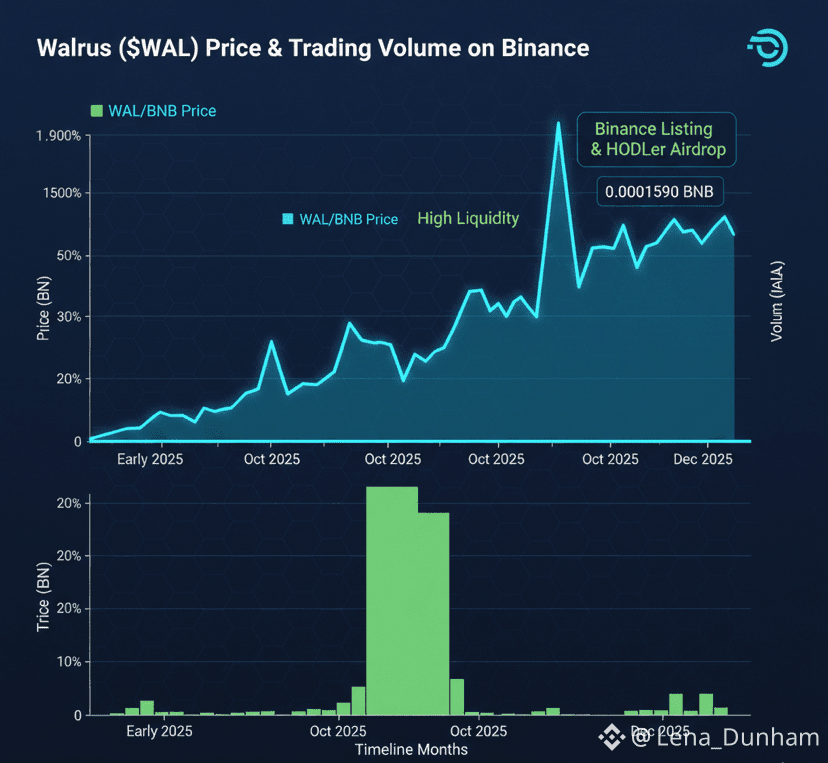
A strong indicator of adoption and institutional interest came when Binance included WAL as the 50th project in its HODLer Airdrop program on October 10, 2025. Users who held and staked BNB in specified Binance earn programs were eligible for WAL token rewards, highlighting Binance’s endorsement and bringing the token to a broad global audience. WAL was listed for trading with pairs including USDT, USDC, BNB, and others.
Conclusion: The Growing Importance of Walrus
In a rapidly maturing blockchain ecosystem, data storage and availability networks are essential for the next generation of decentralized applications, AI systems, and Web3 infrastructure. Walrus combines strong technical architecture with a robust economic design and native integration with the Sui blockchain to deliver a storage solution that is efficient, decentralized, and programmable.
Its adoption by major exchanges like Binance, diverse use cases, and economic incentives for users and developers position Walrus as a leading protocol in decentralized storage and data infrastructure, addressing real limitations of existing systems while opening new possibilities for how data is stored, verified, and used in blockchain environments.