
What struck me most when first starting to analyze the decentralized storage landscape in early 2025 was how quietly the infrastructure was becoming a front line battleground in crypto's broader decentralization narrative. Protocols like Walrus aren’t flashy DeFi yield farms or hyped meme tokens; they’re the plumbing underneath every Web3 app, NFT site and private data marketplace we’re building today. My research led me down an unexpected path the battle for private storage is one of the most consequential wars of our era in crypto and Walrus is right in the thick of it.
Let's unpack what's happening why it matters and what you should consider if you are thinking about staking capital or building with these systems.
A Quiet Arms Race Under the Surface
In my assessment, the conventional picture of DeFi has always been about trading pairs, yield strategies, and token incentives. But there’s a deeper layer beneath the data infrastructure that makes all of it possible. Decentralized finance fundamentally depends on trustless, verifiable storage of data: price feeds, trades, proofs and user assets. As developers strived to build beyond splashy applications, they ran straight into an elephant in the room where and how do we store the enormous amounts of data that modern applications require?
Walrus is one of the most compelling answers to that question. Developed out of the Sui network this protocol is a decentralized storage platform designed to handle large bina objects anything from images and videos to complex AI datasets in a way that is verifiable, resilient and programmable via smart contracts. Unlike blockchains that bloat and slow down when used for vast datasets. Walrus uses advanced encoding and distributed redundancy so storage becomes efficient and scalable compared to raw on-chain solutions. By some estimates the platform already supports over 800 TB of total capacity with millions of stored assets being accessed through independent nodes.
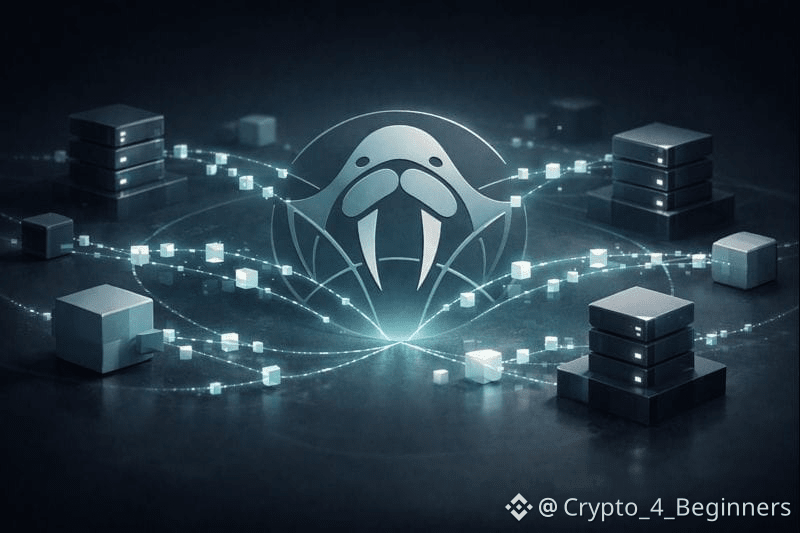
Consider what this means: the same networks that execute DeFi trades could soon store your encrypted files, audit logs and private financial histories without ever touching centralized servers. That is a dramatic shift from today's paradigm where reliance on AWS, Google Cloud or private databases represents a single point of failure and surveillance challenge.
Why Private Storage Matters More Than You Think ?
You might ask is not decentralized storage just another niche piece of infrastructure? In my experience nothing could be further from the truth. Privacy and data sovereignty are increasingly under threat globally including in developed markets where regulatory and corporate interests converge to commoditize personal information. Walrus and similar networks represent a counter movement: a decentralized alternative to incumbent cloud providers that does not just spread storage across a peer to peer network but also enables privacy first access control mechanisms. Tools like Seal integrate with Walrus to create encrypted access gated storage where only holders of specific tokens can unlock the content and without revealing the underlying data to every network participant.
This is where the infrastructure war really heats up. Projects like Filecoin and Arweave laid the conceptual groundwork for decentralized storage but they did not fully solve the programmability or private access control layer that modern DeFi and Web3 apps demand. Walrus aims to fill that gap. Decision makers inside startups building NFT marketplaces encrypted messaging protocols or AI data vaults are beginning to see that storage is not a commodity but a strategic moat and whoever controls it gains leverage similar to how AWS once dominated centralized cloud services. In my assessment decentralized storage does not come without real challenge. For one compared to established storage networks Walrus is younger and less battle tested. The difficulty of creating truly private decentralized storage is often underestimated cryptography and access control add layers of complexity that can introduce vulnerabilities if not implemented correctly. Moreover storing private data even encrypted could draw regulatory scrutiny especially in jurisdictions with strict data retention laws.
There is also a capacity paradox. If usage scales to exabyte levels 1 EB = 1,000,000 TB costs and node incentives must scale too or the network risks fragmentation and centralization pressures. Some theorists argue that private decentralized storage could become more of a niche due to these scaling challenges compared to more specialized archival solutions. As an analogy think of public blockchains as highways optimized for fast, verifiable transactions and decentralized storage networks as freight railroads optimized for bulk but slower movement. They each have roles but mixing them indiscriminately can cause systemic congestion.
Lastly, token economics remain uncertain. Walrus raised $140 million in private funding from heavy hitters like a16z Crypto and Franklin Templeton Digital Assets ahead of its mainnet a powerful signal of confidence sure but funding does not guarantee adoption or demand.
What Traders and Builders Should Be Watching
If you are building a trading strategy around infrastructure tokens like WAL or simply seeking alpha in the broader DeFi network. There are specific levels and scenarios worth tracking. For traders observe how WAL reacts to usage metrics like total data stored or number of private vaults created rather than just price momentum. I have found that storage adoption often precedes price appreciation. A potential strategy could be: accumulate WAL below key support levels while monitoring growth in on-chain storage metrics then scale out smartly around psychological resistance as adoption enters public consciousness. Determine entry if WAL price retraces toward a multi month demand zone e.g., zones seen in early post mainnet trading and set stops just under structural breaks. At the time of writing sentiment remains mixed in social channels but that alone does not diminish the underlying infrastructure value.
A conceptual table here might compare adoption metrics across decentralized storage networks e.g., total TB stored number of unique wallets interacting, private vault creation rates clearly showing which protocols are gaining traction think of it as a heat map of real usage rather than speculative hype. Another useful chart would visualize storage growth versus WAL price over time helping isolate leading indicators.
Walrus vs The Competition: Not All Storage Wars Are Equal
Fair comparison is critical here. In the decentralized storage arena existing names like Filecoin and Arweave serve as architectural predecessors but their focus and capabilities differ. Filecoin emphasizes redundancy and archival storage with economic incentives powered by a Proof of Replication model while Arweave specializes in perpetual immutable storage with upfront payments locked forever. Walrus challenges both by offering programmable storage tied to smart contract ecosystems and supports encrypted private access natively.
In spite of these strengths, centralized clouds still dominate by sheer performance and integration familiarity. Some hybrid models are emerging decentralized storage with centralized performance acceleration that may bridge use cases without fully replacing either paradigm. A potential chart here could plot cost per GB against latency for centralized vs decentralized storage options so builders can see the trade offs at a glance. In my assessment the storage wars are quietly shaping the next phase of Web3. Projects like Walrus are not just building a protocol. They are staking a claim in an emerging layer of the internet one that could determine who controls our data not merely our tokens. Whether Walrus wins the day is still uncertain but its focus on privacy, programmability and real world utility positions it as a serious contender in a space that is only just beginning to matter.
If you want real edge in this market whether that edge is technical, financial or strategic watch where data flows not just where prices go. Because in the end infrastructure is not just the foundation. It is the future itself.

