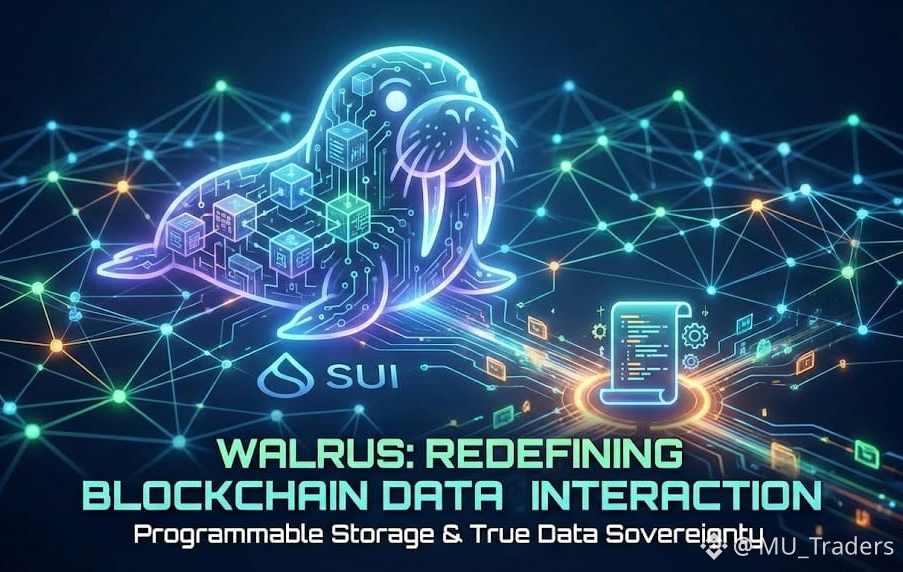
How Walrus Could Redefine Data Interaction on Blockchain
you might be missing how a storage protocol could quietly become one of the most impactful pieces of infrastructure in crypto, not because it stores files, but because it treats data itself as an active element in decentralized applications. Walrus is more than a decentralized storage network. It takes data and embeds it into the smart contract ecosystem in a way that changes how applications interact with that data and how users control it. (Superex)
Most decentralized storage solutions focus on keeping files available, but few give developers and users real agency over that data. Walrus builds on the Sui blockchain’s object model, so every stored file (or “blob”) is associated with on‑chain metadata and availability proofs. Because those references live in Move‑native objects, smart contracts can reference, govern, and even transfer or manipulate stored data natively, instead of treating it as an off‑chain appendage. (Superex)
This matters because data ownership on blockchain has been fragmented. In many NFT projects, for example, the token itself lives on chain but the associated media metadata remains off‑chain. That disconnect creates trust gaps and central points of failure. With Walrus, the storage reference is integrated into the blockchain state, so applications can programmatically use and manage data as part of on‑chain logic, closing that gap. (PANews Lab)
The deeper implication here is that Walrus turns storage into a programmable resource, not merely a repository. Traditional storage is static; once you upload it somewhere, you retrieve it the same way until someone deletes it. Walrus treats storage space and the data within as programmable assets that can be owned, automated, and governed by smart contracts. You can set rules that cause data to expire, rotate backup assets, or dynamically adjust access permissions based on on‑chain events or logic. (Walrus)
This shift makes data far more than a passive input. It becomes a first‑class blockchain component. In practice, that opens the door to applications that were previously hard if not impossible. Imagine decentralized messaging where messages are encrypted, stored, and controlled entirely by user keys and smart contract permissions, or decentralized version control where code is stored with version history and governance rules baked into blockchain logic. Projects already building on this stack demonstrate exactly those experiments. (Walrus)
Another angle that’s often overlooked is how Walrus could bridge legacy and modern systems. Because its storage layer can serve traditional HTTP or CDN requests while anchoring metadata on Sui, developers can build hybrid environments where rich web experiences interact seamlessly with blockchain logic. This means data‑intensive apps like decentralized social platforms, games, and AI models can finally achieve performance and decentralization without compromising either. (Superex)
Finally, the symbiotic relationship between Walrus and Sui should not be understated. Sui provides a secure control plane and execution environment for programmable data, while Walrus handles the heavy lifting of large file storage with efficiency and resilience. That synergy not only expands what Web3 applications can do with data but also subtly shifts the narrative of decentralization from simple token ownership to true data sovereignty. (Superex)
In a world where digital ownership increasingly matters as much as digital currency, Walrus suggests a future where data itself can be a programmable, composable, blockchain‑native asset. And that is the part many in crypto might still be overlooking. Includes mentions of cryptocurrency and crypto.
@Walrus 🦭/acc $WAL #Walrus