
I noticed it during a routine upload, the kind you don’t think twice about. The file moved through the system without delay, without confirmation prompts, without anything that asked for my attention. What caught me wasn’t the speed, but the absence of hesitation. Somewhere in the network, something had already decided what needed to happen next.
That behavior stayed with me. In Walrus (@Walrus 🦭/acc ), nodes don’t wait to be told when to act. They don’t pause for permission or reassurance. They respond. The quiet consistency of that response hinted at something deeper than automation. It suggested an expectation already agreed upon, one that didn’t rely on oversight or reminders.

The first technical idea that made sense to me was fragment repair. Not the mechanism itself, but the way it happened without ceremony. A piece went missing, and another node stepped in, calmly filling the gap. No alerts. No escalation. The system behaved as if absence was normal, not an exception. The consequence was subtle but important: reliability didn’t come from stability, but from readiness.
That’s where Walrus (WAL) became visible to me, not as a number or a balance, but as a pressure that shaped behavior. Walrus (WAL) didn’t announce itself. It didn’t reward loudly. It simply made inaction uncomfortable. When no one was watching, nodes still showed up. Responsibility wasn’t enforced through rules; it was reinforced through alignment.
I began to see Walrus ($WAL ) less as something nodes earn and more as something they respond to. It functioned like a shared understanding: if you take part, you carry your share of the work. When fragments were served instead of ignored, when repairs happened alongside requests, the network wasn’t proving capacity. It was demonstrating characters.
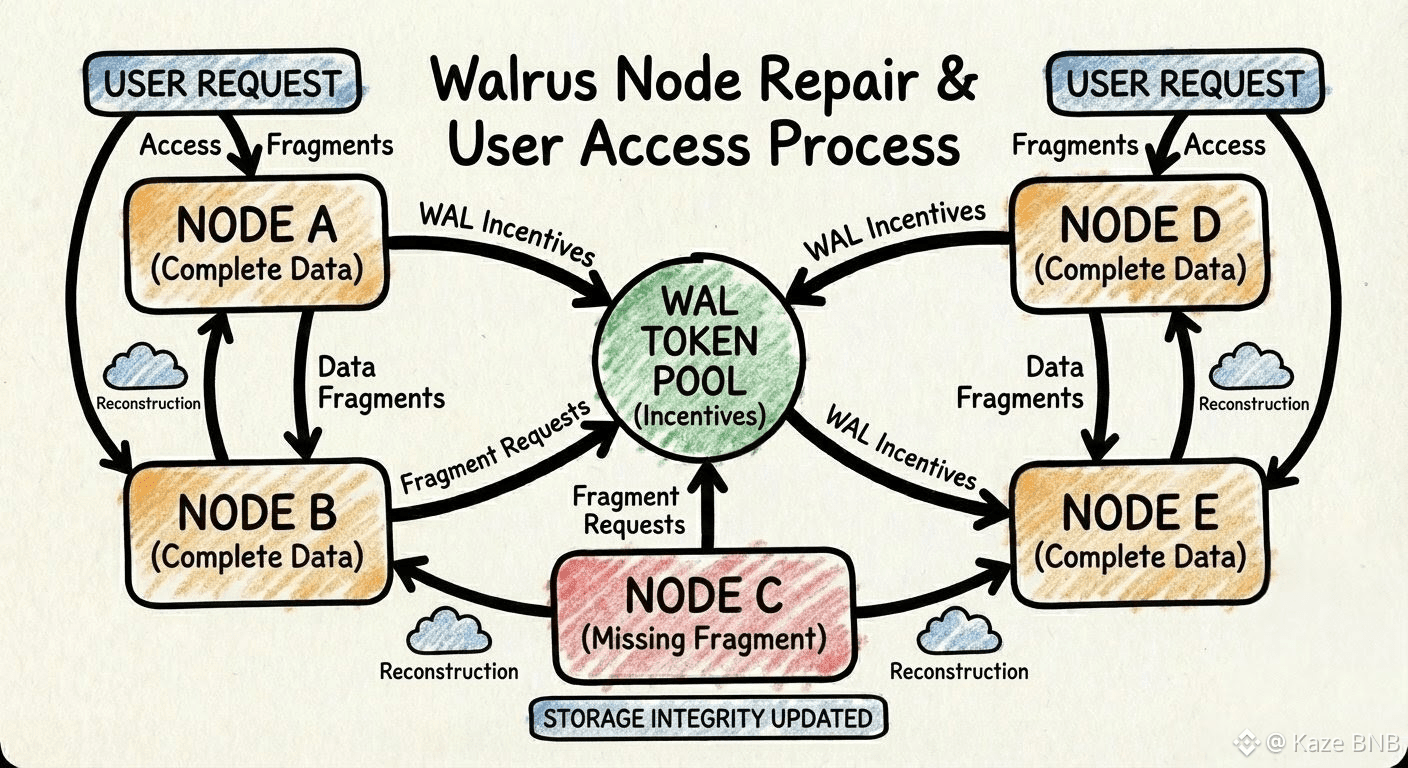
Another moment stood out when multiple requests touched the same data. Nothing dramatic happened. No congestion, no visible prioritization. Just steady delivery. The system didn’t optimize for fairness or speed in that moment; it optimized for continuity. The consequence was that users never felt the negotiation happening underneath.
Concurrency revealed something human about the network. Not urgency, not competition, but composure. Walrus (WAL) seemed to encourage that composure by making every participant accountable for shared outcomes, even when shortcuts were possible. Especially when shortcuts were possible.
What changed my perspective was realizing that Walrus (WAL) wasn’t pushing the network forward. It was holding it together. It didn’t motivate ambition. It sustained responsibility. In a system designed to expect disappearance, Walrus (WAL) quietly ensured presence.
By the time I stopped watching the logs and returned to the application, nothing felt different on the surface. But I carried a shift with me. I stopped thinking of Walrus as storage I used, and started thinking of it as an environment I participated in. And #Walrus WAL wasn’t something moving through that environment. It was the reason everyone behaved as if the environment mattered, even when no one was looking.

