

Dusk is not designed to rival blockchains that prioritize open speculation or radical transparency. From its inception, the project has pursued a far more constrained—and more difficult—objective: creating a blockchain capable of supporting regulated financial activity without sacrificing privacy. Established in 2018, Dusk is built around a reality many crypto projects sidestep. Functional financial markets cannot operate on completely transparent public ledgers, yet they also cannot remain dependent on slow, opaque, and highly centralized systems forever. Dusk positions itself in this uneasy middle space, aiming to demonstrate that blockchains can be compliant, privacy-preserving, and sufficiently decentralized to be meaningful.
The challenge Dusk tackles is fundamentally structural, not philosophical. Conventional blockchains excel at coordination and settlement but fail when it comes to protecting sensitive financial data. Financial institutions cannot publicly expose client balances, transaction records, or ownership details, regardless of how secure the underlying ledger may be. Meanwhile, legacy financial infrastructure is fragmented, costly, and reliant on intermediaries whose trust is institutional rather than cryptographic. Dusk seeks to reduce this reliance by replacing portions of assumed trust with verifiable computation, all while maintaining confidentiality. The project is less about immediate disruption and more about methodically rebuilding financial infrastructure in a form that regulators and institutions can realistically adopt.
From a technical standpoint, Dusk is a layer-1 blockchain purpose-built for this use case. Its modular architecture separates responsibilities across different system components instead of forcing all functionality into a single execution framework. At its foundation, Dusk manages consensus, settlement, and data availability in a way that accommodates both public and private transactions. Above this base lies a smart contract environment that feels familiar to Ethereum developers, helping lower the barrier to entry. The defining distinction is that Dusk smart contracts can work with confidential data through cryptographic proofs, enabling verification without revealing sensitive information. In practice, this means the network can enforce rules without exposing underlying financial details.
Privacy within Dusk is not an optional add-on; it is integral to the protocol’s design. Zero-knowledge proofs are central to how transactions and contract logic are validated while keeping critical data hidden. This capability is essential for regulated assets, where selective disclosure is often legally required. Regulators may need visibility for audits, but the general public does not. Dusk’s architecture supports this distinction, aligning privacy with accountability rather than treating them as opposing goals.
The economic layer of the network is anchored by the DUSK token. It secures the system through staking, requiring validators to lock tokens in order to participate in consensus and block production. This mechanism incentivizes honest behavior, as malicious actions can result in slashed stakes. The token also serves as the medium for transaction fees, ensuring network resources are used responsibly. Over time, DUSK is expected to play a role in governance, allowing long-term stakeholders to influence protocol upgrades and configuration changes. The incentive model is straightforward: users pay fees, validators earn rewards, and the token aligns the interests of network operators with overall system health.
Dusk does not aim to exist in isolation. Interoperability, particularly with Ethereum and other major blockchains, is a core part of its strategy. Through bridges and cross-chain standards, assets can move between Dusk and external networks, which is critical for liquidity and broader adoption. This setup allows regulated assets issued on Dusk to interact with the wider crypto ecosystem without compromising confidentiality. Rather than replacing existing blockchains, Dusk seeks to complement them by focusing on use cases they are not well-equipped to handle.
The project’s real-world focus is most evident in its work on tokenized financial instruments, including equities, bonds, and other regulated securities. Dusk’s token standards are purpose-built for these assets, embedding compliance rules and transfer restrictions directly into smart contract logic. This approach enables issuers to meet legal obligations while benefiting from faster settlement and streamlined operations. Pilot programs and partnerships have explored these concepts with traditional financial entities, not just crypto-native teams. Although adoption remains early, the effort is grounded in practical constraints rather than abstract theory.
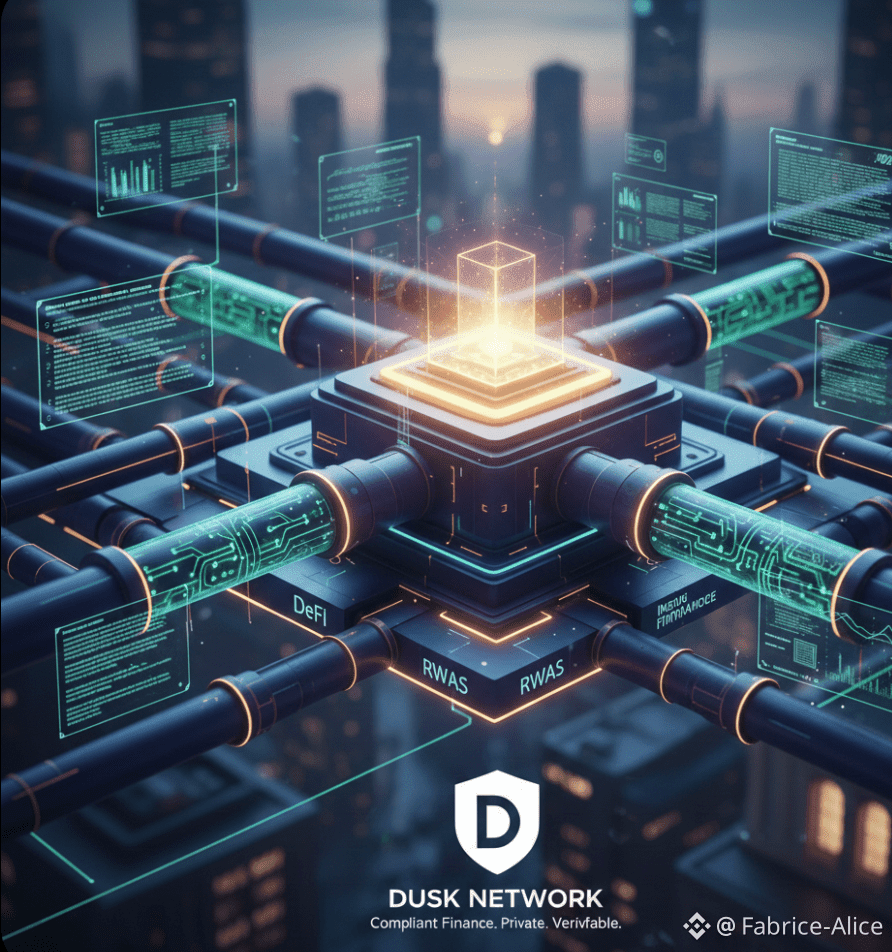
Development has progressed steadily rather than explosively. Dusk has transitioned from testnets to mainnet, gradually rolling out features such as staking, privacy-enabled transactions, and developer tools. This deliberate pace reflects the nature of the problem being addressed. Regulated finance moves cautiously, and the infrastructure designed to support it must do the same. The emphasis has consistently been on correctness, auditability, and long-term sustainability instead of rapid user acquisition.
That said, significant challenges remain. Regulatory requirements vary across jurisdictions, and building a blockchain flexible enough to adapt to changing rules is an ongoing effort. Institutional adoption is inherently slow and depends on legal clarity, trust, and proven reliability. On the technical side, privacy-preserving systems introduce added complexity and performance trade-offs that must be carefully balanced. There is also the issue of liquidity and network effects—without sufficient usage, even well-designed financial infrastructure can struggle to gain relevance.
Looking ahead, Dusk appears focused on strengthening its role as foundational infrastructure for regulated digital finance. The emphasis is not on consumer-facing apps or speculative trends, but on integration with institutions that issue, trade, and settle real-world assets. If successful, Dusk could become part of a broader shift in which blockchains quietly replace outdated financial plumbing rather than loudly redefining markets. Its success will depend less on short-term narratives and more on its ability to translate cryptographic assurances into systems that regulators and institutions trust.
Dusk’s ambition is subtle yet substantial. It seeks to show that decentralization does not have to conflict with privacy or legal compliance, and that blockchains can evolve beyond fully transparent ledgers into something resembling genuine financial infrastructure. Whether it ultimately achieves this remains uncertain, but the problem it addresses is persistent, tangible, and unlikely to fade anytime soon.
