
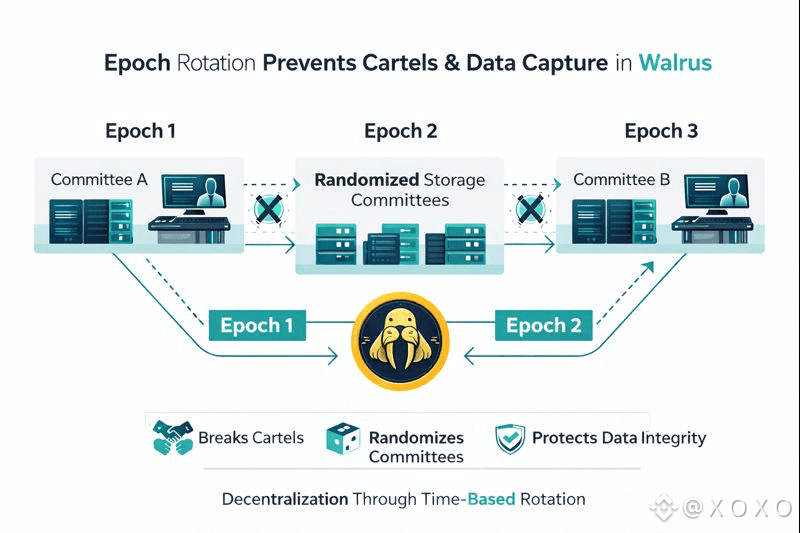


In most discussions about decentralised storage, people focus on where the data is stored and who stores it. They talk about nodes, shards, proofs, and cryptography. All of that matters, but there is a deeper layer that often goes unnoticed: time. In @Walrus 🦭/acc , time is not just a background variable. It is a core part of the security model. This is expressed through epochs, the structured time periods that govern how committees are formed, how stake is used and how responsibilities are reassigned. Without epochs, Walrus would be vulnerable to one of the most dangerous threats in any decentralized network, cartel formation and data capture.
To understand why, we first have to understand what cartels look like in decentralized systems. A cartel is not always a group of villains meeting in secret. Often it is simply a small set of large operators who, through capital, coordination, or early advantage, come to control a disproportionate share of a network. In storage networks, this is especially dangerous. If the same operators keep holding the same data over long periods of time, they gain power over availability, performance, and even subtle forms of censorship. They can choose to delay serving certain data, quietly degrade quality, or use their position to extract extra rent from users and developers.
Walrus was designed to make this kind of long term capture extremely difficult. The key is that nothing in the network is meant to be permanent except the data itself. Who stores it, who verifies it, and who earns from it all change over time. Epochs are the rhythm that drives this change.
An epoch in Walrus is a defined time window during which a specific set of nodes is responsible for storing and serving a specific set of data. At the end of an epoch, the network re evaluates stake, performance, and randomization and then forms new storage committees. Data is handed off to new sets of operators, and the old ones are released from their obligations. This process repeats over and over.
This might sound like an operational detail, but it is actually the foundation of Walrus’s political economy. By forcing responsibilities to rotate in time, Walrus ensures that no group can entrench itself as the permanent custodian of valuable data.
Imagine a world without epochs. Storage providers would be selected once and then keep their assignments indefinitely. Over time, large providers would accumulate more and more of the most valuable data. Smaller nodes would struggle to compete. Eventually, a handful of players would control the majority of the network’s storage. Even if everything was technically decentralized, power would be concentrated. That is data capture.
Epochs break this dynamic. Because committees are reshuffled every epoch, no operator can rely on holding the same data forever. Even if a node is very large and very well staked, it will still be rotated in and out of different committees. This means that influence over any specific dataset is temporary. To keep earning, operators must keep performing and keep staking. They cannot simply lock in a position and extract rent forever.
There is also an important randomness component. Committee selection is influenced by stake, but it is not fully predictable. This means that even if a group of operators tries to coordinate, they cannot guarantee that they will end up together in the same committee in future epochs. That uncertainty makes collusion much harder. You cannot form a stable cartel if you do not know who your partners will be tomorrow.
From a game theory perspective, this is powerful. Cartels rely on repeated interactions between the same players. They need stability to coordinate, punish defectors, and maintain shared strategies. Epoch based rotation disrupts those repeated interactions. The network keeps shuffling the deck.
This matters even more when you consider the value of data. In Web3, data is not just files. It is the history of financial positions, governance decisions, identity records, AI models, and more. Whoever controls access to that data controls a layer of power. Walrus is explicitly designed to make that layer of power fluid rather than fixed.
Epochs also interact with WAL staking in a crucial way. Storage providers stake WAL to participate in committees. That stake is at risk if they misbehave. But stake alone is not enough to prevent capture. Large players can always stake more. What epochs do is turn stake into a temporary ticket rather than a permanent license. You are buying the right to participate for the next epoch, not forever.
This creates a continuous market for storage participation. Every epoch is a new auction of trust. Nodes that perform well, provide proofs, and stay online are more likely to be selected again. Nodes that fail or cheat are less likely or get slashed. Over time, this creates a dynamic but merit based system. You cannot simply buy the network and keep it.
For users and developers, this means something very important. When you store data on Walrus, you are not trusting a specific company or operator. You are trusting a process that keeps re distributing trust over time. Even if some operators become malicious or incompetent, they will not hold your data forever. The network will move it.
There is also a resilience benefit. Correlated failures are one of the biggest risks in distributed systems. If many nodes use the same hardware, same cloud provider, or same jurisdiction, a single event can knock them all out. Epoch rotation naturally increases diversity. Over time, your data will pass through many different machines, networks, and regions. This makes long term loss much less likely.
Another subtle benefit is that epochs create natural checkpoints. At the boundary between epochs, the network verifies that data has been correctly transferred and that proofs are valid. This makes it easier to detect and isolate problems. Instead of silent decay, you get periodic audits enforced by the protocol.
In a sense, Walrus is applying the idea of rolling rebalancing, which is common in finance, to data. You do not keep all your assets in the same place forever. You rebalance to manage risk. Epochs rebalance data custody to manage trust and security.
This design is especially relevant as Walrus becomes more deeply integrated with AI and onchain systems. AI agents need to rely on data that is not just available but also provably untampered with over time. Governance systems need to know that historical records have not been quietly altered by a long standing cartel. Epochs provide a temporal layer of security that complements cryptographic proofs.
Critically, this is not something that can be added later as an afterthought. If you build a static system and it becomes captured, it is very hard to undo. Walrus bakes time based rotation into its core. It assumes that power will try to concentrate and designs against it from day one.
My take is that epochs are one of the most underappreciated innovations in decentralized storage. They acknowledge a simple truth: decentralization is not a state you reach, it is a condition you have to keep maintaining. By forcing storage, stake, and responsibility to move through time, Walrus turns decentralization into an ongoing process rather than a one time setup. In a world where data is becoming more valuable and more contested, that might be the difference between a network that looks decentralised and one that actually stays that way.