When Nodes Go Dark, Data Stays Bright: Walrus’ Byzantine-Tolerant Availability Bet
A storage failure rarely announces itself with a banner headline. More often, it appears as a blank space, an empty frame where content should be.
Imagine opening a digital wallet to view an NFT you own. The blockchain confirms your ownership with perfect records. Yet, the image itself either endlessly spins or presents a simple "404 Not Found" error. No hack occurred, no dramatic event transpired. The network simply ceased to retain the data your ownership points to.
This disconnect, this chasm between verifiable ownership and dependable data access, is the critical juncture where storage systems either become reliable infrastructure or fade into cautionary tales.
Walrus distinguishes itself not through aggressive marketing, but through a more fundamental promise: your data remains recoverable even when the network is unpredictable, potentially hostile, and partially offline. The primary reason Walrus can make this claim, and a feature often misunderstood, is its design choice:
Walrus relies on erasure coding, specifically its proprietary "Red Stuff" 2D encoding, rather than full data replication.
Replication is comforting — and expensive in all the wrong ways
Replication is the intuitive approach to resilience:
"If we fear something might vanish, we create multiple copies of it."
This method functions effectively under specific conditions:
when the storage nodes are stable,
when operators act predictably,
and when the system's primary threat is a straightforward outage.
However, decentralized environments are inherently less predictable. Nodes frequently join and leave the network. Network connections can break. Some participants may act with malicious intent or strategic self-interest. In such a dynamic setting, replication begins to expose three significant drawbacks:
1) Copies scale cost far faster than trustworthiness
Replication achieves safety through sheer volume. Each additional layer of "safety" means another complete copy of the data. Over time, this shifts from intelligent redundancy to a costly accumulation driven by anxiety.
2) Replication's self-healing is slow amidst constant change
If nodes frequently disconnect, the system expends considerable resources constantly recreating lost data copies. The network becomes preoccupied with fixing past problems rather than serving current requests.
3) Replication doesn't inherently address malicious behavior
Replication guards against data loss. It doesn't inherently protect against deliberate deception, such as corrupted data, selective data withholding, or false claims of storage that fail under scrutiny.
Consequently, Walrus poses a different question:
What if resilience wasn't about "more copies," but about "smarter recovery"?
Erasure coding: resilience without the cost of duplicates
Erasure coding rethinks the problem.
Instead of storing multiple identical copies, it involves:
breaking a larger data file into smaller segments,
adding mathematically generated redundant pieces,
distributing these segments and redundant pieces across numerous nodes,
and reconstructing the original file from a sufficient subset of these pieces.
The key principle here is that not all original pieces must survive; only a specific quantity is needed.
Walrus employs this technique for storing large, unstructured files (blobs) because full replication becomes impractical at scale. Furthermore, conventional one-dimensional erasure coding can create bandwidth bottlenecks during recovery in networks with high node turnover.
Walrus: “Red Stuff” is not just erasure coding — it’s erasure coding designed for chaos
Walrus's primary innovation is Red Stuff, a two-dimensional (2D) erasure coding protocol that governs how data is prepared for storage within its network.
Two aspects are particularly important here:
1) 2D encoding enables efficient self-healing
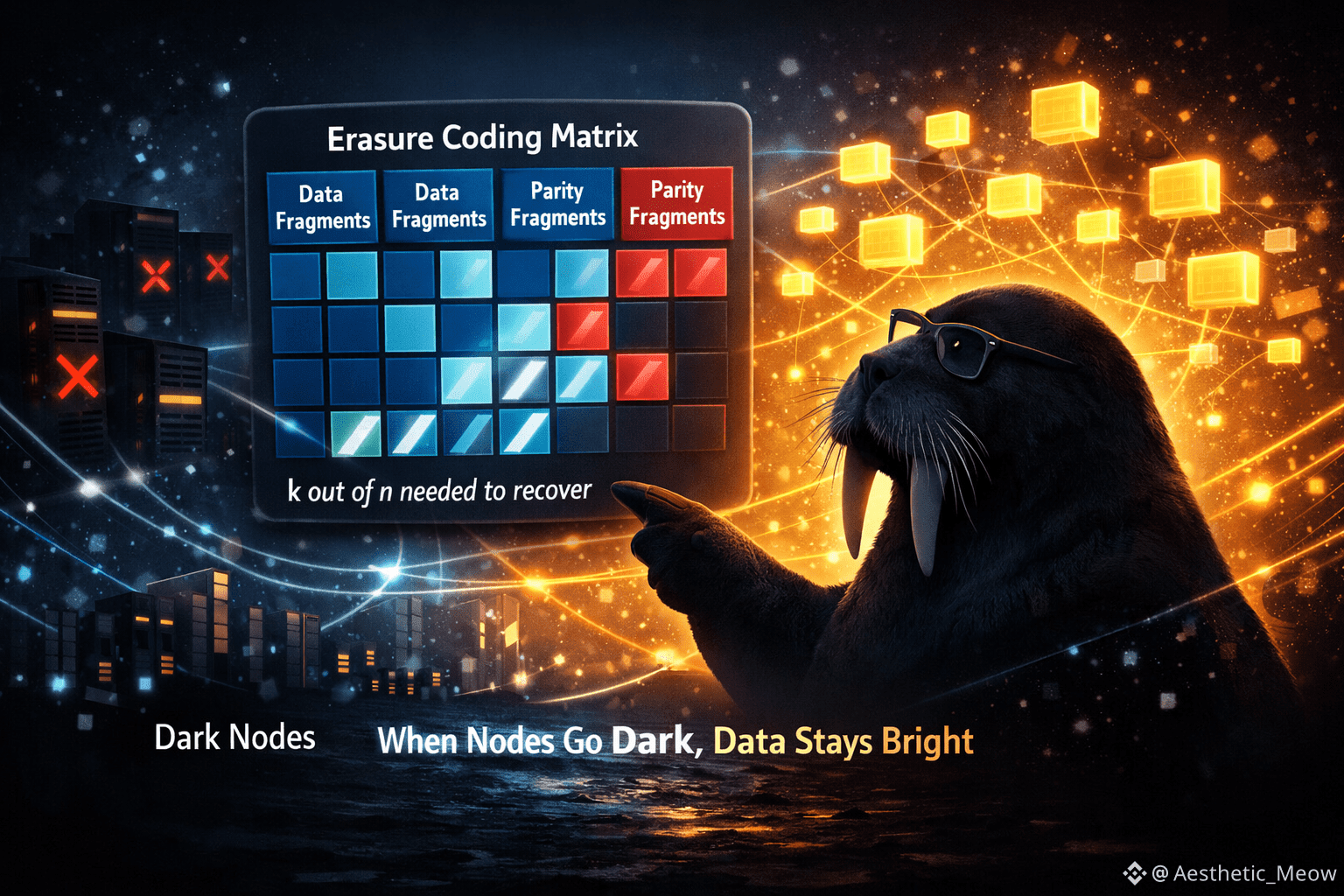
Walrus describes Red Stuff as employing a matrix-based encoding process. This method creates primary and secondary data fragments, facilitating "lightweight self-healing" and rapid recovery with minimal bandwidth usage.
Research findings further clarify this: Red Stuff allows for the recovery of lost fragments using bandwidth directly proportional to the amount of data lost. This is a significant advantage when network repairs are frequent.
2) It’s built for Byzantine-tolerant availability
Walrus's design does not assume a cooperative network. Instead, it optimizes for conditions where:
some nodes may become unavailable,
some nodes might respond with delays,
and some nodes could actively attempt to disrupt the system.
This is the practical meaning of "Byzantine-tolerant availability": the ability to reconstruct accurate data without relying on the honesty or even presence of any single node.
The real innovation: availability becomes a verifiable state, not just a hopeful expectation
Walrus treats data storage not as a passive background process but as an active lifecycle with distinct verification stages. This is where its "availability bet" becomes tangible.
Writing: you don’t store a blob — you store provable fragments
Walrus nodes do not store entire data blobs. Instead, they store encoded fragments. When a client needs to store data:
it reserves storage space and duration on the Sui blockchain.
it encodes the blob into primary and secondary fragments using the Red Stuff algorithm.
it distributes these fragments to the active committee of storage nodes.
Then comes the critical step:
Proof-of-Availability (PoA) certificate.
The client gathers signed confirmations from at least two-thirds of the storage nodes. This collection forms a write certificate, which is then published on the Sui blockchain as the PoA record.
This publication is crucial because it transforms storage from a mere "someone claims they stored it" scenario into a formally recorded obligation backed by evidence from a quorum of nodes.
Reading: resilience is integrated into the quorum rules
For data retrieval, the client:
fetches metadata and integrity commitments from the Sui blockchain.
requests fragments from the designated storage nodes.
verifies the integrity of the received fragments against their corresponding commitments.
reconstructs the original blob through the Red Stuff decoding process.
Walrus indicates that data reads can proceed successfully if at least one-third of the correct secondary fragments are retrieved, ensuring read resilience even when a substantial portion of the storage nodes are offline.
Maintenance: the system anticipates changes in the node committee
Walrus operates in distinct periods (epochs) and supports updates to its storage node committee. This ensures continuous availability even as the active set of storage nodes changes over time.
This adaptability is a key strength: many systems function adequately with a stable group of participants. Walrus, however, assumes that changes in node membership are normal and designs its operations around this expectation.
“When nodes go dark, data stays bright” — what that really means
This seemingly poetic phrase translates to a concrete outcome:
If some storage nodes disappear, you can still reconstruct the data.
If some storage nodes become unresponsive, you can still achieve the required quorum.
If some storage nodes attempt to provide incorrect data, you can verify the fragments against their commitments and reconstruct the correct information.
Therefore, Walrus's resilience is not an abstract concept but a functional process: encode → distribute → certify → verify → reconstruct → self-heal.
Red Stuff is the underlying technology that prevents this process from faltering due to either excessive replication costs or the complexities of fragile erasure coding recovery.
The deeper insight: Walrus defines “availability” as true recoverability
Replication focuses on preservation through duplication.
Walrus emphasizes preservation through reconstruction.
This represents a subtle yet significant philosophical shift for the Web3 space:
Web3 has established methods for making ownership records permanent.
The next evolutionary step requires making the actual referenced data dependable.
The internet doesn't fundamentally break when new blocks stop being added to a chain.
It breaks when everything verifies correctly, but the content itself fails to load.
Walrus aims to reduce the likelihood of this specific failure mode not by increasing data duplication, but by ensuring the system can rebuild essential data even under challenging and adversarial network conditions.
Key takeaways:
Replication offers straightforward resilience but incurs escalating costs and repair complexities.
Erasure coding provides efficient resilience but depends on practical recovery processes, especially in volatile network environments.
Red Stuff is Walrus's solution: a 2D erasure coding system featuring self-healing capabilities and bandwidth-efficient recovery, engineered for the realities of decentralized networks.
Walrus transforms "availability" into a verifiable state, akin to a certified condition (evidenced by PoA on Sui), rather than a mere best-effort promise.