
Fogo is the kind of chain you notice for the obvious reason first. It is fast, it feels sharp, it gives you that clean impression of a system that was built by people who obsess over execution. But speed is the easy part to talk about because it fits into numbers and screenshots. The real question is what happens when the market stops being polite.
In trading, the worst day is the only day that matters. Not because traders are dramatic, but because stress is where hidden costs appear. When volatility spikes, everyone shows up at the same time. Bots amplify every micro-inefficiency. Humans start clicking faster than they should. Liquidity thins, spreads widen, and the difference between a clean exit and a forced liquidation can be a handful of seconds, sometimes less. On those days, a chain is not competing on its best-case performance. It is competing on whether it stays usable while the entire system is being pushed toward its limits.
That is what I think people miss when they review crypto networks like they are reviewing a gaming PC. They talk about throughput and latency as if those metrics exist in a vacuum. In real markets, performance is not a trophy. It is a form of reliability. And reliability is not just uptime. It is the ability to submit, cancel, confirm, and settle with predictable behavior when the environment turns hostile.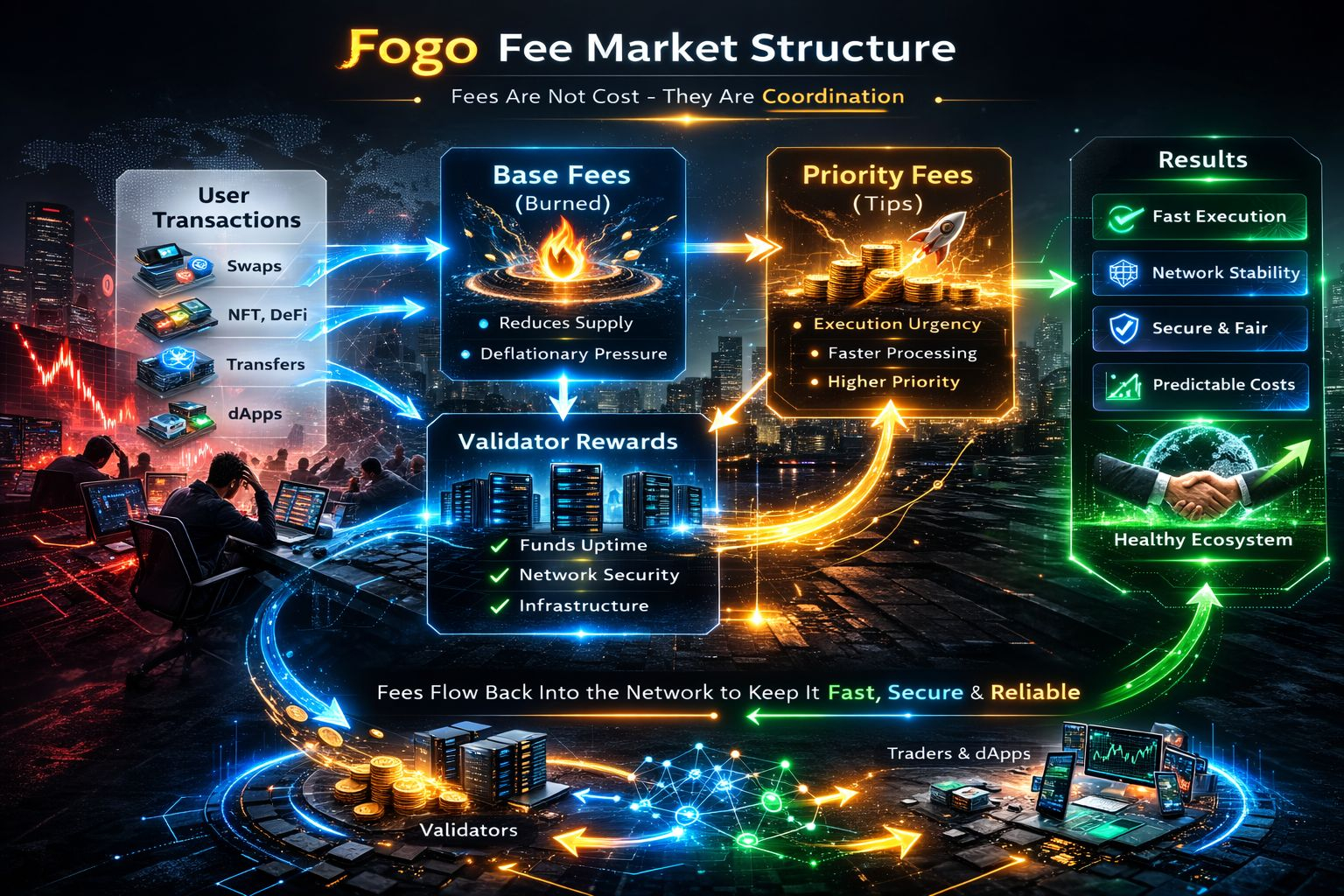
Fogo’s documents read like they were written by someone who understands that the venue is the product. Not the vibe, not the roadmap, not the theoretical decentralization score. The venue. A place where transactions are not “transactions,” they are risk decisions. When I move collateral, when I hedge, when I unwind, I am not looking for a philosophical experience. I am looking for the system to act the same way it acted five minutes ago, even if the entire world just tried to use it at once.
The foundation matters here. Fogo is built on the Solana technical stack, which already reflects a certain worldview: treat throughput as an engineering discipline, pipeline the work, push the hardware, accept that networking is a first-class constraint. Fogo then leans into that worldview and makes it more opinionated. Instead of celebrating a bunch of different clients, it pushes toward a canonical high-performance client derived from Firedancer, with the explicit argument that client diversity can become a bottleneck because the network ends up constrained by the slowest implementation.
That is a choice with consequences, and it is worth acknowledging it. If you come from a “permissionless at all costs” mindset, you will immediately see the downside. A canonical client increases systemic coupling. Bugs matter more. One dominant implementation can feel like centralization. Those concerns are real. But the upside is equally real if your goal is consistent behavior under load. Traders do not like “it depends.” They do not want a network that behaves differently depending on which validator implementation happens to be leading, or which RPC stack happens to be handling your request, or which corner case gets triggered by a traffic spike. Predictability is a feature. Fogo is basically saying that out loud.
The same realism shows up in how it treats geography. Most chains talk about the internet as if it is flat. It is not flat. Latency is physical distance. Congestion is route-dependent. Under stress, even tiny differences in propagation can turn into weird confirmation behavior. Fogo’s multi-local consensus approach is an attempt to acknowledge that reality rather than pretend it does not exist. Validators co-locate within zones to push latency toward physical limits, and then zones rotate across epochs so the network does not become permanently anchored to one region.
This is not just about making the chain faster. It is about making it behave more consistently. Consistency is what lets traders model their risk. It is what lets applications tune their retry logic, their batching, their timeouts, their quoting engines. If confirmation behavior becomes erratic under stress, you do not just get slower performance. You get uncertainty. And uncertainty is the most expensive thing in leveraged markets.
Then you get to the least popular topic in crypto, but one of the most important: operator quality. Permissionless networks are beautiful in theory, but in practice you get a wide distribution of competence. Some validators run pristine infrastructure with disciplined ops. Others cut corners. Some are underprovisioned. Some are barely paying attention. In calm markets, that variance can hide. In chaotic markets, it becomes visible. Weak links slow propagation, increase repair load, amplify forks, and make the whole network feel unpredictable.
Fogo’s answer is curation and standards. A curated validator set, minimum requirements, the ability to remove validators who persistently underperform or engage in harmful behavior. Again, this triggers ideological alarms, and it should. Any curated model creates questions about who decides, how the rules evolve, whether enforcement is fair, and what happens when incentives change. But from a venue perspective, there is a blunt logic to it. If reliability is the product, then operator standards are part of the product. This is how every serious piece of market infrastructure works. Exchanges have uptime requirements. Market makers have quoting obligations. Clearing systems have operational standards. It is not about being exclusive. It is about not letting random negligence become systemic risk.
MEV is another area where people talk in circles instead of facing the structural reality. Ordering is not a neutral detail. It decides who captures surplus. Under stress, the surplus can be enormous, and it becomes a hidden fee paid by users who do not even know they are paying it. Many chains treat MEV like weather, something you complain about but accept. Fogo’s posture implies that it wants governance or enforcement mechanisms that can actually remove actors whose behavior is destructive to the venue. That does not magically fix MEV, but it does change the social contract. It says the network is not pretending fairness will emerge by accident.
Still, if you ask traders what “downtime” feels like, they will often describe something different from consensus failure. They will describe RPC failure. They will describe timeouts. They will describe a wallet that cannot load balances. They will describe a backend that starts returning inconsistent state. In those moments, it does not matter if blocks are being produced. The venue is effectively closed for them.
That is why Fogo spending attention on the access layer is not a side note. It is core. Public RPC endpoints are one part, but the more telling piece is FluxRPC, designed as a validator-decoupled RPC layer built for speed and consistency, with edge caching and a gateway model. That kind of architecture is what you build when you accept that market stress produces ugly traffic patterns. You get retry storms. You get bots hammering the same methods. You get millions of clients asking the same few questions about the world state. Edge caching sounds like a web2 thing until you realize that in a volatile market, a huge fraction of requests are repetitive reads. If you can absorb them at the edge, you protect the system from drowning in its own demand for information.
This is also where reliability becomes emotional in a very real way. When you are managing risk and something stops responding, your brain does not treat it like a normal software glitch. Your brain treats it like loss. You feel trapped. You start over-clicking. You start escalating risk with every retry. You start making worse decisions because the system is not giving you clear feedback. A reliable venue reduces that psychological spiral. Not by “making you feel good,” but by making outcomes legible. It tells you what happened. It confirms in time. It does not leave you guessing.
There is also a quieter aspect of reliability that most people ignore: user safety when behavior gets frantic. In calm conditions, people are careful with approvals and signatures. In chaotic conditions, they are not careful. They are trying to move fast. That is exactly when scams, malicious prompts, and accidental over-permissions do the most damage. Fogo Sessions, with bounded permissions, limits, and expiry, fits here in a way that is easy to underestimate. It is not just convenience. It is a way to let users act quickly without opening the full surface area of their wallet. It is risk containment, expressed as UX.
None of these choices guarantee success. Reliability is a reputation, not a promise. And some of Fogo’s design decisions come with real trade-offs. A curated validator set can concentrate power and create social fragility if governance is not handled carefully. A canonical client strategy can increase correlated risk if a bug slips through. A strong RPC layer can become a dependency that makes the chain “feel” down even if consensus is fine. Session systems and paymasters introduce new surfaces that must be audited and defended.
But the thing I respect is that Fogo appears to be choosing its trade-offs intentionally, with a clear idea of what it wants to be. It is not trying to win the loudest benchmark competition. It is trying to build a venue that stays coherent when the world is leaning on it.
That is the real edge, if it holds. Not that it can be fast in ideal conditions, but that it can stay usable when conditions are not ideal. That it can behave predictably when everyone else is flooding the same pipes. That it can keep the feedback loop clean enough that humans and machines can manage risk without guessing.
And maybe the most honest ending is this. When markets get ugly, nobody cares about the slogan they read last week. They care about whether they could act when they needed to. Over time, that is what trust becomes. Not a belief. A memory.
