
Instead of Reading Whitepapers
There’s a specific moment that happens in most blockchain gaming projects where you realize the people building the infrastructure have never actually played games seriously. Not casually on mobile during commutes. Really played. Spent hundreds of hours mastering mechanics. Felt the difference between 60fps and 144fps. Understood why a 50-millisecond input delay ruins competitive games completely. Experienced the flow state where you stop thinking and just react.
That moment usually comes when you see their transaction confirmation times. Or their fee structures. Or how they handle inventory management. The infrastructure reveals instantly that it was designed by people optimizing blockchain metrics rather than gaming experiences.
Fogo feels different because somewhere in the development process, actual gamers were making actual decisions about what matters.
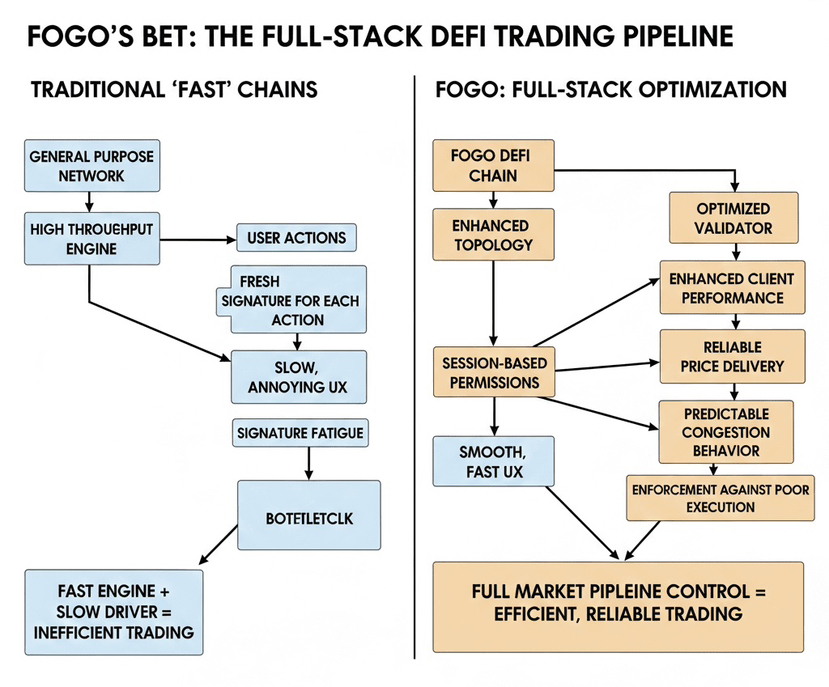
Let me give you a concrete example that illustrates this difference better than abstract architectural discussions.
In a typical blockchain game, you kill an enemy and it drops an item. Here’s what happens next on most platforms. The game client requests the item drop from the server. The server generates the drop and submits a transaction to the blockchain. The transaction enters the mempool. Eventually it gets included in a block. Consensus happens. The block finalizes. Confirmation propagates back to the client. Your client displays the item. This entire process takes anywhere from two to thirty seconds depending on network conditions.
Now imagine you’re actually playing. You’re in combat. Things are happening quickly. You kill an enemy and nothing happens for five seconds. Then an item suddenly appears. Except you’ve already moved on and killed three more enemies and now you’re confused about which enemy dropped what. The rhythm of combat is completely destroyed. The satisfaction of getting a drop is gone because it felt disconnected from the action that caused it.
This is what happens when blockchain people design game infrastructure without understanding how games actually feel to play.
Fogo’s approach is different in a way that seems small on paper but matters enormously in practice. The game client shows the drop immediately using optimistic execution. The blockchain verification happens in the background in milliseconds. If verification fails for some reason, the client handles it gracefully without disrupting gameplay. The player experiences instant feedback that feels exactly like any other game while genuine ownership happens transparently underneath.
This seems obvious once you see it but most blockchain gaming projects never figure it out because they’re optimizing for blockchain properties rather than gaming experiences.
The inventory management problem reveals similar thinking differences.
Traditional games let you organize inventory however you want. Sort by type. Sort by rarity. Sort by level. Filter to show only specific categories. Create custom organization systems. Search for items by name. All of this happens instantly because it’s just database queries and UI updates. No blockchain involvement needed or wanted.
Early blockchain games tried to put inventory operations on-chain because of some confused idea that player actions need blockchain verification even when they’re purely cosmetic organizational preferences. This made inventory management incredibly slow and expensive. Reorganizing your inventory cost gas fees and required waiting for transactions to confirm. It was completely absurd.
Fogo separates concerns properly. Ownership lives on the blockchain. Organizational preferences live locally. You can reorganize inventory instantly because it’s just local UI state. The blockchain only gets involved when actual ownership transfers happen. This seems obvious but you’d be surprised how many blockchain gaming projects get this wrong by trying to blockchain-ify things that don’t need or benefit from blockchain verification.
Combat feedback represents another area where gaming intuition matters more than technical sophistication.
When you hit an enemy, you need immediate feedback. Visual effects. Sound effects. Damage numbers. Screen shake. All of this needs to happen within 50-100 milliseconds or the combat feels disconnected and unsatisfying. If there’s any dependency on blockchain confirmation for this feedback, the combat is ruined regardless of how impressive the blockchain technology might be.
Fogo’s architecture handles this by separating the combat experience from ownership verification. Combat happens at normal game speed with normal feedback. Ownership of loot earned through combat gets verified on blockchain in background. Players experience responsive satisfying combat while genuine ownership happens transparently. The blockchain is completely invisible during gameplay because that’s where blockchain should be in gaming contexts.
Marketplace dynamics show similar gaming intuition.
In good game marketplaces, you can browse quickly. Filter instantly. Sort by different criteria immediately. Search by name or properties. See price history graphs. Compare similar items easily. All of this needs to feel instant because you’re shopping for entertainment not conducting serious research requiring patience.
Blockchain marketplaces often feel terrible because every operation involves transactions and confirmations. Want to check an item’s price history? Transaction. Want to compare three similar items? Three transactions. Want to filter by rarity and level? Wait for queries to execute on-chain. The experience is so slow and cumbersome that players avoid using marketplaces even though they want to trade items.
Fogo solves this by caching marketplace data locally and updating it continuously in background. You browse and search using local data that updates in realtime. Only when you actually execute a trade does blockchain involvement happen. The marketplace feels exactly like shopping in any other game while genuine decentralized trading happens underneath. This is what good infrastructure design looks like when people building it understand that user experience matters more than technical purity.
Guild coordination mechanisms reveal whether infrastructure builders understand multiplayer social dynamics.
Guilds need to communicate, coordinate activities, share resources, make collective decisions, and track member contributions. Most of this doesn’t need blockchain at all. Chat doesn’t need blockchain. Coordinating what time to play doesn’t need blockchain. Discussing strategy doesn’t need blockchain. Only resource sharing and treasury management actually benefit from blockchain verification.
Good infrastructure recognizes this and provides guild tools that use blockchain only where it adds value. Communication tools work normally without blockchain overhead. Calendar and scheduling work normally. Only treasury operations and resource distribution involve blockchain. Fogo’s guild infrastructure reflects this understanding. Most guild activities happen using normal efficient systems. Blockchain gets involved only for economic operations where trustless verification actually matters.
The scholarship system implementation shows similar gaming intuition about how these arrangements actually work.
In theory, scholarship is simple. Asset owner loans items to player. Player uses items and shares earnings. Smart contract enforces terms. In practice, there are dozens of edge cases. What happens if the scholar doesn’t return items on time? What if the asset owner wants to use the item themselves suddenly? What if the item gets damaged or degraded through use in games that have durability mechanics? What if either party wants to renegotiate terms?
Fogo’s scholarship infrastructure handles these real-world complications because it was designed by people who thought through how these arrangements actually function rather than just implementing a simple smart contract that handles the happy path. Timeouts and penalties for non-return. Recall mechanisms with notice periods. Damage tracking and compensation. Renegotiation workflows. Dispute resolution processes. All of this exists because the infrastructure designers understood that human relationships are complicated even when mediated by smart contracts.
The anti-cheat integration question separates gaming infrastructure from blockchain infrastructure.
Games need anti-cheat systems. Players will exploit any advantage they can find. In blockchain gaming, there’s tension between transparency that blockchain provides and obscurity that anti-cheat requires. If all game state is visible on-chain, clever players can analyze patterns and find exploits. If game state is hidden, blockchain’s verification benefits are reduced.
Fogo handles this through hybrid architecture where different types of game state get different visibility and verification levels. Combat outcomes that need verification get blockchain treatment. Internal state that would enable cheating stays hidden. The balance is thoughtful rather than dogmatic, prioritizing fair gameplay over technical purity.
Achievement systems and progression mechanics need similar gaming intuition.
Achievements need to feel meaningful and surprising sometimes. If every achievement is publicly visible on blockchain before it’s discovered, the surprise is ruined. If achievements are completely hidden, verification is impossible and cheating becomes easy. Finding the right balance requires understanding gaming psychology not just blockchain technology.
Fogo’s achievement system reveals achievements progressively. Completed achievements are verified on-chain. Undiscovered achievements remain obscured. The system provides verification without spoiling discovery. This kind of nuanced design comes from understanding what makes achievements satisfying rather than just implementing blockchain verification mechanically.
The seasonal content and progression reset problem is particularly interesting.
Many games use seasonal resets where progression starts fresh periodically. This keeps competition interesting and gives new players entry points. In blockchain gaming with genuine ownership, how do you implement resets when players actually own their items permanently? If items persist across seasons, new players face insurmountable disadvantages. If items reset, ownership feels hollow.
Fogo enables different approaches that game designers can choose based on their specific needs. Seasonal leagues where items are scoped to specific seasons. Lifetime persistence modes where accumulation continues indefinitely. Hybrid models where some items persist and others reset. The infrastructure provides flexibility rather than imposing one philosophical approach, recognizing that different games need different solutions.
The tutorial and onboarding experience for blockchain features requires gaming intuition about how players actually learn.
Players don’t read documentation. They learn by doing. Tutorial design is incredibly important and incredibly difficult. Blockchain gaming tutorials are often terrible because they try to explain blockchain concepts when they should be teaching gameplay and letting blockchain happen invisibly.
Fogo’s reference implementations show good tutorial design. Players learn by playing. Blockchain features get introduced gradually through gameplay rather than through explanations. By the time players consciously realize they own items cryptographically, they’ve already been playing and enjoying the game for hours. The blockchain understanding comes from experience rather than from reading which is how gaming tutorials should work.
The modding and user-generated content question reveals interesting tensions.
Gaming culture values mods and user-generated content. Blockchain culture values immutability and permanence. These values conflict when thinking about user-created items or modifications. Fogo’s architecture provides hooks for user-generated content while maintaining ownership verification. Players can create items that get verified on-chain if they meet game requirements. The system stays open to creativity while maintaining integrity.
The whole infrastructure reflects a philosophy that blockchain should serve gaming rather than gaming serving blockchain. This sounds obvious but it’s rare in practice. Most blockchain gaming projects put blockchain first and compromise gaming experiences constantly. Fogo puts gaming first and uses blockchain only where it genuinely improves the experience. That fundamental priority reversal is why the infrastructure feels different and why games built on it might actually succeed where previous blockchain gaming attempts failed.