For any decentralized network to thrive, robust tokenomics are essential. As we look at the @Walrus 🦭/acc in 2026, it's clear that the WAL token is more than just a governance asset—it's the critical fuel that powers its secure and scalable decentralized storage ecosystem. Understanding its role is key to appreciating Walrus's long-term potential.
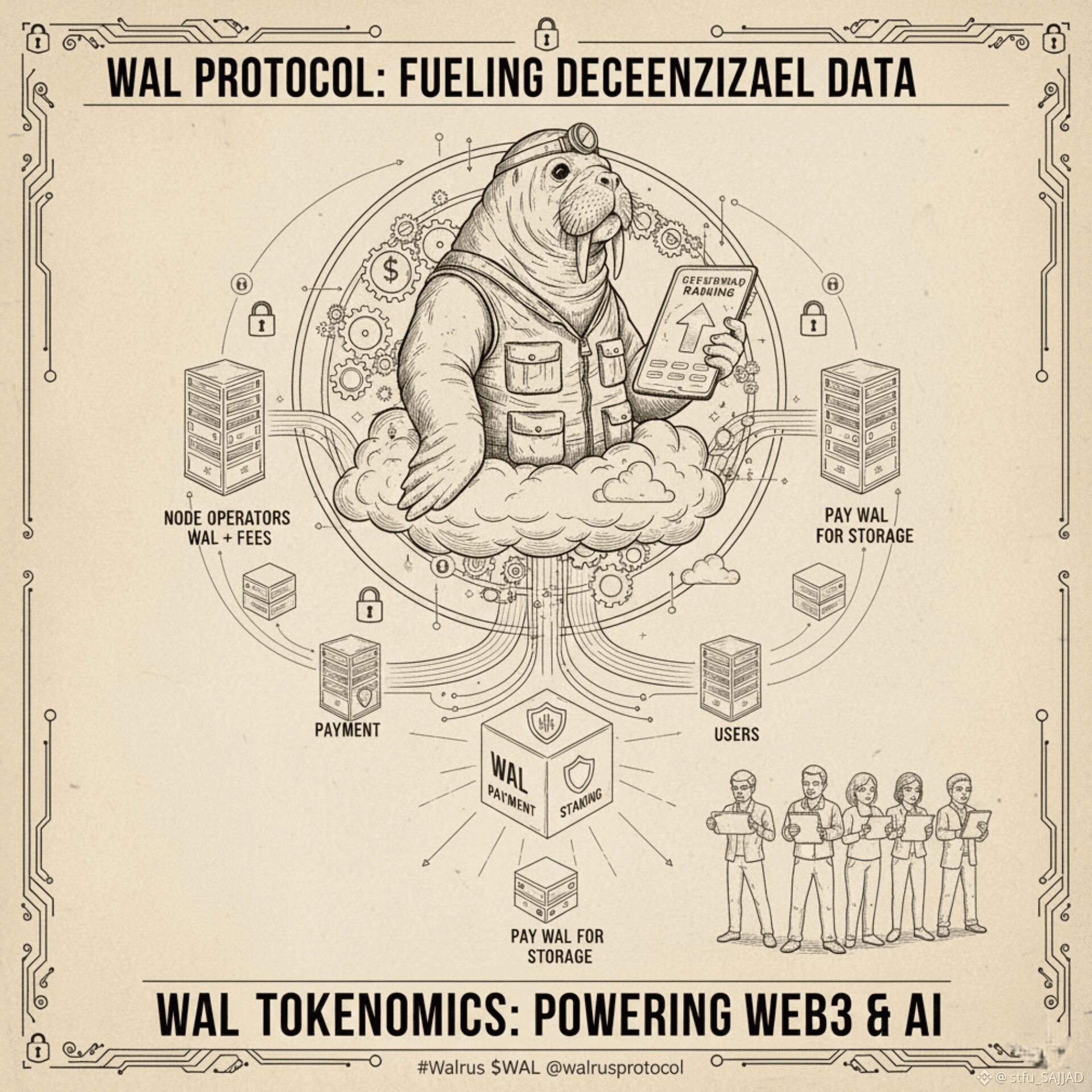
The $WAL token serves multiple vital functions. Firstly, it's the payment mechanism for storage services. Users pay $WAL to store their data, creating consistent demand for the token. This revenue is then distributed to the network's node operators, incentivizing them to provide reliable and efficient storage.
Secondly, $WAL is used for staking by node operators. To become a trusted storage provider, nodes must stake a certain amount of WAL. This acts as a security deposit, aligning their incentives with the network's health. If a node acts maliciously or fails to provide service, a portion of their staked $WAL can be slashed, ensuring accountability. This mechanism is crucial for maintaining the integrity and security of the "Red Stuff" data shards.
Finally, WAL is a governance token, allowing community members to vote on important protocol upgrades, fee structures, and future developments. This ensures that @Walrus 🦭/acc remains decentralized and responsive to its community's needs. As the demand for scalable AI and Web3 data solutions grows, the intrinsic value and utility of $WAL are poised to grow alongside it, making it a cornerstone for the decentralized future.

Understanding $WAL Tokenomics: Fueling Decentralized Storage & Node Incentives in 2026
Penafian: Berisi opini pihak ketiga. Bukan nasihat keuangan. Dapat berisi konten bersponsor. Baca S&K.


WAL
0.1536
+6.00%
64