
Every generation of technology has its rush. The internet had its gold rush years, social media had its growth-at-any-cost phase, and Web3 is still living inside its own acceleration trap. Speed is celebrated, visibility is rewarded, and patience is often misunderstood as weakness. Yet history keeps repeating a quieter truth: systems that last are rarely the ones that moved first. They are the ones that moved with intention. This is where @dusk_foundation fits into the broader Web3 story.
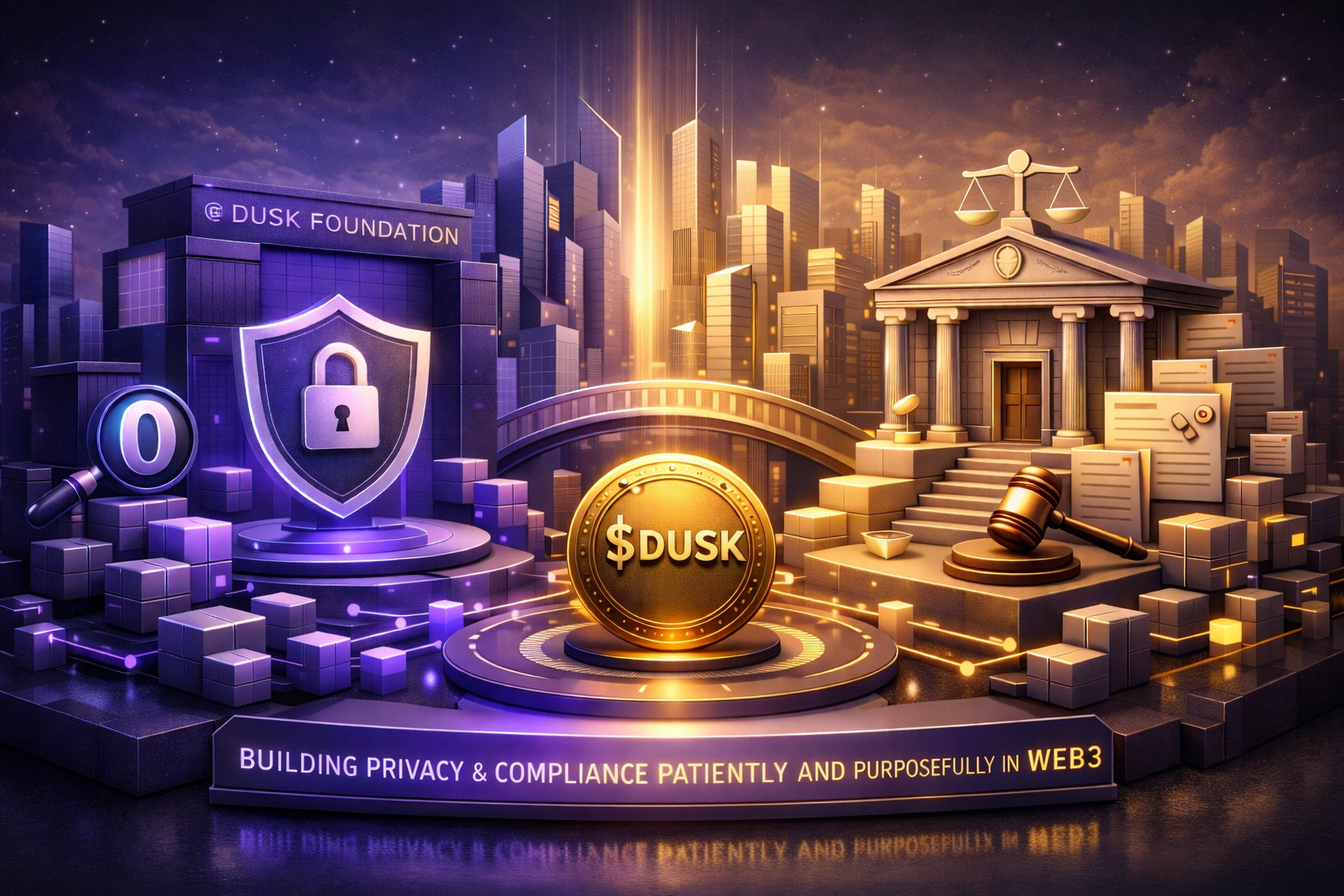
While many projects chase momentum, Dusk focuses on structure. Instead of promising instant transformation, it asks more difficult questions about privacy, regulation, and trust. These questions are not exciting on the surface, but they are unavoidable if decentralized technology is meant to serve real economies rather than isolated communities.
Why is privacy more than just secrecy?
Privacy is often framed as invisibility. In reality, it is closer to dignity. In everyday life, people do not want to expose every detail of who they are just to participate in society. Financial systems should work the same way. Dusk approaches privacy as selective disclosure, where proof matters more than exposure.
Using zero-knowledge technology, Dusk allows information to be validated without being revealed. The contrast here is important. Traditional systems demand full transparency, while early crypto often demanded blind trust. Dusk aims for something more balanced, where trust is earned through cryptography rather than enforced through surveillance.
What happens when compliance is treated as design, not restriction?
Compliance has long been treated as an obstacle in crypto. Something to avoid, delay, or work around. Dusk challenges that mindset by treating compliance as a design constraint, similar to security or scalability.
Think of it like building a bridge. Weight limits are not there to limit freedom, they exist to prevent collapse. By designing with regulatory clarity in mind, Dusk creates space for institutions to participate without compromising decentralization. This does not weaken the system. It strengthens its ability to exist in the real world.
Why does real adoption move slower than speculation?
Speculation moves fast because it requires belief, not reliability. Adoption moves slowly because it demands trust, stability, and clear incentives. Dusk understands that meaningful adoption does not come from excitement alone.
For enterprises and financial institutions, uncertainty is a deal-breaker. Privacy without compliance is risky. Compliance without privacy is unacceptable. Dusk’s approach sits between these extremes, offering a framework where both sides can coexist. This balance is not dramatic, but it is practical, and practicality is what adoption depends on.
How does infrastructure quietly shape the future?
Most users never think about infrastructure until it fails. Roads, electricity, and water systems only gain attention when they break. Blockchain infrastructure is no different. Dusk focuses on building layers that work quietly in the background, supporting applications that require confidentiality and correctness.
This focus on fundamentals often goes unnoticed, but it defines what can be built on top. When infrastructure is designed with care, developers gain freedom. When it is rushed, limitations surface later. Dusk chooses the slower path upfront to avoid fragile systems later.
What does $DUSK symbolize in this broader vision?
$DUSK is not just a representation of market activity. It symbolizes participation in a network that values restraint and long-term thinking. In an environment where many tokens represent ambition without accountability, $DUSK reflects an ecosystem built around responsibility.
It is a reminder that decentralization does not mean chaos, and privacy does not mean isolation. Both can exist within systems that respect users, institutions, and the realities of global finance.
Closing reflections
Web3 is still defining itself. The choices made today will shape how it is perceived tomorrow. Projects that prioritize endurance over attention are laying foundations that others may one day depend on, even if they do not realize it yet.
Dusk’s quiet approach may not dominate headlines, but it aligns with a deeper need within the industry: systems that can withstand scrutiny, scale responsibly, and earn trust over time.
Final statement
If Web3 is to mature beyond experimentation, it will require builders who think beyond cycles and narratives. @Dusk and $DUSK reflect a belief that privacy, compliance, and decentralization can grow together, shaping a future that is not just decentralized, but dependable. #dusk
