


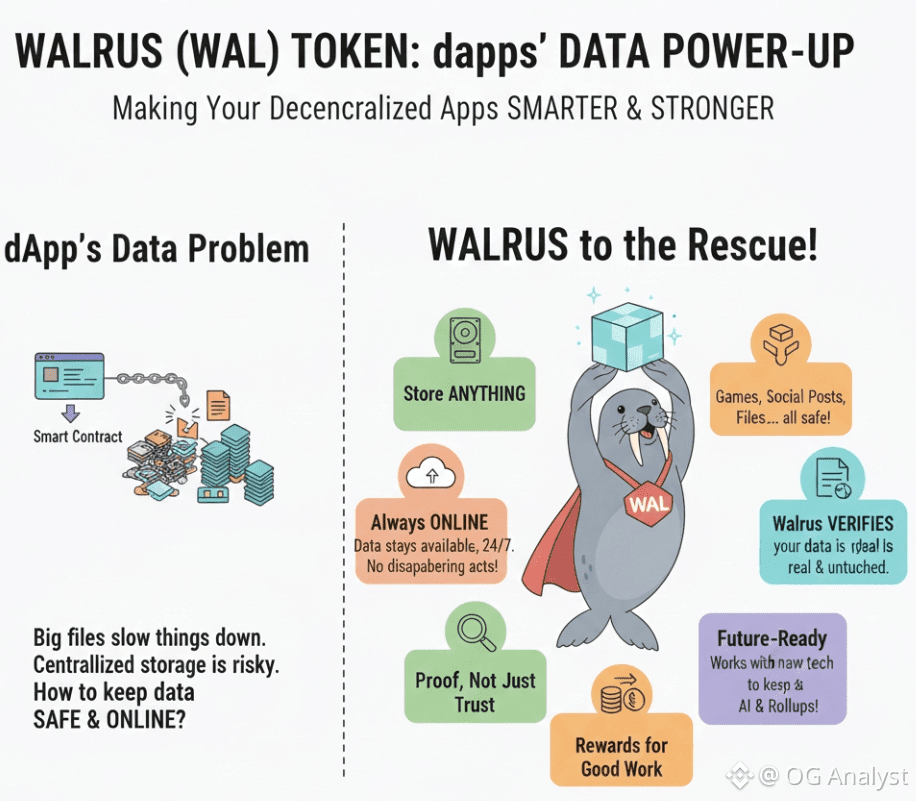
Decentralized applications often promise trustlessness and transparency, yet many still depend on fragile data assumptions. Smart contracts may be decentralized, but the data they rely on—media, histories, proofs, or user-generated content—frequently lives off-chain in ways that are hard to verify or sustain. Walrus addresses this gap by acting as a verifiable data backbone, and WAL is the economic glue that makes this backbone function.
Rather than being a speculative add-on, WAL is embedded directly into how dApps store, verify, retrieve, and economically sustain their data flows.
Persistent data storage for state-heavy dApps
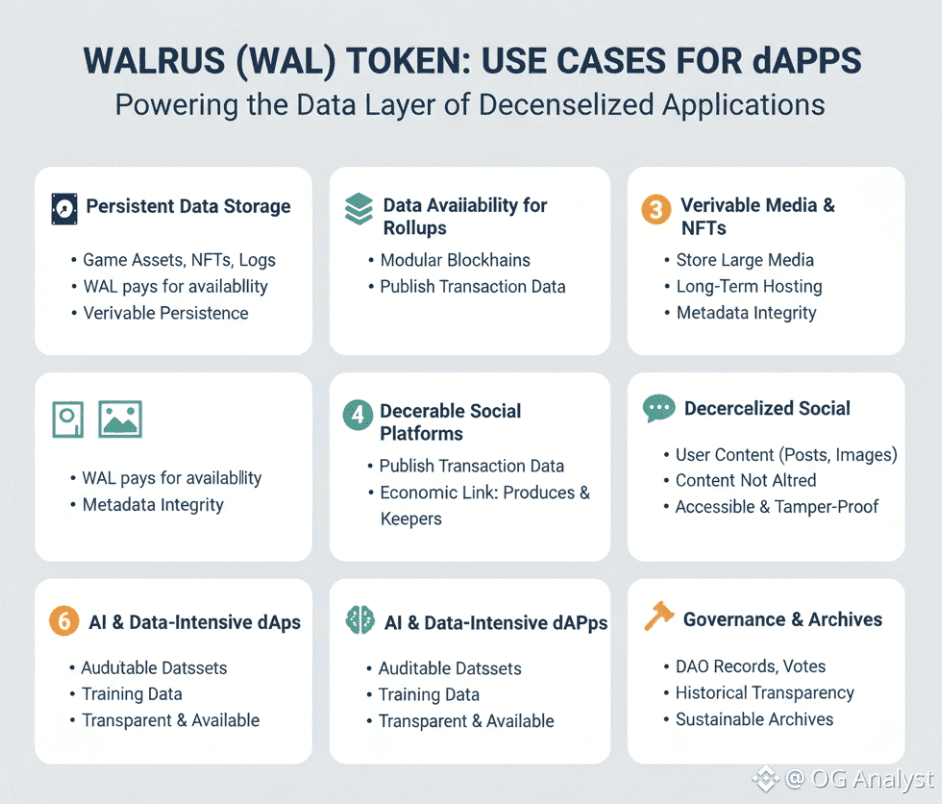
Many dApps generate data that is too large or too dynamic to live fully on-chain: game assets, NFT metadata, social content, DAO records, or application logs. Walrus allows these applications to store large blobs of data off-chain while keeping cryptographic commitments on-chain.
In this context, WAL is used to pay for storage duration and availability guarantees. The token transforms storage from a best-effort service into a measurable, enforceable resource. dApps are no longer relying on goodwill or centralized hosts; they are purchasing verifiable persistence.
Data availability for rollups and modular systems
Modern dApps increasingly live within modular blockchain stacks—rollups, appchains, and execution layers that separate computation from data availability. For these systems, data availability is not optional; it is existential.
Walrus serves as a data availability layer where rollups and modular dApps can publish transaction data, state diffs, or proofs. WAL is used to compensate storage providers who commit to retaining this data and responding to availability challenges. This creates a direct economic link between data producers and data keepers, without requiring trust.
Verifiable media and NFT ecosystems
NFTs and media-centric dApps often struggle with a quiet contradiction: the token is on-chain, but the artwork or content is not guaranteed to be. Walrus provides a way to store large media files in a decentralized, erasure-coded format, while anchoring their integrity on-chain.
In these use cases, WAL supports long-term hosting and retrieval incentives. NFT platforms can rely on Walrus to ensure that metadata and media remain accessible years later, not just at mint time.
Decentralized social and content platforms
Social dApps generate continuous streams of user content—posts, images, interactions—that must remain accessible without becoming prohibitively expensive. Fully on-chain storage is unrealistic, while centralized servers undermine decentralization.
Walrus enables these platforms to store content off-chain with cryptographic verifiability. WAL aligns incentives so storage providers are rewarded for honest participation, while users gain confidence that content has not been silently altered or removed.
AI and data-intensive dApps
AI-driven dApps require large, auditable datasets: training corpora, inference inputs, and model artifacts. Walrus can store these datasets in a way that preserves integrity and availability without central custody.
In this setting, WAL functions as a coordination token. It enables data producers, storage providers, and consumers to interact economically while maintaining transparency about what data exists and whether it remains accessible.
Governance records and historical archives
DAOs and governance-heavy dApps rely on historical transparency—proposals, votes, rationale, and execution records. Walrus allows these records to be stored efficiently and retrieved verifiably over long time horizons.
WAL supports the sustainability of these archives, ensuring that governance history is not lost or selectively pruned due to cost pressures.
A quiet but critical role
Across all these use cases, WAL does not try to be a universal payment token or a governance abstraction layered on top of speculation. Its role is narrower and more disciplined: to price data availability honestly and to reward the infrastructure that keeps decentralized applications usable over time.
Conclusion
In the context of decentralized applications, Walrus and WAL function less like a feature and more like infrastructure. WAL enables dApps to store large data, guarantee availability, verify integrity, and sustain long-term access without reverting to centralized systems. Its primary use cases emerge wherever decentralized logic meets real-world data—quietly solving a problem most applications cannot afford to ignore.

