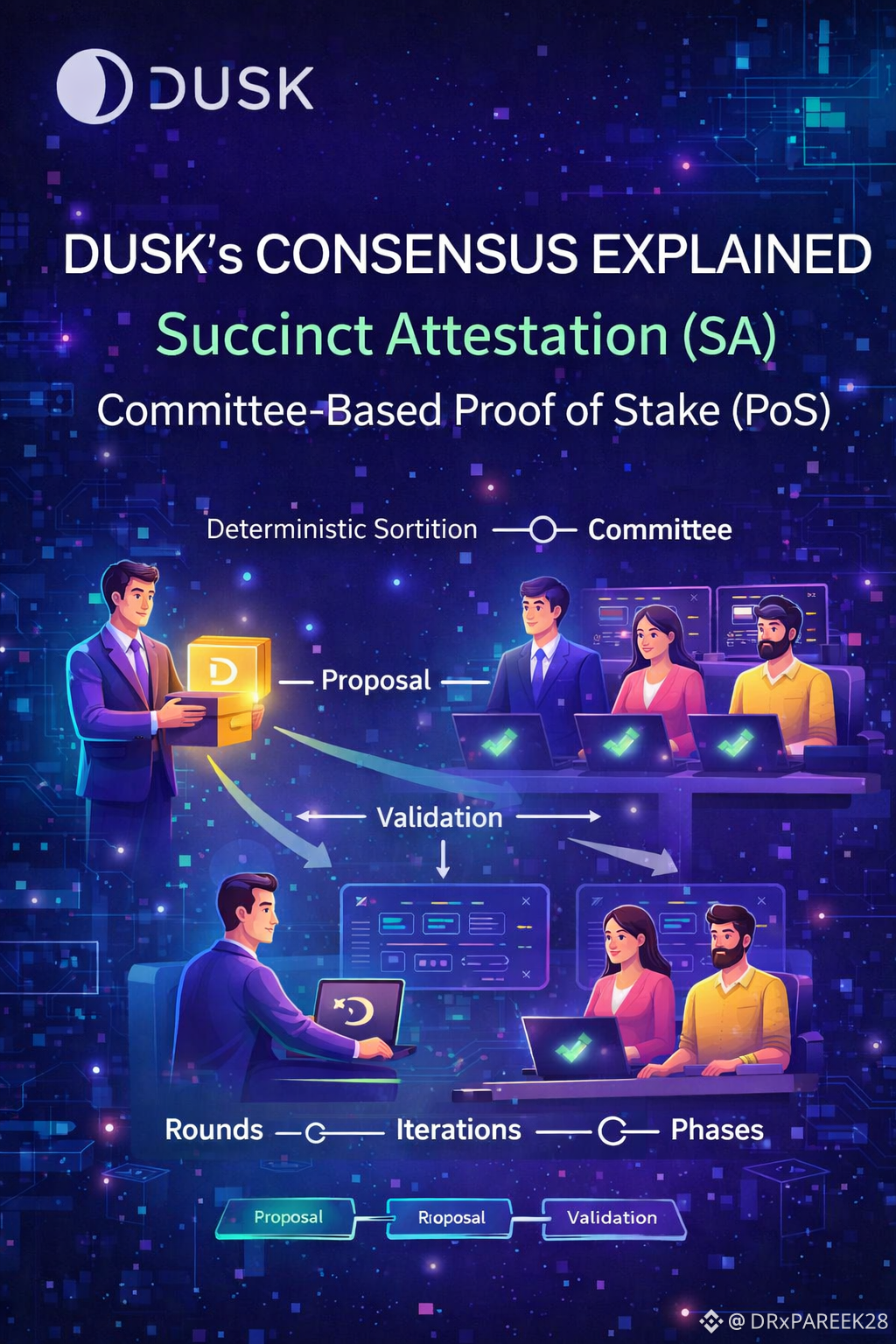
When most people hear Proof-of-Stake (PoS), they imagine validators producing blocks and receiving rewards. But DUSK takes a more refined route with its consensus mechanism called Succinct Attestation (SA). This is not your typical “everyone votes all the time” model. SA is permissionless, but it works with committees selected in a smart and efficient way—almost like giving the network a “committee brain” for each block.
In DUSK, stakers are called Provisioners. They lock DUSK tokens as stake, and then the protocol selects participants through a deterministic selection algorithm. Instead of relying on continuous interaction or random gossip, DUSK uses Deterministic Sortition (DS) which picks:
one block generator (proposal step)
a set of voting committees (validation + ratification)
Now what makes SA powerful is structure:
It runs in rounds, and every round produces a new block.
Each round contains iterations, and each iteration has 3 phases (proposal → validation → ratification).
This gives DUSK fast decision-making while keeping consensus solid.
Also, voting isn’t just “one person = one vote.” Provisioners get committee credits (a set number), and votes are weighted by credits. So if someone has more credits, their vote carries more weight for that committee.
This is extremely important for DUSK because its core mission is privacy-preserving financial applications. A network targeting compliance + confidentiality cannot afford messy consensus or uncertainty. SA keeps DUSK highly structured, secure, and scalable—designed like a real infrastructure, not a casual blockchain experiment.