
I’ve been circling the Walrus ecosystem for a few months now, quietly observing how it tries to carve out a niche in decentralized storage. On paper, WAL is just another Web3 storage token, but spending time with the project reveals a subtler story about what users and developers are really looking for when they store data beyond the cloud giants.
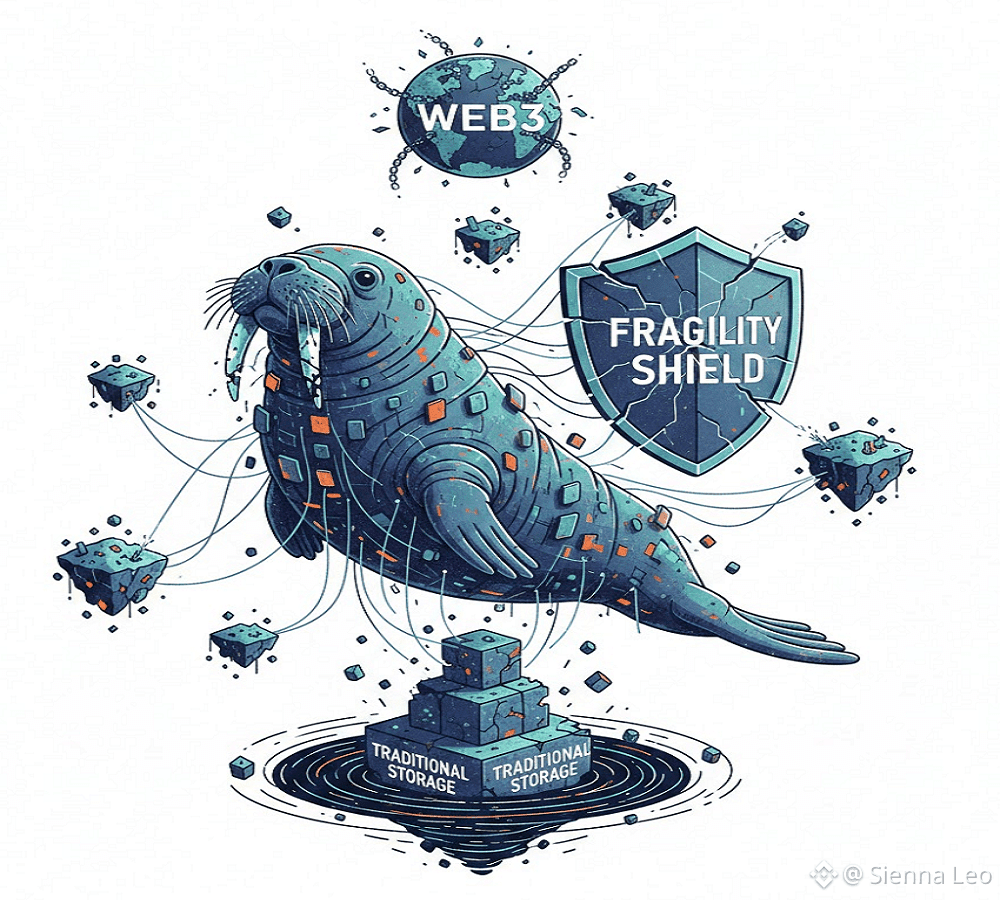
Walrus started with a clear promise: provide a decentralized alternative where files aren’t just stored in a single server farm but spread across a network of contributors. Early adopters were drawn to the transparency of its ledger and the idea that storage could be rented, verified, and retrieved without a middleman. Today, WAL sits in a more measured phase. It’s functional, its network has grown, but adoption hasn’t exploded. That’s not a failure, exactly. It’s more a reflection of how experimental these systems still are.
Technically, Walrus operates in a familiar way if you’ve looked at Web3 storage models before. Think of it like a library where every book has multiple copies scattered in different cities. You don’t rely on a single building to hold your knowledge, and if one branch shuts down, your book is still safe somewhere else. That resilience is appealing, especially compared with centralized cloud storage. But there’s a catch: retrieval speeds, uptime, and long-term reliability are variable. Every node is run by an independent party, which introduces practical friction.
Comparing WAL with other ecosystems like Filecoin or Arweave highlights different priorities. Filecoin emphasizes incentivized storage contracts and heavy cryptographic proofs. Arweave leans toward permanent storage with a “pay once, store forever” model. Walrus lands somewhere in between, aiming for simplicity and community flexibility. For developers or projects evaluating these platforms, the trade-offs are tangible. WAL is easier to experiment with for small-scale storage but may not yet have the robustness or enterprise-level assurances of Filecoin.
One subtle risk I’ve noticed is overconfidence. People sometimes assume decentralized storage automatically means indestructible. In practice, node operators can go offline, software upgrades can break retrieval paths, and network incentives can fluctuate. Thinking in terms of probability rather than certainty is key. Decentralization is powerful, but not magic.
Looking forward, WAL’s potential isn’t just in raw storage. Its ecosystem could benefit from integrations that make these distributed files more accessible to everyday apps. If retrieval becomes seamless and community participation stabilizes, it could quietly become a backbone for small-scale decentralized applications. But it will need patience, careful auditing, and continued engagement to reach that point.
Spending time with WAL reminds me that Web3 storage isn’t just a technical problem—it’s a behavioral one. Users have to trust networks that aren’t controlled by any single authority. That’s a radical shift, and it’s not solved overnight. Observing how different ecosystems tackle this challenge, I’ve realized that resilience and usability often pull in opposite directions, and projects like Walrus are learning to balance the two.
There’s something quietly hopeful about that tension. Watching decentralized storage mature feels less like chasing hype and more like witnessing an ecosystem experiment with the fundamentals of trust and persistence.

