


(It’s not easy to write code, attention and sharing are the biggest motivation, thank you brothers)
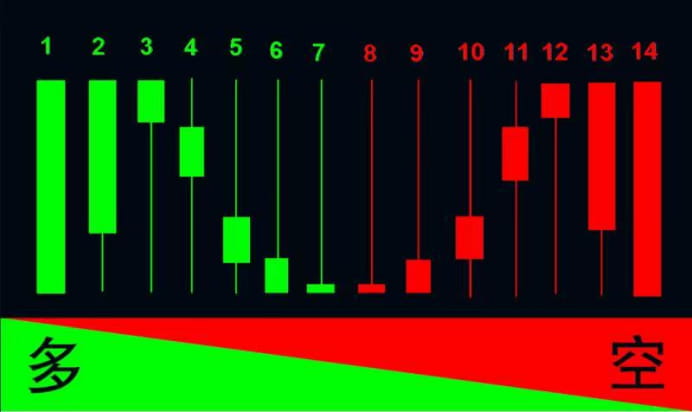
The first candlestick is a bareheaded and barefoot Yang candlestick, which means that the bulls have won and the bears have no power to fight back.
The second K-line is a bald positive line with a slight lower shadow. After the opening, the short side launched an attack and hit the lowest point, and then the long side launched a counterattack and closed at the highest point, indicating that the long side has the overwhelming advantage.
The third K-line is a bald positive line with a long lower shadow. The bulls have a certain advantage. After the opening, the bears pushed down to the lowest point, and then the bulls launched a counterattack and continued to hit the highest point to close;
The fourth K-line is a positive line with upper and lower shadows. The bulls have a slight advantage. The lower shadow is longer than the upper shadow. After the opening, the bears push down to the lowest point. Then the bulls counterattack to the highest point. At this time, the bears suppress the market and the market closes with a short upper shadow.
The fifth K-line is a positive line with an upper shadow. The upper shadow is longer than the lower shadow. On the surface, it is a positive line, but in fact it is a false positive and true negative pattern with the short side slightly dominant. The opening is the short side pushing down to the lowest point, and then the long side launches a counterattack to the highest point, but is suppressed downward by the short side and closes with a long upper shadow.
The sixth K-line is a bare positive line with a long upper shadow. On the surface, it is a positive line, but in fact it is a false positive and real negative pattern in which the bears have the upper hand. After opening at the lowest point, it goes all the way to the highest point in multiple directions. At this time, the bears launch downward suppression and close the K-line pattern with a small entity with a long upper shadow.
Since the upper shadow represents the strength of the seller and is longer than the buyer's body, it is a true Yin and a false Yang line, and the bears have the advantage.
The seventh K-line is a bare Yang line with a long upper shadow. On the surface, it is a Yang line, but in fact, it is a false Yang and true Yin pattern dominated by the short side. After opening at the lowest point, the multi-directional attack to the highest point was suppressed by the short side all the way and closed with a long lower shadow and small real Yang line;
The eighth K-line is a bare-legged black candle with a long upper shadow and a small body. The bears are dominant. After the opening, the bulls attack to the highest point, and then encounter the bears to suppress it to the lowest point and close.
The ninth K-line is a bare-legged black candlestick with a long upper shadow and a small real body. The bears have the upper hand. After the opening, the market attacks in multiple directions to the highest point. However, the bears push the market down to the lowest point and close the market as a black candlestick with a long upper shadow and a small real body.
The tenth K-line is a negative line with upper and lower shadows, with the upper shadow longer than the lower shadow. The bears are dominant. After the opening, the bulls attack upward to the highest point, and the bears launch a counterattack all the way to the lowest point. Then the bulls launch an upward counterattack again and close with the lower shadow.
The eleventh K-line is a negative line with upper and lower shadows, with the lower shadow longer than the upper shadow. On the surface it appears to be a negative line, but in reality it is a false negative and true positive pattern in which the bulls have a slight advantage. After the opening, the bulls attacked upward to the highest point, but were pushed down to the lowest point by the bears. The bulls launched a counterattack again and closed with a long lower shadow.
The twelfth K-line is a bald negative line with a long lower shadow. It looks like a negative line on the surface, but it is actually a false negative and true positive pattern, and the bulls are dominant. After opening at the highest price, the bears pushed down all the way to the lowest point, and the bulls launched a counterattack and closed with a long lower shadow;
#币安sensei I think you guys can use this K-line basis to ask it and see if there are any other insights. What do you think, guys?
(Follow Uncle Ai for continuous technical analysis)