

This market is suitable for learning!!!
Web 3.0 is a user internet of information aggregation and value sharing.
Overview of WEB3.0
Web 3.0 is a user internet of information aggregation and value sharing.
Web 3.0 is the next generation internet technology system, an ecosystem of user co-construction, privacy protection, and platform openness.
Web 3.0 is a new economic system constructed in a decentralized organizational form.
Web 3.0 is a user-centered internet where users are both the producers and owners of content, as well as the disseminators and value holders.
Core features of Web3.0
Web 3.0 will decentralize platforming, achieving user-driven value creation, value confirmation, and value exchange, allowing for a two-way penetration between the real world and the virtual world.
Core technologies
Blockchain is the key technology of Web 3.0, and its decentralized and tamper-proof characteristics are the basis for value belonging to users and protecting user privacy. Furthermore, underlying technologies such as operating systems, distributed storage, and immersive and visualization technologies like VR/AR and 3D modeling need to be adapted to the development of Web 3.0.
Scenario applications
Web 3.0 application scenarios mainly focus on gaming, social networking, finance, and DAO fields. Currently, gaming is the most popular area in Web 3.0, and the development of GameFi will accelerate the accumulation of users and NFT assets, driving more enterprises and capital to deepen their layout in Web 3.0.
Differences in development between China and the United States
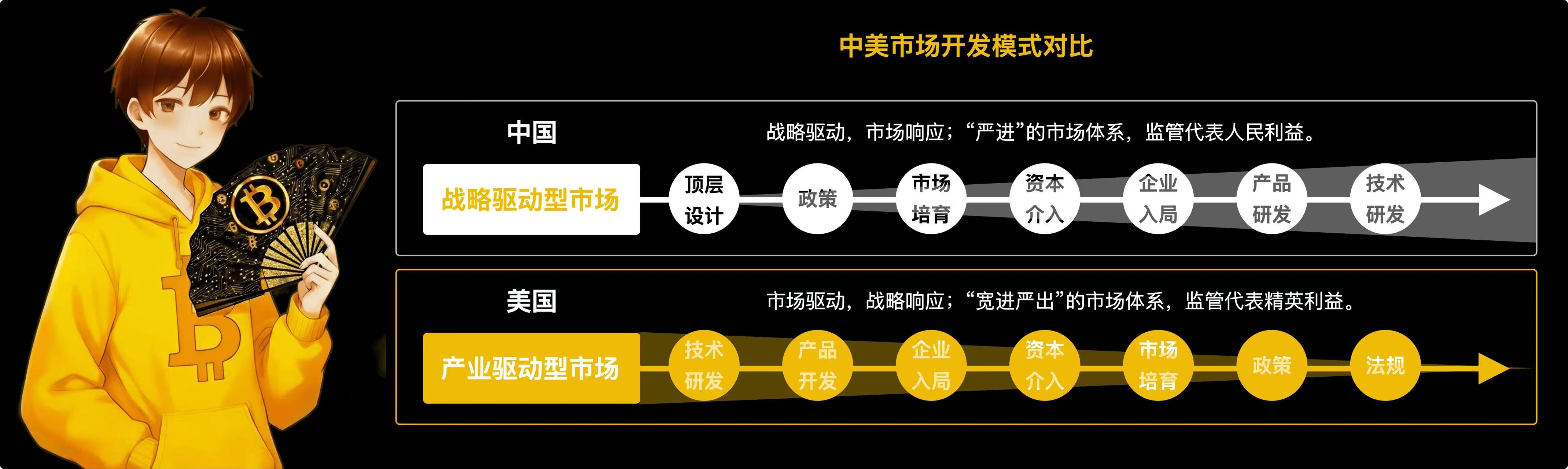
Market differences: China is strategic-driven, while the United States is industry-driven.
Application scenario: China focuses on the metaverse, immersive experiences, and visualization-related industries, while the United States has advantages in infrastructure and the development of the 'on-chain economy'.
The Chinese path
The future growth point of China's economy lies in the digital economy, with Web 3.0 being the key to its development. Currently, the overseas Web 3.0 system still poses certain economic and financial risks. China should play a strategic driving role, improve the regulatory system, and explore a Chinese path for Web 3.0 within a compliance framework.
The past and present of WEB 3.0
The global internet has entered the Web 3.0 era, where the new generation of the internet will be characterized by information aggregation and user value sharing.
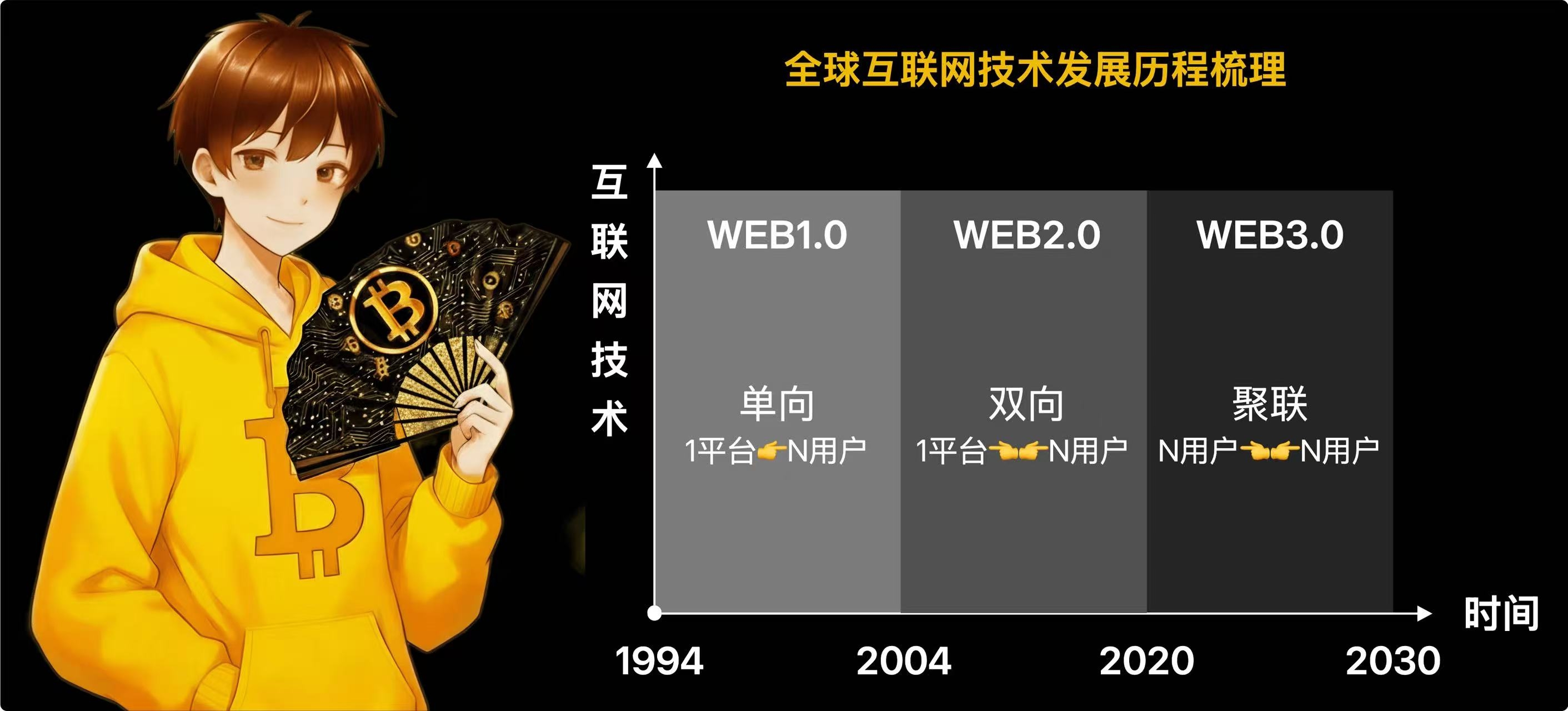
The global internet is currently transitioning from Web 2.0 to Web 3.0.
Two major dilemmas have arisen in the development of Web 2.0:
The internet traffic space has reached its peak, and the traffic dividend is gradually disappearing.
Internet giants exhibit oligopolistic monopolies, with power excessively concentrated, leading to risks in user privacy protection and data ownership.
Web 3.0 triggers the transfer of value to users:
Web 3.0 will address the core issue of concentrated control in most centralized companies during the Web 2.0 era, achieving safe, transparent, and trustworthy value transfer to users.
Main characteristics of Web 3.0:
Users may have higher permissions
Users may profit from the data they own
Integration of the virtual world and the real world
Achieving safe, transparent, and trustworthy value transfer
The boundary between WEB 2.0 and WEB 3.0
The emergence of Web 3.0 has broken many boundaries of the internet ecology in the Web 2.0 era, comprehensively reshaping aspects such as the positioning of the internet, central models, content transmission forms, digital identity management models, user role positioning, and data forms.
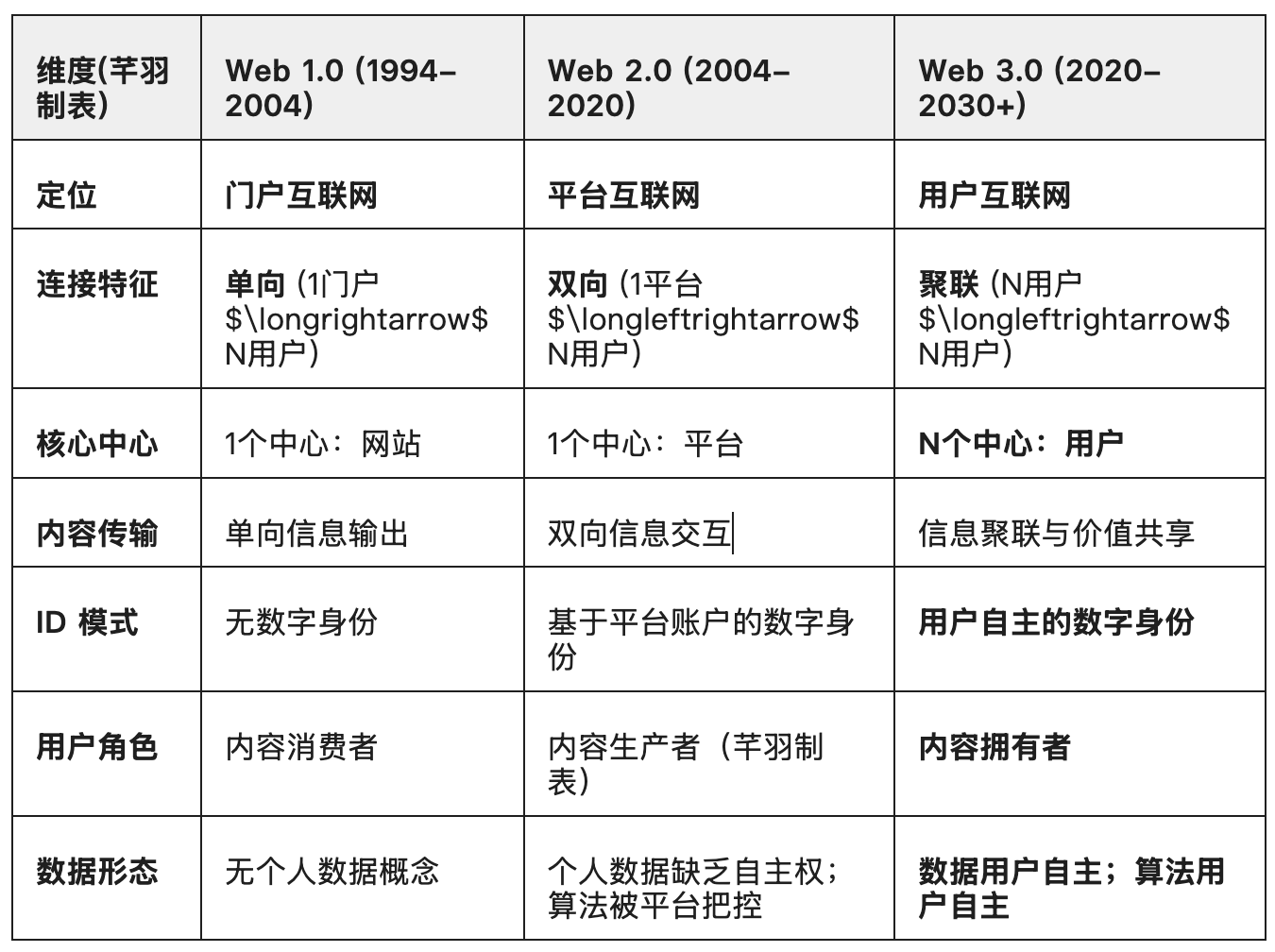
Driving forces behind the development of WEB 3.0: Strategic level
The strategic driver in the United States is the industry, while China should leverage its own strategic-driven market advantages with top-level design as a priority.
The United States is an industry-driven market, adhering to a 'wide entry, strict exit' strategy; thus, Web 3.0 is mainly driven by the industry in the United States, developing in a disordered manner until a certain level is reached, after which regulation is introduced.
China is a strategically driven market because the government represents the interests of the people, adhering to a 'strict entry' strategy. It is appropriate to first clarify the top-level design of Web 3.0, then determine policies and regulations, after which the market will naturally cultivate and develop.
Web 3.0 has become a means for the United States to construct financial discourse power in the virtual world, and China needs to establish its own distinctive Web 3.0 system.
The three-dimensional system that maintains American global hegemony
As a major world power, the United States ensures its global leading position primarily through military, technology, and finance. The financial system, as an important link, has become a crucial means for the United States to maintain its discourse power. The Russia-Ukraine war has led the United States to exclude certain Russian banks from using SWIFT, resulting in some banks turning to the Renminbi cross-border payment system (CIPS).
China needs to establish its own distinctive Web 3.0 system.
The financial system, as an important link in the three-dimensional system, is consolidating the real-world financial settlement system while constructing a financial discourse power system in the virtual world. However, China's digital RMB is essentially still Web 2.0, and a corresponding system needs to be launched to respond.
Let's learn this much for now. My obsessive-compulsive disorder makes creating graphics overwhelming!!!