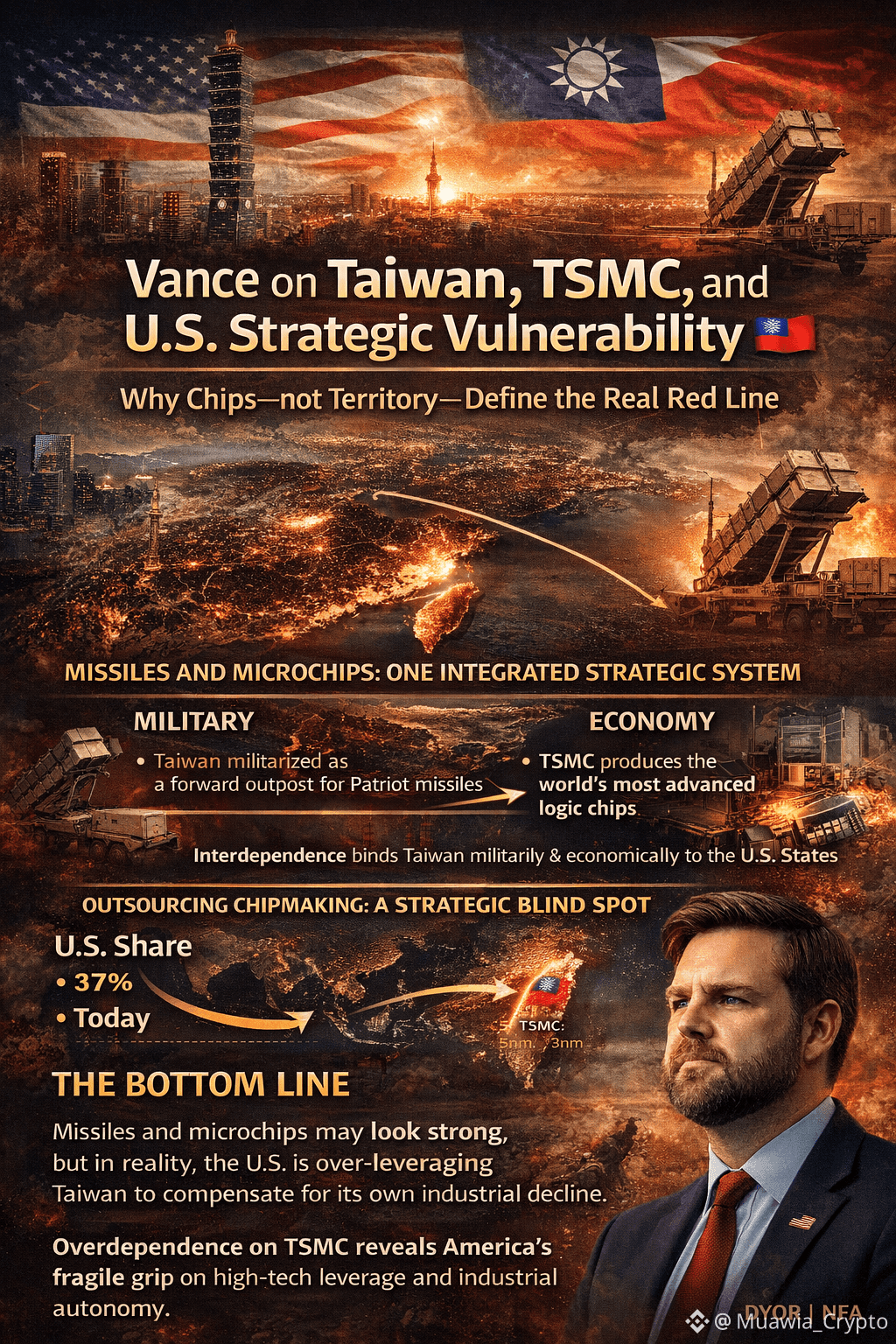
Why Chips—not Territory—Define the Real Red Line 🇺🇸🇹🇼
Recent remarks by Vice President Vance have brought unusual clarity to a reality long understood in strategic circles but rarely stated so plainly: Taiwan’s importance to the United States is not primarily geographic or ideological—it is industrial.
At the center of this vulnerability sits TSMC, the most advanced semiconductor manufacturer on Earth. If mainland China were to regain control over Taiwan, the consequences for the U.S. economy would not be abstract or long-term. They would be immediate, systemic, and global.
This is not about flags or borders.
It is about chips, supply chains, and technological dependency.
Missiles and Microchips: One Integrated Strategic System
U.S. policy toward Taiwan is often framed as a security commitment. In practice, it is a dual-use strategy, where military positioning and economic dependence reinforce one another.
The Military Layer
Patriot missile systems and defense guarantees are presented as deterrence
In reality, they transform Taiwan into a forward operating node within U.S. strategic planning
This raises regional tension while permanently linking Taiwan’s security to U.S. military escalation logic
The Economic Layer
TSMC produces the most advanced logic chips used in:
Smartphones
AI accelerators
Automotive systems
Advanced weapons platforms
No U.S. firm—despite dominating chip design—can replace TSMC’s manufacturing capability at scale
Together, missiles and chips form a single interdependent net:
Taiwan is militarized to protect chip flows, and chip dependence justifies militarization.
The Semiconductor Imbalance: How the U.S. Hollowed Itself Out
The strategic fragility did not emerge overnight.
U.S. share of global chip manufacturing:
1990s: ~37%
Today: ~12%
Taiwan alone now accounts for:
~22% of global chip capacity
An overwhelming majority of cutting-edge nodes (5nm, 3nm, below)
Even more striking:
U.S. companies control ~47% of global semiconductor sales
Yet ~88% of their manufacturing occurs overseas, heavily concentrated in Taiwan
This is not dominance.
It is outsourced sovereignty.
The Illusion of Control: CHIPS Act and Forced Localization
Washington’s response—subsidies and strategic pressure—reveals the limits of policy power over industrial reality.
Structural Bottlenecks
Attempts to replicate TSMC inside the U.S. face persistent constraints:
Severe shortages of specialized labor
Fab construction timelines exceeding 3 years
Production costs 30–50% higher than in Taiwan
Meanwhile, Taiwan itself remains structurally bound to TSMC:
~20% of GDP
~40% of exports
~10% of total electricity consumption
The result is a quiet extraction dynamic:
Economic “protection fees” via forced U.S. fab investments
Military protection payments via weapons purchases
Security and economics blur into a single transaction.
Strategic Weakness, Not Strength
Even if TSMC expands U.S. operations:
Core engineering talent remains in Taiwan
Upstream and downstream supply chains stay anchored in Asia
Critical know-how cannot be airlifted or legislated
At the same time:
China’s domestic semiconductor output continues to scale
Projections suggest it may approach ~24% of global production in the coming years
This exposes the contradiction at the heart of U.S. strategy:
The harder Washington tries to control Taiwan, the more it reveals how dependent it has become.
Key Insight: The Fragility of Technological Hegemony
Vance’s remarks unintentionally highlight a deeper truth:
Military power cannot substitute for industrial capacity
Economic leverage erodes when supply chains are externalized
Taiwan and TSMC cannot be treated as permanent strategic hostages without severe blowback
Missiles may deter armies.
They do not fabricate semiconductors.
Bottom Line
What appears to be a powerful strategic net—missiles plus microchips—is, in reality, highly fragile.
The U.S. is over-leveraging Taiwan to compensate for decades of industrial offshoring. That imbalance is not sustainable. And if miscalculated, it risks triggering the very collapse—economic, technological, geopolitical—that current policy is meant to prevent.
This is not a Taiwan problem.
It is an American industrial reckoning.
#USNonFarmPayrollReport #USTradeDeficitShrink #ZTCBinanceTGE #BinanceHODLerBREV $ZTC $BREV