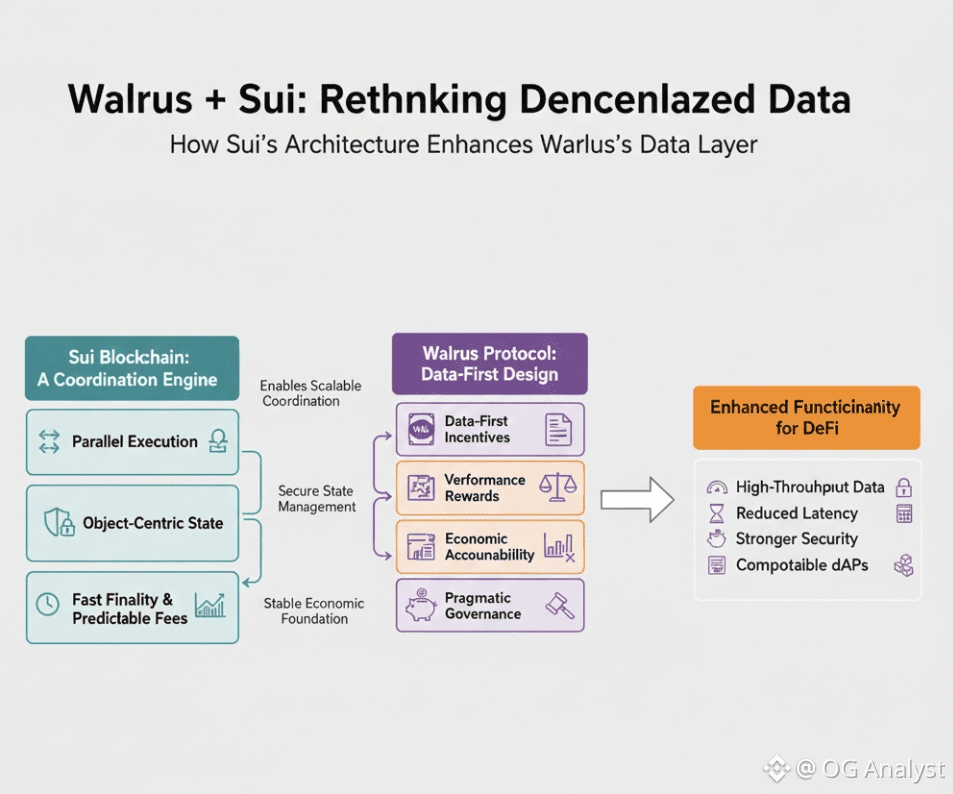
At first glance, Walrus and Sui appear to solve different problems. Walrus focuses on decentralized, verifiable data storage and availability, while Sui is a high-performance Layer 1 optimized for parallel execution and low latency. The integration between the two is not cosmetic; it is structural. Sui provides the execution environment that allows Walrus to operate at scale without sacrificing verifiability, decentralization, or economic clarity.
To understand this enhancement, it helps to move beyond the idea of “blockchain as a ledger” and instead view Sui as a coordination engine for complex data workflows.
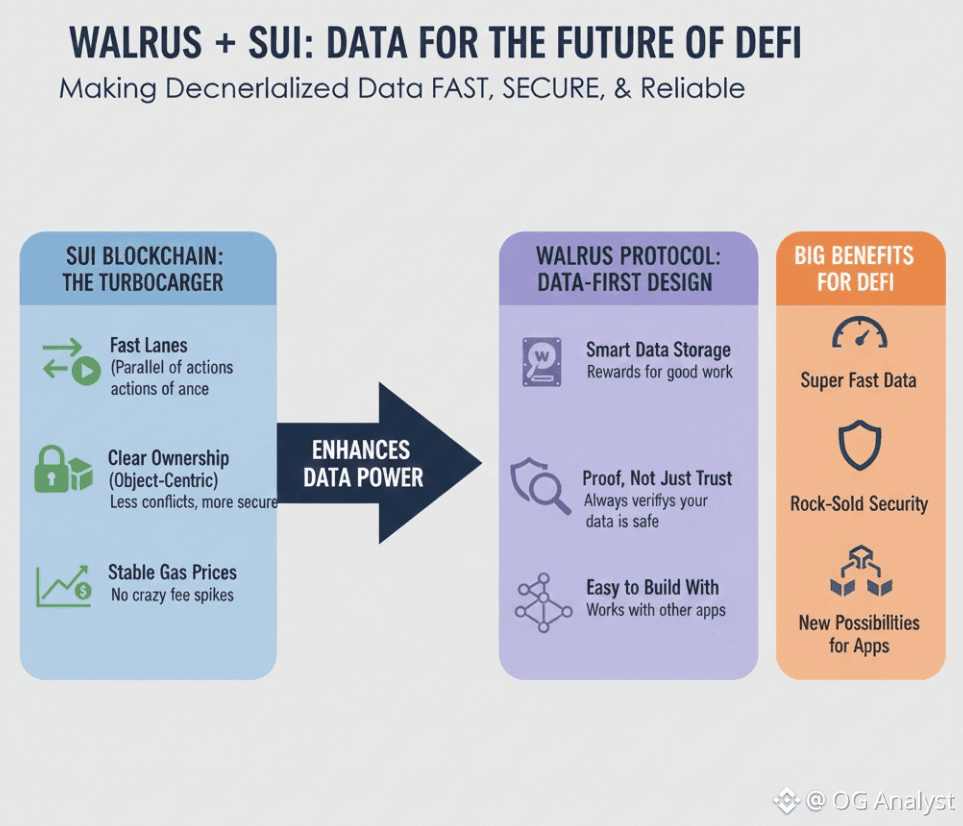
Parallel execution changes how storage coordination works
Traditional blockchains process transactions sequentially. This model is sufficient for simple transfers but becomes a bottleneck when protocols need to coordinate many independent actions at once—such as registering storage commitments, updating availability proofs, or settling payments across multiple nodes.
Sui’s object-centric and parallel execution model allows Walrus to handle these operations simultaneously. Storage providers can post commitments, consumers can verify availability, and WAL-denominated payments can settle without waiting in a global execution queue. This reduces latency and prevents the system from slowing down as usage grows.
For Walrus, this means data availability checks feel closer to infrastructure than finance—fast, predictable, and continuous.
Clear state ownership improves security guarantees
One of Sui’s quieter but most important contributions is its explicit ownership model. Data objects and state transitions have clearly defined owners and access rules. Walrus leverages this to manage storage metadata, availability attestations, and economic balances in a way that minimizes ambiguity.
Instead of relying on shared mutable state—which is a common source of bugs and exploits—Walrus can isolate responsibilities across well-defined objects. This reduces the attack surface and makes incorrect behavior easier to detect and penalize. Security here is not just cryptographic; it is architectural.
WAL benefits from predictable and low-variance fees
Storage systems require long-term planning. Users need to estimate costs not just for today, but for months or years of data availability. Sui’s fee structure, designed for throughput rather than congestion-driven bidding wars, gives Walrus a more stable economic foundation.
This predictability flows directly into WAL’s utility. Payments for storage, renewals, and verification are less exposed to sudden fee spikes. As a result, WAL functions more like a service token tied to measurable protocol activity, rather than a volatile toll subject to network noise.
Faster finality strengthens data verifiability
Data availability is only meaningful if proofs can be finalized quickly. Sui’s fast consensus and low-latency finality allow Walrus to anchor cryptographic commitments on-chain without long confirmation delays.
For developers and downstream protocols—such as rollups, archives, or AI systems—this means fewer assumptions and simpler designs. Data published through Walrus can be relied upon sooner, with stronger guarantees, and without introducing complex off-chain trust layers.
Composability without friction
Because Walrus is deeply integrated into Sui’s execution environment, it becomes natively composable with other Sui-based applications. Smart contracts can reference Walrus-stored data, verify its availability, and trigger WAL-based payments within the same ecosystem.
This reduces integration overhead and encourages more experimental use cases. Walrus is not an external service bolted onto Sui; it behaves like a first-class component of the network’s data layer.
A quieter but more durable synergy
The real enhancement Sui brings to Walrus is restraint. By offloading execution complexity, fee volatility, and state coordination to a blockchain designed for scale, Walrus can remain focused on its core mission: making data verifiable, available, and economically sustainable.
Conclusion
The integration of the Sui blockchain enhances Walrus by giving it room to operate correctly under pressure. Parallel execution enables scale, object-based state improves security, predictable fees stabilize WAL’s economics, and fast finality strengthens trust in data availability. Together, Sui does not redefine Walrus—it allows Walrus to fully express what it was designed to be.