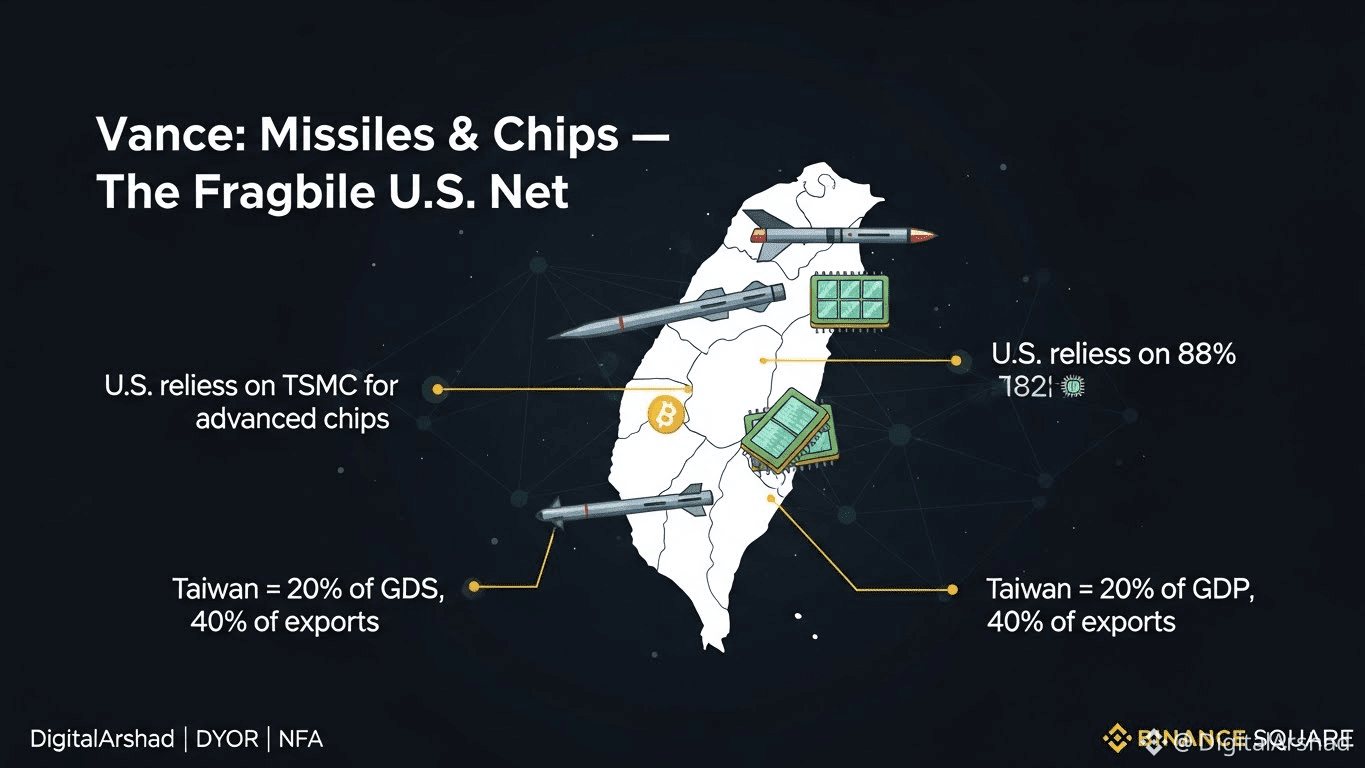
The Vice President of the Trump administration, Vance, recently explained that if mainland China reclaims Taiwan, the U.S. could face serious economic disruption. His key point: the U.S. isn’t just worried about territory—it’s worried about high-tech supply chains, particularly TSMC, the world’s most advanced semiconductor manufacturer.
🔹 Missiles and Chips: Two Sides of the Same Net
Military: Patriot missiles deployed to “protect” Taiwan, but effectively turn it into a frontline outpost, raising defense spending and tying the island’s security to U.S. military strategy.
Economy: TSMC controls critical chip production for smartphones, AI, automotive, and defense systems. U.S. dependence on TSMC makes Taiwan a strategic economic leverage point.
Together, these form a single interdependent net, binding Taiwan militarily and economically to U.S. interests.
🔹 The Chip Crisis
U.S. domestic chip manufacturing has shrunk from 37% → 12% of global production
Taiwan alone accounts for 22% of global chip capacity, much of it cutting-edge (5nm, 3nm)
Even U.S. firms with 47% global chip sales manufacture 88% overseas, largely relying on TSMC
🔹 Attempts at Control
Subsidies (CHIPS Act) and forced TSMC relocations to the U.S. face structural bottlenecks:
Lack of skilled labor
Long construction timelines (3+ years per fab)
Higher costs (30–50% more than Taiwan)
Taiwan’s economy is deeply tied to TSMC: 20% of GDP, 40% of exports, 10% of power consumption
The strategy extracts both economic “protection fees” (through forced investment in U.S. fabs) and military protection payments (through weapons purchases).
🔹 Strategic Weaknesses Exposed
Even if TSMC builds in the U.S., core technologies and supply chains remain in Taiwan/Asia
China’s domestic chip production is rapidly growing and may reach 24% of global output soon
U.S. attempts to dominate Taiwan expose structural vulnerability rather than strength
💡 Key Insight
Vance’s statement demonstrates the fragility of U.S. hegemony:
Military and economic levers are interwoven but unsustainable
Dependency on foreign technology undermines claimed strategic dominance
Taiwan and TSMC cannot be treated as permanent “hostages” without risking U.S. industrial collapse
Bottom line:
Missiles and chips may look like a strong strategic net—but reality shows it is fragile. The U.S. is over-leveraging Taiwan to compensate for its own industrial shortfalls, and this miscalculation could have long-term geopolitical and economic consequences.
DYOR | NFA
✍️ DigitalArshad
#USNonFarmPayrollReport #USTradeDeficitShrink #ZTCBinanceTGE #BinanceHODLerBREV