
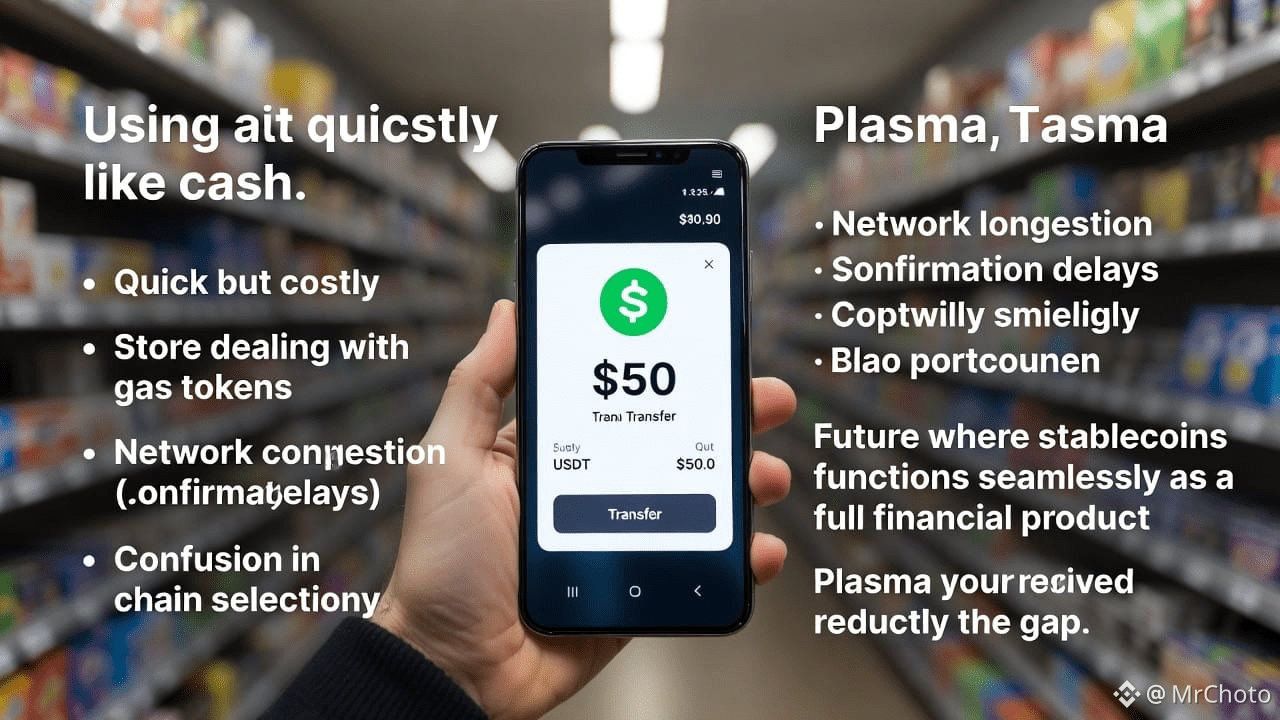
You discover the unsettling reality when you attempt to send stablecoins "like cash" for the first time: although stablecoins are already quick, the rails they run on aren't necessarily designed for payments. One day, a $50 USDT transfer can be quick, and the next, it might be oddly costly. In principle, a store can accept stablecoins, but in reality, they might have to deal with issues like gas tokens, network congestion, confirmation delays, and whether the customer even knows which chain to use. It doesn't feel like money that "just works." It seems like a financial product that still requires technical supervision.
In the future, stablecoins will perform like a full product rather than a clever workaround, and Plasma is working to reduce that gap.
Stablecoins have quietly emerged as the most practical use of cryptocurrencies. They are utilized not only for trading but also for treasury management, cross-border transfers, emerging market payroll, and settlement amongst companies that are crypto-native. The stablecoin economy is now well beyond a niche, executing trillions of transactions annually and surpassing $160 billion, according to even mainstream reporting. However, traders and investors are also aware of the annoying aspect: the majority of stablecoin "adoption" occurs on networks that weren't created specifically for stablecoin payments. Ethereum is strong, but it can be expensive. Tron is inexpensive, but it has trade-offs and ecosystem concerns of its own. Users still encounter friction despite competition from other chains.
The fundamental concept of Plasma is straightforward and useful: create a payment chain in which stablecoins are treated as first-class citizens rather than an afterthought.
#Plasma presents itself as a high-performance Layer 1 designed especially for stablecoin transfers, with near-instant settlement, very low or even zero fees for certain transfers, and full EVM compatibility so developers can use well-known tools, according to its own design documentation and materials. Its emphasis on zero-fee USDT transfers (USD₮), which directly addresses the largest psychological barrier to regular usage—people detest paying fees to shift dollars—is the most eye-catching assertion. Small costs in particular, especially on a regular basis.
This is not a small UX detail. It's the distinction between "interesting" and "normal" stablecoins.
This real-world example helps to make this seem less theoretical. Consider a tiny export company with a buyer in Turkey, a supplier in Vietnam, and a broker in Dubai. Invoices are paid on a weekly or occasionally daily basis. They can already avoid slow correspondent banking routes thanks to stablecoins, but they still have to deal with confusing network choices and unpredictable costs. Operational complexity increases if their settlement system necessitates the possession of a distinct gas token. Fees that increase at the wrong moment create a hidden expense that appears little but adds up over the course of a year. Additionally, the company cannot accept stablecoins as "working capital" with confidence if transaction confirmations are inconsistent.
According to Plasma, more reliable financial process can be achieved by designing the network around stablecoin behavior, such as quick finality, predictable costs, and stablecoin-native fee logic.

Plasma also fits perfectly into a larger 2025–2026 trend from an investment perspective: stablecoins are transitioning from "crypto product" to "payments infrastructure." Major payments and financial companies have openly pushed into stablecoins in the past year. For instance, Klarna plans to provide a dollar-backed stablecoin (KlarnaUSD), which is anticipated to launch in 2026, according to Reuters. Executives' sudden love of crypto culture is not the reason for this. This is taking place because stablecoins address a genuine business issue: transferring wealth inexpensively and internationally.
Thus, the question arises: what will happen if blockchains perceive stablecoins as the main event rather than merely another token standard?
Plasma's "unique angle" is important in this situation. It is not attempting to be a global computer. With EVM compatibility, it aims to create a specialized settlement layer for digital dollars that is developer-friendly, compliance-aware, and optimized for stablecoin throughput. This appears to be an infrastructural play rather than a meme or a short-term narrative trade, so traders should be aware of the strategic parallel.
Not to be overlooked is a credibility indicator. Bitfinex and other well-known companies apparently participated in Plasma's $24 million fundraising round, which was led by Framework Ventures. Although funding does not ensure product success, it is important in infrastructure categories since serious payment networks need distribution, alliances, time, and security effort.
Let's now tackle the challenging aspect: retention.
People in the cryptocurrency space enjoy experimenting with new networks, but they leave unless things get easier. When users must remember too many rules, such as "Use this bridge" or "Hold this gas token," retention suffers. "Wait for confirmations," "Avoid this time window," "Don't transfer on the wrong chain," and "Check fees." Drop-off occurs with each additional step. Additionally, since stablecoins are not meant to be sentimental assets, retention is crucial. Nobody wants to "believe" in a digital currency. They wish to depend on it.

@Plasma Plasma's success won't be due to its sophisticated technology. The reason for this is that the experience is dull in the nicest possible way. Instead of communicating with a blockchain, it will feel like sending money.
Future traders and investors should concentrate on whether the infrastructure will develop to enable stablecoins to function as a default layer of global finance, rather than whether stablecoins will expand (which they currently are). Plasma is an effort to create stablecoins that settle rapidly, move for nearly nothing, and don't require a technical mindset.
The best course of action when assessing Plasma as an opportunity is to avoid both blind skepticism and hype. Mainnet delivery, wallet integrations, liquidity commitments, actual payment flows, and whether users continue to use it after the initial transaction are all important metrics to monitor. Because the chain with the loudest marketing does not win when it comes to payments. People stop thinking about this network because it just works.
The most important conclusion is that "more crypto users" is not the endpoint for stablecoins. There are less reasons to pay any attention to cryptocurrency. Plasma is wagering that the next wave of adoption will occur when stablecoins consistently feel like money. $XPL

