



For a long time, I treated off-chain failures as background noise.
Storage glitches. Provider downtime. “Temporary” unavailability that teams smooth over with retries, mirrors, and support replies. The chain executes correctly, so the system — formally — is still sound.
Walrus forced me to look at where that soundness quietly ends.
On most blockchains, responsibility stops at execution.
A transaction runs.
State updates commit.
Ownership rules resolve exactly as written.
From the protocol’s perspective, the outcome is final.
The moment that outcome points to data living off-chain, Walrus asks a question most systems avoid: who owns the failure if that data can no longer be accessed?
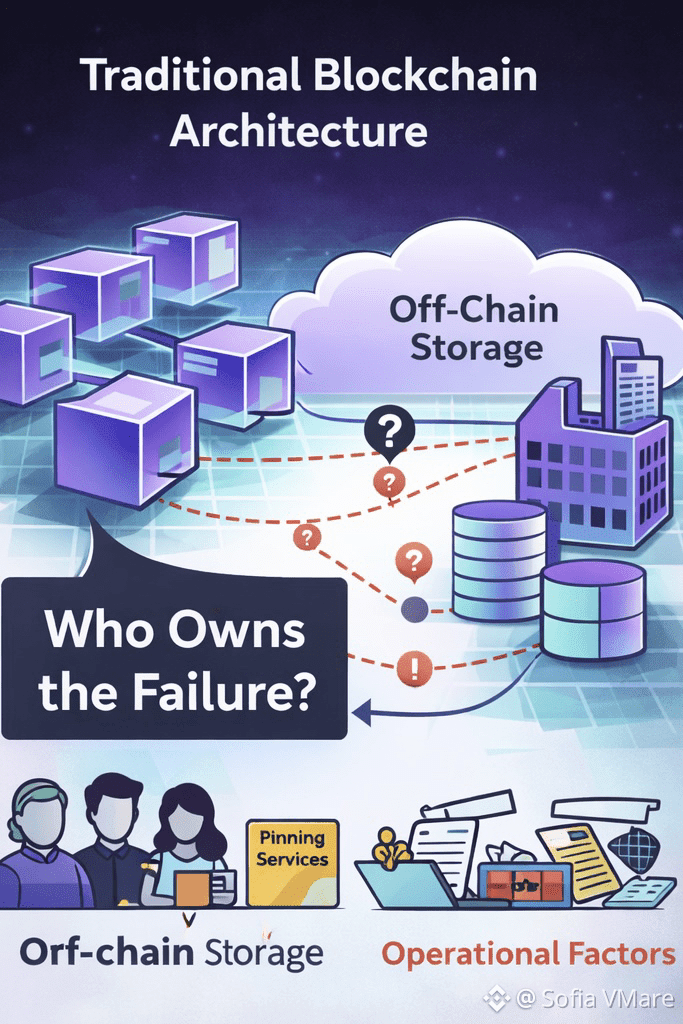
In traditional architectures, no layer explicitly owns that failure.
Contracts are correct.
State is valid.
And yet the application breaks.
At that point, failure slips outside the chain’s reasoning space. Availability becomes an operational concern handled through providers, SLAs, pinning services, and “best effort” guarantees. When access degrades, execution does not react. The chain keeps moving forward, while meaning drains away somewhere else.
This is how off-chain risk actually works:
not as a single failure, but as a displacement of responsibility.
What Walrus changes is not availability itself — it changes where availability is evaluated.
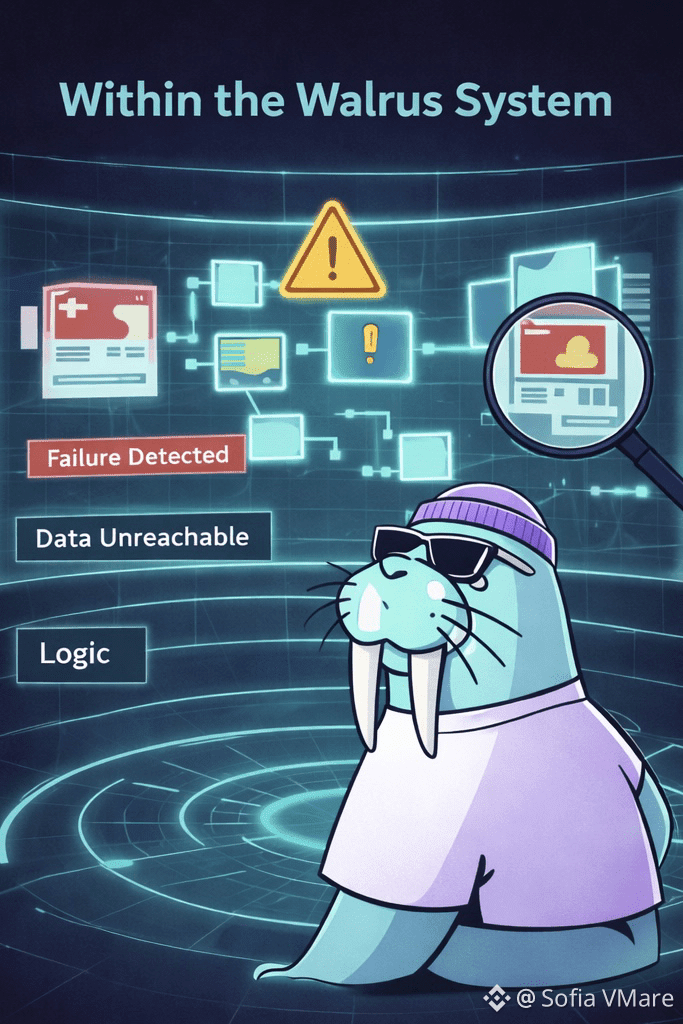
With Walrus, data availability is no longer something the system assumes and later explains away. It becomes a condition the protocol itself can observe. When a Sui application references a blob through Walrus, the question is not whether a storage provider responds. It is whether the network can still reconstruct that data under current participation conditions.
If reconstruction becomes harder, the system knows.
If it becomes impossible, the system knows.
Nothing quietly fails elsewhere.
That difference reshapes responsibility.
Without Walrus, teams compensate after the fact:
fallback logic,
retry loops,
cron jobs,
manual recovery,
support explanations that start with “the infrastructure had an issue.”
With Walrus, those compensations stop being external patches. Failure remains inside the system’s own model of reality. Execution does not proceed under assumptions the protocol can no longer justify.
This is why Walrus is not just another storage integration.
It does not promise perfect uptime.
It does not shift blame onto providers.
It refuses to let availability live in a place the chain cannot reason about.
By keeping reconstruction inside the protocol’s logic, Walrus prevents responsibility from drifting outward. The chain cannot claim correctness while quietly relying on conditions it cannot verify. If data access changes, that change is expressed where execution and state already live.
The system stays honest about what it can still stand behind.
Most off-chain designs are comfortable with being “technically correct” while operationally fragile. Walrus rejects that comfort. It does not eliminate failure — it eliminates ambiguity about who owns it.
I’ve stopped trusting systems where contracts are always right but outcomes keep needing explanations. In practice, that usually means responsibility has already been pushed somewhere invisible.
Walrus keeps failure where it can be seen, reasoned about, and accounted for — inside the system itself.
And once responsibility stops drifting, off-chain risk finally has a place to live.