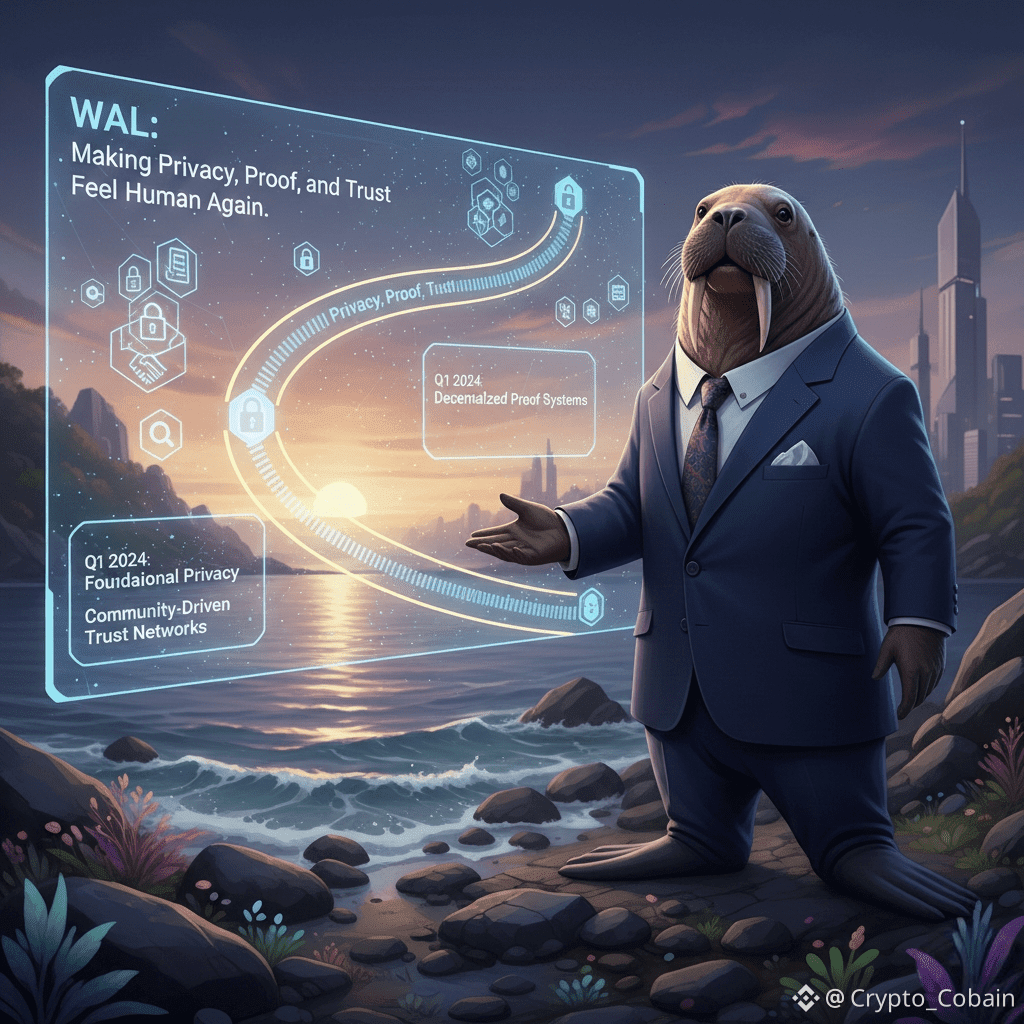
For a long time, the digital world has forced us into uncomfortable trade-offs. If we want convenience, we give up privacy. If we want transparency, we expose sensitive information. If we want trust, we rely on middlemen and promises instead of real proof. Most people don’t think about this every day, but they feel it—when data leaks happen, when platforms change rules overnight, or when AI systems make decisions nobody can clearly explain. @Walrus 🦭/acc (WAL) exists because this situation is no longer good enough.
The old problem is simple but serious: data is fragile and trust is expensive. Information usually sits in centralized servers controlled by a few entities, and everyone else just hopes they behave well. When something breaks, users pay the price, not the system. This matters because data now drives money, identity, AI, healthcare, and even laws. If the foundation is weak, everything built on top becomes risky.
#walrus approaches this problem with a calm, grounded idea: you should be able to prove something is true without showing everything. In real life, we already do this. You can prove you’re old enough to enter a building without showing your entire ID history.Walrus brings this same common-sense logic to blockchain, data storage, and digital interactions. It’s not about hiding; it’s about sharing only what is necessary.
At a technical level, Walrus is built on the Sui blockchain and focuses on decentralized, privacy-preserving storage and transactions. Instead of storing large files in one place, Walrus breaks them into pieces and spreads them across many nodes using erasure coding and blob storage. Think of it like storing a valuable document by tearing it into parts and locking each part in a different vault. No single vault tells the full story, but together they guarantee the document is real and unchanged.
This design has two powerful effects. First, it makes censorship and data tampering extremely hard. Second, it lowers costs by efficiently using storage across the network. For users, this means they don’t have to choose between security and affordability. For developers and companies, it means they can build serious applications without relying on fragile centralized infrastructure.
Institutions are especially interested in this kind of setup, even if they don’t always talk about it publicly. Consider a financial institution that needs to prove to regulators that it holds enough reserves. Today, this often means sharing sensitive internal data or hiring expensive auditors. With Walrus, the institution can store encrypted records and provide cryptographic proofs that the numbers add up—without revealing customer details or internal strategies. The regulator gets confidence, and the institution keeps its privacy.
Another example is in supply chains. Imagine a global manufacturer that needs to prove where materials came from and that standards were followed. Instead of publishing all supplier contracts and internal documents, the company can store verified records on Walrus and later prove authenticity and timelines. Partners and regulators can verify claims without seeing confidential business information. This saves time, reduces disputes, and builds trust across borders.
AI is where the lack of trust is becoming most visible. Models are trained on massive datasets, yet people often don’t know where that data came from or whether it was used responsibly. Walrus helps solve this by creating verifiable data provenance. A dataset can be stored and timestamped on the network, allowing anyone to later confirm that a model was trained on that exact data. This matters when copyright, bias, or ethical questions come up.
Another AI use case is accountability over time. AI models change constantly—new versions, fine-tuning, updated rules. When an AI system makes a harmful decision, organizations often struggle to prove which version was active at that moment. With Walrus, model checkpoints and configurations can be stored immutably. If questions arise, there is a clear, verifiable record instead of confusion and finger-pointing.
Regulators are also quietly facing a crisis of tools. Laws move slowly, but digital systems move fast. By the time a report is filed, the reality may already have changed. Walrus enables something closer to real-time compliance. Instead of periodic disclosures, systems can continuously prove they are following rules. This doesn’t mean more control—it means better alignment between innovation and oversight.
For example, a regulated DeFi platform can prove that it follows transaction limits or reserve requirements at all times without exposing user identities. Regulators gain visibility into system health, while users retain privacy. Over time, this kind of setup could reduce sudden bans, heavy-handed enforcement, and reactive regulation. Everyone benefits from clearer signals and fewer surprises.
The WAL token plays a practical role in this ecosystem. It is used to pay for storage, verification, and network services, while storage providers earn WAL for contributing resources. This creates a straightforward economic loop: users pay for what they use, and providers are rewarded for keeping the network reliable. As demand for secure and private data grows, the value of this utility grows with it. It’s not about hype—it’s about usage.
Governance is another quiet strength of the Walrus protocol. Token holders can participate in decisions about upgrades, parameters, and long-term direction. This doesn’t mean endless debates or chaos. It means the system can evolve without depending on a single company or authority. Over time, this shared responsibility builds trust in a way closed systems rarely achieve.
What makes Walrus feel different is that it respects human reality. People make mistakes. Companies change. Laws evolve. Walrus doesn’t assume perfection; it assumes the need for proof, flexibility, and resilience. It reduces the need for blind trust and replaces it with quiet verification.
Imagine a future where companies don’t need to overshare to be trusted, where AI systems can explain their past, and where regulators can oversee complex systems without slowing them down. Walrus fits naturally into that future, not as a flashy product, but as infrastructure. Like good roads or reliable electricity, its success may be invisible—but deeply felt.
In the end,Walrus is not trying to reinvent everything. It’s trying to fix something fundamental: how we store data, prove truth, and protect privacy at the same time. If the next generation of the internet is built on trust that can be verified rather than promised, Walrus has a real chance to become part of that foundation.