
Walrus has been showing up more often in developer conversations lately, usually in the same breath as long-term storage, data availability, and the Sui ecosystem. I first came across it not through announcements, but through code discussions and quiet references in technical docs. That context matters, because Walrus is not a consumer-facing product yet. It is infrastructure, and it behaves like infrastructure in both good and inconvenient ways.
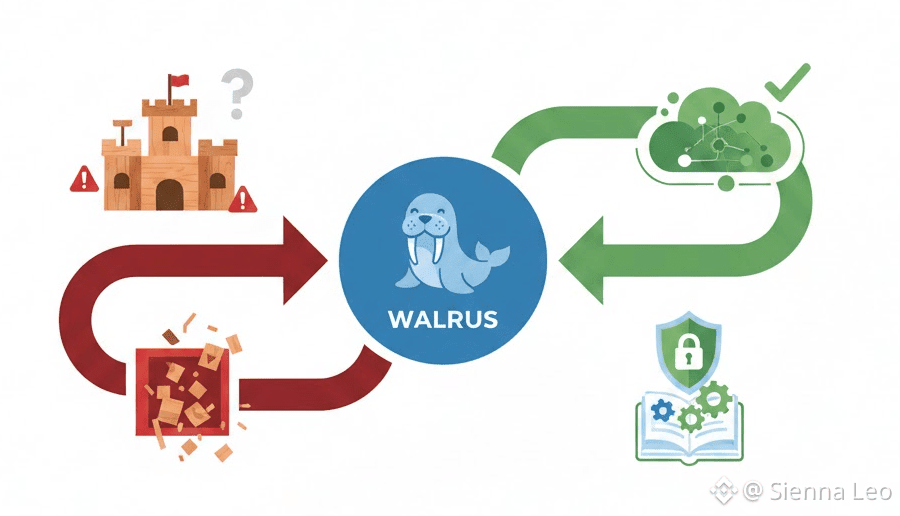
At its core, Walrus is a decentralized storage protocol designed to handle large binary objects, often called blobs. Instead of treating data as something that lives directly on a blockchain, Walrus separates storage from execution. It stores data off-chain but anchors it to the Sui blockchain for verification and access control. That design choice keeps blockchains from being overloaded while still preserving integrity and traceability.
The project grew out of a very practical problem. Modern decentralized applications, especially games, media platforms, and AI-related tools, generate far more data than a traditional blockchain can comfortably store. Walrus attempts to fill that gap by offering scalable storage that still fits into a crypto-native trust model. In that sense, it sits somewhere between raw cloud storage and fully on-chain data, borrowing ideas from both without fully imitating either.
For developers, the appeal is fairly straightforward. Walrus allows large files to exist without bloating the chain, while still being addressable, verifiable, and permissioned through smart contracts. This makes it suitable for NFTs with actual media content, long-lived application state, or datasets that need to persist beyond a single transaction lifecycle. If you are building on Sui, Walrus feels less like an optional add-on and more like a missing layer being filled in.
Users interact with Walrus more indirectly. Most people will not upload files to Walrus manually. They will encounter it through applications that rely on it for storing assets, histories, or user-generated content. From a user perspective, Walrus is about reliability and access. If an app uses Walrus properly, data should remain available even if the original developer disappears. That is the promise, at least.
Where things get more complicated is in the trade-offs. Walrus is still young, and its guarantees depend heavily on the network of storage nodes that participate. Decentralized storage only works if enough independent operators are maintaining the data honestly and consistently. In early stages, that decentralization is often thinner than it appears on paper. Developers need to factor that reality into how critical their stored data really is.
There are also cost considerations that are easy to overlook. Storing large blobs for long periods is not free, even in decentralized systems. Walrus introduces economic assumptions about pricing, incentives, and renewal that developers must understand clearly. Data persistence may require ongoing payments or re-commitments, and applications that ignore this can end up with silent failures months later.
Another limitation is composability. While Walrus integrates well with Sui, it does not automatically integrate with every other chain or ecosystem. Cross-chain access to Walrus-stored data introduces complexity and sometimes defeats the simplicity that made the system appealing in the first place. Developers building multi-chain tools need to be realistic about these boundaries.
Security also deserves a sober look. While data integrity is verifiable, availability is probabilistic. Walrus is not the same as a personal hard drive or a centralized cloud provider with service-level guarantees. It relies on economic incentives rather than contractual obligations. That difference matters when storing data that users emotionally or legally depend on.
Looking forward, Walrus could become a quiet but essential layer for data-heavy decentralized applications, especially as on-chain execution continues to prioritize efficiency over storage. It is unlikely to be flashy, and that may be its strength. Infrastructure that works well tends to fade into the background.
For now, Walrus rewards careful engagement. It is useful, promising, and thoughtfully designed, but not magical. Understanding its limits is just as important as understanding its capabilities, and that balance is usually where the real long-term value lives.


