

When people evaluate blockchain projects, attention usually gravitates toward price action, narratives, and surface-level metrics. Infrastructure tends to stay in the background quiet, technical, and largely ignored. Yet in decentralized storage networks, infrastructure is not a supporting character; it is the story. In the case of Walrus Network, storage nodes form the foundation that determines whether the protocol can scale, remain reliable, and sustain real-world usage over time.
This article reframes @Walrus 🦭/acc not as a token or a speculative asset, but as a functioning system one where storage nodes act as economic actors, security providers, and availability guarantees all at once.
Walrus Network at a Systems Level
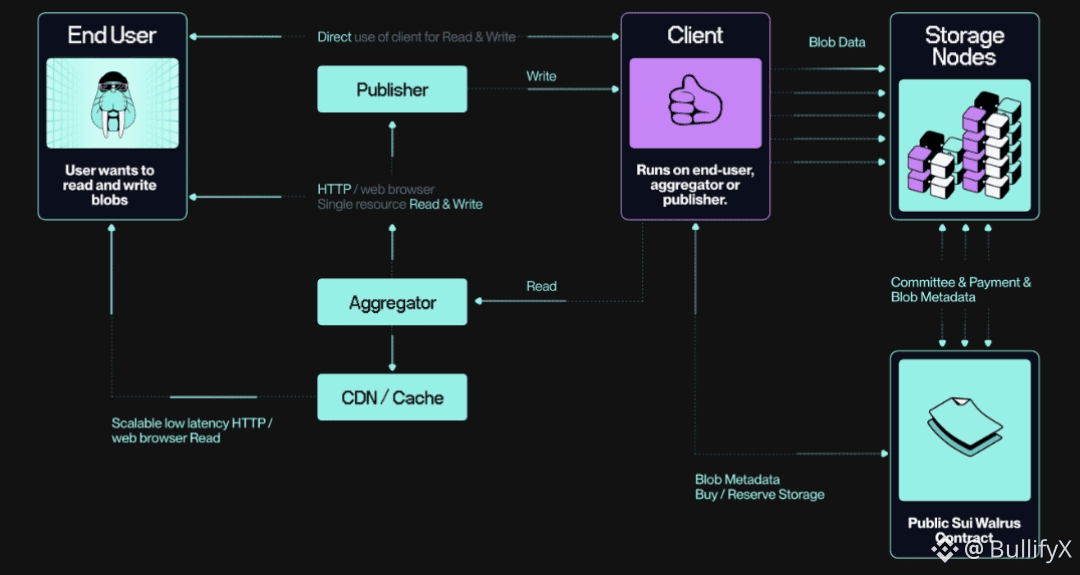
Walrus is a decentralized storage and data availability protocol built on Sui. Its core objective is straightforward: make data reliably available without relying on centralized servers. Achieving this goal, however, requires far more than simply distributing files across machines. It requires incentives, cryptographic guarantees, fault tolerance, and continuous coordination between independent operators.
This is where storage nodes enter the picture.
What Storage Nodes Actually Do (Beyond “Storing Data”)
At a basic level, Walrus storage nodes provide disk space and bandwidth. But reducing their role to that description misses the deeper mechanics involved.
Each node participates in a coordinated system where data is:
Split into fragments
Encoded using redundancy mechanisms
Distributed across multiple independent operators
No single node holds complete data in isolation. Instead, availability emerges from cooperation. Even if several nodes go offline, the system remains functional because enough fragments still exist elsewhere to reconstruct the original data.
This design shifts reliability away from trust in individual operators and toward mathematically enforced resilience.
Incentives: Why Nodes Behave Honestly
Decentralized systems fail without proper economic alignment. Walrus addresses this by tying node behavior directly to capital at risk.
Storage nodes must stake $WAL as a security commitment. This stake serves two purposes:
Guarantee of reliability – Nodes are financially motivated to maintain uptime and performance.
Penalty mechanism – Failure to serve data or dishonest behavior can result in slashing.
In return, nodes earn:
Ongoing protocol rewards
Fees paid by users and applications storing or retrieving data
This creates a closed-loop economy where network usage feeds directly into node revenue, and node reliability feeds back into user trust.
Why Node Performance Matters to Token Value
For long-term participants, token value is inseparable from network utility. Walrus ties demand for $WAL to actual usage rather than abstract governance promises.
When data storage demand increases:
More fees are paid in $WAL
More nodes are incentivized to join
More stake is locked for security
This dynamic links adoption, scarcity, and yield into a single system. In other words, the network does not rely on speculation alone; it monetizes utility.
Decentralization as a Practical Advantage, Not a Slogan
Decentralization often sounds ideological, but in storage networks it has concrete consequences.
A highly centralized storage system introduces:
Single points of failure
Censorship risk
Operational fragility
Walrus counters this by encouraging geographically and operationally diverse nodes. Independent operators across different regions reduce correlated failures and prevent any single entity from exerting control over data availability.
For enterprises or applications storing critical data, this diversity is not philosophical—it is risk management.
Fault Tolerance Through Redundancy and Erasure Coding
Walrus integrates redundancy at the protocol level. Data is fragmented and encoded so that only a subset of pieces is required for reconstruction.
Practically, this means:
Temporary node outages do not interrupt access
Maintenance or upgrades do not halt availability
Network reliability can be mathematically verified
For users and investors alike, this is a measurable strength. Uptime is not promised—it is engineered.
Transparency and Observability
One of Walrus’ underappreciated strengths is observability. Node operators have access to dashboards that show:
Uptime metrics
Storage contribution
Earnings and penalties
At the same time, token holders can evaluate network health through on-chain data rather than marketing claims. This transparency reduces information asymmetry and allows informed participants to assess risk realistically.
Why Infrastructure Outlasts Market Cycles
Markets rotate. Narratives change. Attention moves on. Infrastructure, however, compounds quietly.
Protocols that survive multiple cycles tend to share one trait: their underlying systems continue working regardless of price. Walrus’ node-centric design reflects this philosophy. By aligning incentives, enforcing accountability, and distributing risk, the network prioritizes longevity over short-term hype.
A Simple Real-World Scenario
Imagine a company storing sensitive operational data. In a centralized system, downtime or policy changes could instantly block access. In Walrus, data fragments live across many independent nodes. Even if several operators fail, the data remains accessible.
That resilience is the difference between theoretical decentralization and functional reliability.
Final Thoughts
Storage nodes are not a peripheral feature of Walrus Network—they are its core. Their economic incentives, geographic distribution, and technical responsibilities collectively determine whether the protocol can support real adoption.
For traders, nodes signal network health.
For investors, they represent sustainable value creation.
For users, they provide reliability without trust.
#Walrus demonstrates that decentralized storage succeeds not through abstraction, but through disciplined infrastructure design. Understanding this layer is essential for anyone evaluating the protocol beyond surface-level metrics.

