
@Walrus 🦭/acc | #walrus | $WAL
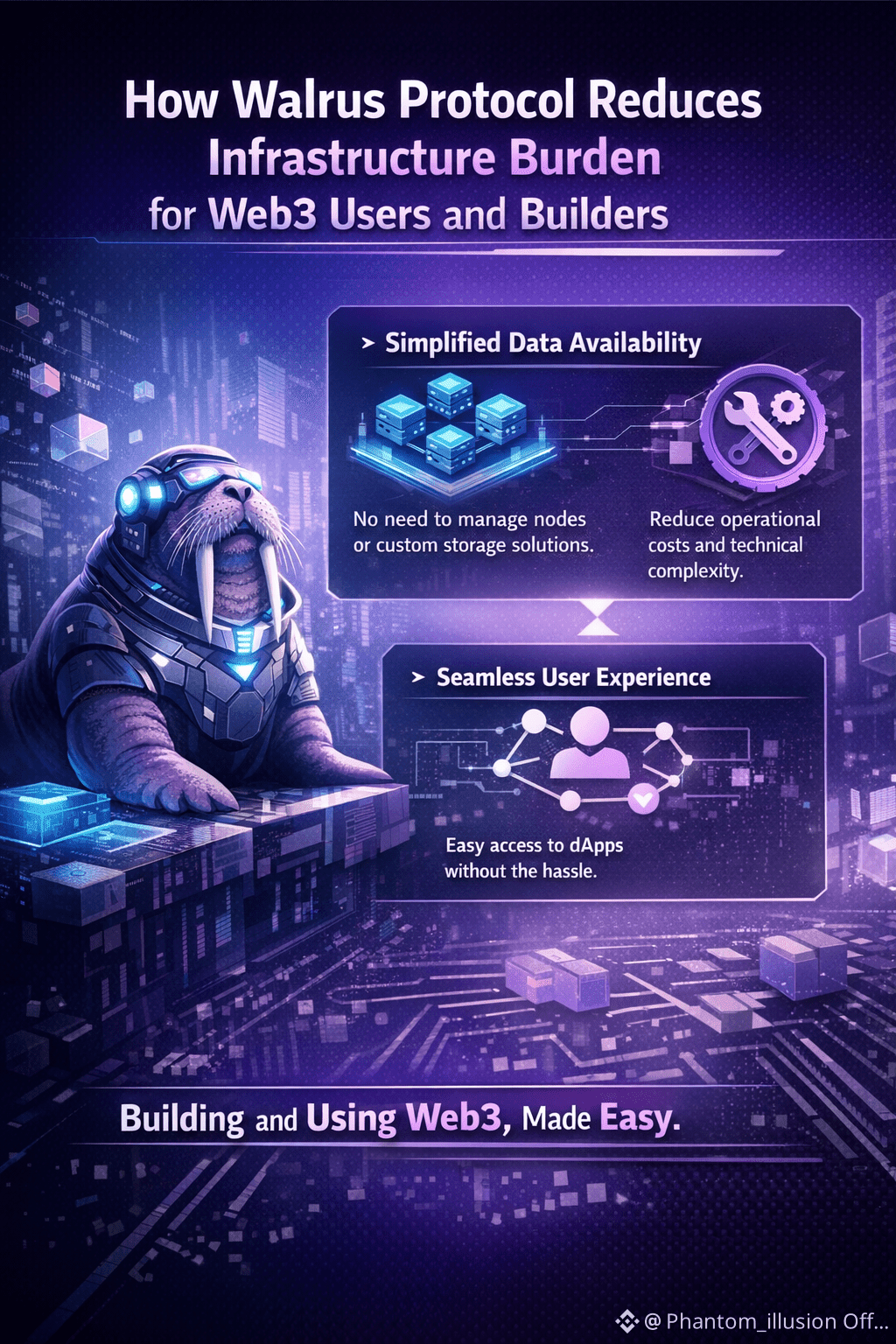
If you’ve ever dabbled in Web3, you know it comes with a lot of excitement but also a lot of complexity. Managing wallets, handling smart contracts, ensuring data security, and scaling applications can quickly become overwhelming for both users and developers. That’s where Walrus Protocol steps in, aiming to simplify the Web3 experience by taking the heavy infrastructure lifting off your shoulders.
So, how does it actually work? Let’s break it down.
1. Making Onboarding Seamless for Users
One of the first hurdles in Web3 is onboarding. For new users, creating wallets, securing private keys, and funding accounts can be a major barrier. Walrus Protocol reduces this friction by abstracting away much of the underlying blockchain complexity. Users can interact with decentralized apps (dApps) without worrying about technical details like gas fees or wallet setups. Essentially, it acts like a bridge, letting users experience Web3 without the steep learning curve.
2. Simplifying Infrastructure for Developers
Building on Web3 traditionally requires setting up nodes, managing APIs, and ensuring your smart contracts are robust and scalable. Walrus Protocol provides a layer that handles many of these backend tasks automatically. Developers can focus on the creative side of building dApps, while Walrus takes care of infrastructure challenges like transaction processing, storage management, and network reliability. This means faster deployment, fewer bugs, and a more predictable user experience.
3. Cost and Resource Efficiency
Running your own blockchain infrastructure is expensive and resource-intensive. Walrus Protocol optimizes resource usage by offering shared infrastructure that scales with demand. For small teams or solo developers, this is a game-changer it eliminates the need to maintain costly servers or complex cloud setups, all while ensuring that apps remain responsive even under heavy usage.
4. Enhanced Security and Reliability
Security in Web3 is notoriously tricky. Users and developers alike can be vulnerable to exploits if infrastructure isn’t handled properly. By managing core infrastructure components, Walrus Protocol adds a layer of reliability and security. Its system is designed to handle common attack vectors and network hiccups, so developers don’t have to constantly monitor nodes or worry about downtime.
5. A Focus on Innovation
At its core, Walrus Protocol frees developers and users from the “plumbing” of Web3. This allows everyone to focus on what really matters: building innovative applications and experiences. For developers, that might mean creating new DeFi protocols, NFTs, or social apps. For users, it means smoother interactions and more intuitive access to Web3 functionality.
In short, Walrus Protocol acts like a scaffolding for Web3 you still get all the benefits of decentralized technology, but without the headache of building and maintaining the heavy infrastructure yourself. By simplifying onboarding, optimizing resources, enhancing security, and freeing developers to innovate, it’s making Web3 more accessible, scalable, and user-friendly.
For anyone looking to dive into the decentralized world without getting bogged down in technical burdens, Walrus Protocol is starting to feel less like a tool and more like a trusty guide.

