


I didn’t understand Fogo until I caught myself hesitating.
It was during a volatile session. Nothing dramatic — just the usual fast tape, spreads tightening, liquidity shifting. I went to execute and, without thinking, I sized a little smaller than I wanted to.
Not because of market direction.
Because of settlement uncertainty.
That’s when it clicked.
I wasn’t just trading the asset. I was trading around the chain.
That realization bothered me more than any temporary loss ever has.
For years, we’ve talked about on-chain trading like it’s just a better venue — transparent, composable, programmable. But under the surface, most traders quietly price in latency risk. We factor in confirmation delay. We assume occasional congestion. We build caution into our flow.
It becomes muscle memory.
When I started looking deeper at Fogo, what stood out wasn’t the 40ms block time headline. It was the obsession with coordination.
It runs on the Solana Virtual Machine — so execution is already capable. That part isn’t new. But execution speed alone doesn’t solve timing anxiety.
Consensus does.
Multi-Local Consensus is Fogo’s answer to that tension. Validators aren’t scattered globally in a way that maximizes distance. They’re coordinated in zones. Communication paths are shorter. Agreement cycles are tighter.
At first, I saw that as a decentralization compromise.
Now I see it as a performance philosophy.
Because if your use case is latency-sensitive — high-frequency DeFi, real-time settlement, serious trading — then worst-case coordination delay matters more than ideological purity.
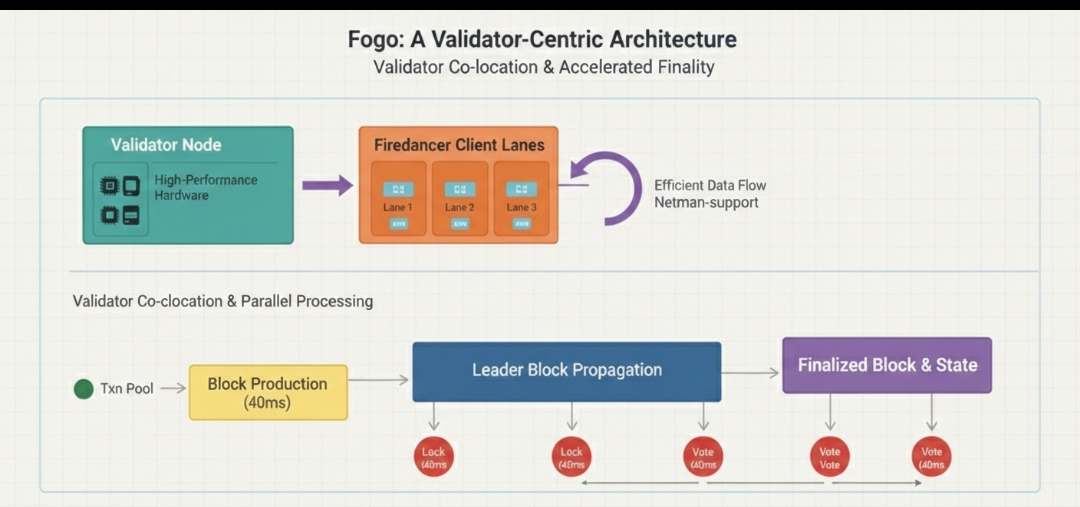
The other piece that shifted my perspective was the Firedancer-only validator model.
Most chains diversify clients for resilience. Fogo narrows to optimize. That’s not a safe choice. It’s a focused one.
Firedancer is engineered for hardware-level efficiency. Cleaner packet handling. Lower jitter. Deterministic performance under load. It feels less like “crypto infra” and more like something designed with exchange-grade systems in mind.
And when you combine that with geographic clustering, something interesting happens:
The network stops feeling fragile.
Not invincible. Just stable.
That stability changes behavior.
When I imagine deploying size on Fogo, I don’t automatically discount execution reliability the way I subconsciously do elsewhere. That doesn’t mean I trust it blindly. It means I don’t instinctively brace for variance.
That’s a subtle but powerful shift.
I still have questions.
Will liquidity consolidate there?
Will institutions actually lean into the model?
Can a narrower validator philosophy coexist with crypto’s decentralization culture long term?
Those aren’t small uncertainties.
But what I respect is that Fogo isn’t pretending to be universal infrastructure. It’s not chasing NFT hype or social experiments or governance theater. It feels engineered for environments where milliseconds influence outcome.
That’s not the loudest lane in crypto.
But it might be one of the most economically serious ones.
The day I realized I’d been pricing in latency risk changed how I look at every L1.
Now I ask: when things get chaotic, does the chain stretch?
Fogo’s bet is that it won’t.
And if that holds true under real stress — not just demos — then it’s not just another fast chain.
It’s one that quietly changes how traders think.