


Walrus Protocol is a decentralized data storage and availability network designed to support large-scale, data-heavy blockchain applications. As Web3 evolves beyond simple transactions into AI, gaming, social platforms, and advanced DeFi systems, blockchains face increasing pressure from data that cannot be efficiently stored or verified on-chain. Walrus directly addresses this challenge by providing a high-throughput, verifiable storage layer that integrates natively with the Sui blockchain.
Rather than competing with execution layers, Walrus complements them. It allows blockchains to remain fast and cost-efficient while still supporting applications that rely on massive datasets, frequent updates, and long-term data persistence.
Technical Architecture
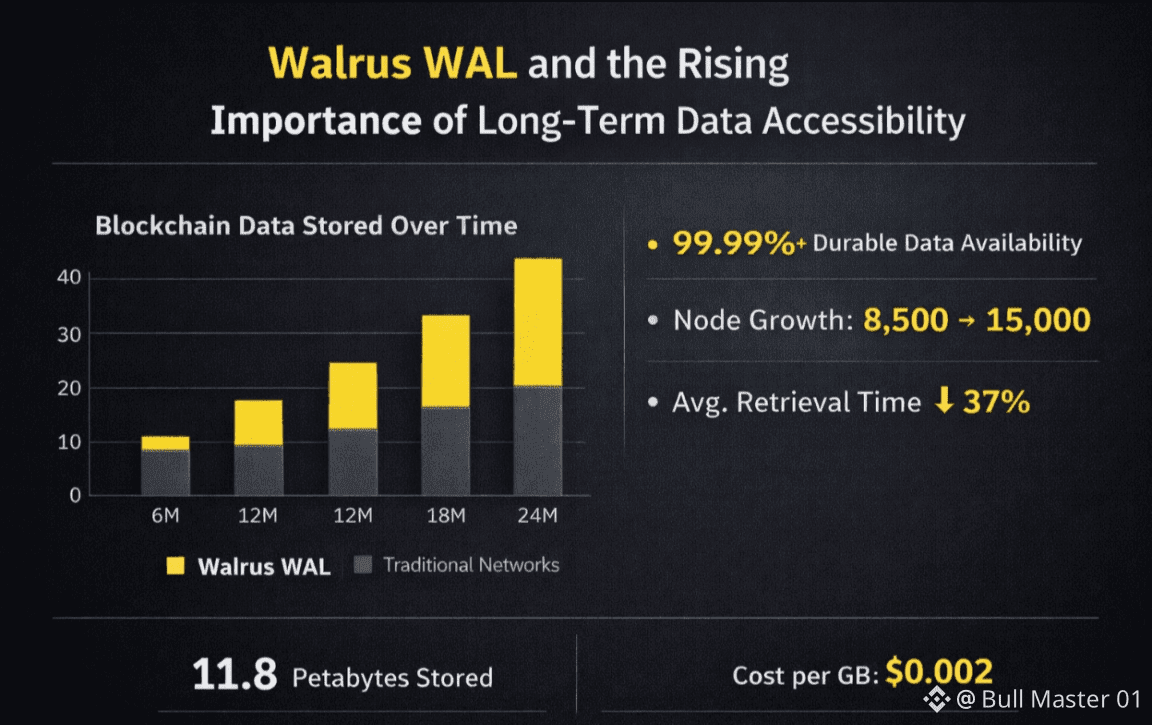
Walrus is built around erasure-coded blob storage, a method that breaks large data objects into fragments and distributes them across a decentralized set of storage operators. Only a subset of these fragments is required to reconstruct the original data, ensuring high availability even during node failures or network disruptions.
What distinguishes Walrus from traditional decentralized storage systems is its tight integration with Sui. Storage commitments, availability proofs, and verification metadata are published on-chain, enabling applications to independently verify that their data exists, is intact, and remains accessible. This eliminates reliance on trust assumptions and external service guarantees.
The protocol is optimized for parallel verification, allowing multiple data checks to occur simultaneously. This design aligns with Sui’s object-centric execution model and makes Walrus suitable for applications requiring low latency and high concurrency.
Programmable and Verifiable Storage
Walrus introduces programmable storage logic, enabling developers to define rules around how data can be accessed, updated, or referenced over time. Stored data is not static; it can evolve alongside the application without requiring repeated full uploads.
This capability enables:
Smart contracts to reference off-chain data with cryptographic assurance.
Applications to maintain historical records that remain auditable.
Systems to manage large datasets while preserving deterministic verification.
For developers, this means data becomes a first-class component of application design rather than an external dependency.
The WAL Token Economy
The WAL token is central to the Walrus ecosystem. It functions as the economic coordination layer between users, storage operators, and governance participants.
Key roles of WAL include:
Storage Fees: Users pay WAL to store data for defined durations.
Staking: Storage operators stake WAL to participate in the network.
Incentives and Penalties: Reliable operators earn rewards, while failures can result in slashing.
Governance: WAL holders vote on protocol parameters such as pricing, redundancy levels, and upgrade paths.
This model ensures that network reliability is economically enforced rather than socially assumed.
Storage Operators and Network Security
Storage operators are responsible for maintaining data fragments and responding to availability challenges. Their performance is continuously evaluated through cryptographic proofs posted on-chain.
This approach creates:
Strong incentives for uptime and correctness.
Measurable service quality.
A competitive environment that discourages centralization.
Because operators must stake WAL, malicious or negligent behavior carries real economic consequences.
Use Cases Across Web3
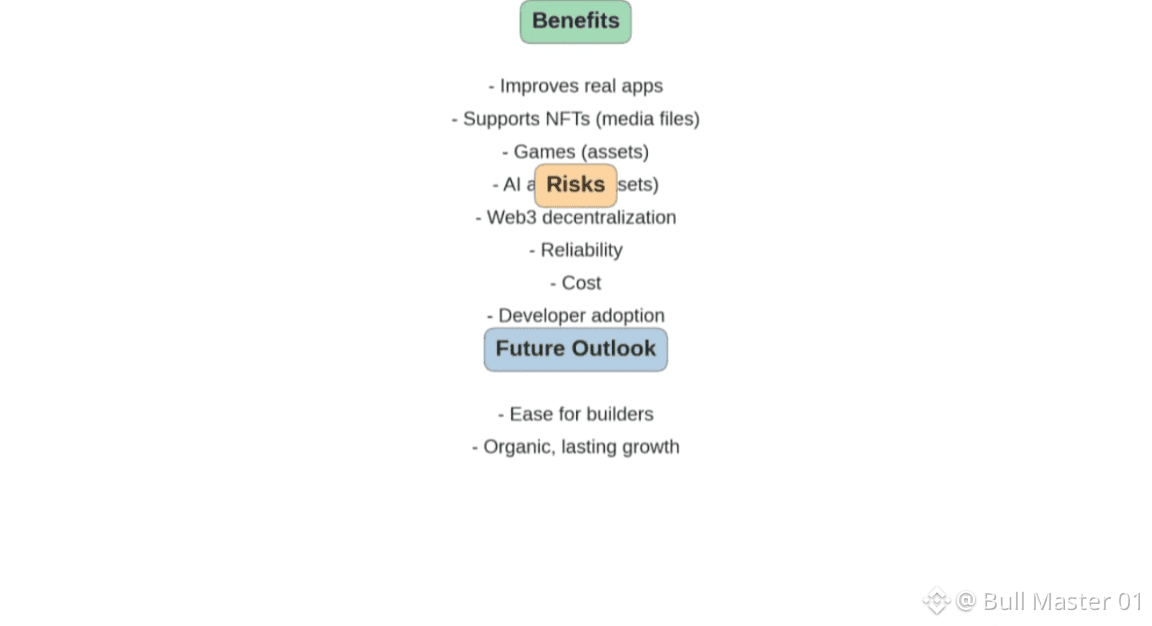
Walrus is designed for applications where data scale and verifiability are critical:
Artificial Intelligence
AI systems can store training datasets, inference outputs, and model checkpoints with verifiable integrity. This enables decentralized AI workflows where data provenance and reproducibility matter.
Gaming and Metaverse
Games can store world states, assets, and player history without centralized servers. Persistent environments become possible without sacrificing decentralization.
DeFi and Financial Infrastructure
Walrus enables storage of audit trails, historical pricing data, compliance records, and off-chain computations that can be verified when needed.
Social and Content Platforms
Media, reputation data, and moderation logs can be stored with transparency and durability, reducing reliance on centralized platforms.
Long-Term Archives
Legal documents, research datasets, and institutional records benefit from tamper-resistant, verifiable storage.
Developer Experience
Walrus provides APIs and tooling that make it straightforward for developers to integrate storage into their applications. Data uploads, proof verification, and lifecycle management are designed to be programmatic and composable.
Because Walrus abstracts complexity behind standardized interfaces, developers can focus on application logic rather than storage engineering.
Governance and Protocol Evolution
Walrus governance is managed by WAL token holders. Decisions include:
Adjusting economic parameters.
Introducing new storage features.
Expanding cross-chain compatibility.
Upgrading cryptographic verification methods.
This governance structure ensures that the protocol evolves in alignment with user and operator incentives rather than centralized control.
Walrus aims to become a foundational data layer for decentralized systems. Its roadmap includes:
Cross-chain storage verification.
More advanced programmable storage rules.
Improved efficiency for extremely large datasets.
Deeper integration with AI and enterprise use cases.
As blockchain applications grow more complex, the demand for scalable and verifiable data infrastructure will increase. Walrus is positioned to meet that demand.
Walrus Protocol addresses one of Web3’s most persistent limitations: handling large amounts of data without compromising decentralization, security, or performance. By combining erasure-coded storage, on-chain verification, and a well-aligned token economy, it provides a practical solution for modern decentralized applications.
Rather than treating data as an afterthought, Walrus makes it a core primitive. In doing so, it enables a new class of applications that require both scale and trust—without tradeoffs.


