U.S.-based crypto exchange Coinbase is heading toward a direct confrontation with lawmakers. If the new crypto legislation restricts its ability to pay rewards to customers holding stablecoins, the company is threatening to withdraw its support for the bill entirely. That could derail or delay one of the most significant regulatory efforts for digital assets in the country.
The bill — expected to be unveiled Monday and debated Thursday in a Senate committee — aims to set clear rules for digital assets. But Coinbase insists that the regulation of rewards should be limited to transparency requirements, not outright bans or heavy restrictions.
Banks Want Limits — Coinbase Defends Open Market Competition
The draft bill includes proposals that would allow only licensed financial institutions to offer interest or yield on stablecoins, a move strongly supported by traditional banks. They argue that rewards offered by crypto exchanges draw deposits away from bank accounts and undermine their lending capacity.
Coinbase has applied for a federal trust charter, which could eventually give it permission to offer such rewards under stricter oversight. But the company also wants crypto platforms to retain the ability to offer these services without being required to obtain full licensing, warning that tighter rules would hurt fair market competition.
What’s at Stake: $1.3 Billion and USDC’s Market Dominance
For Coinbase, this is more than a matter of principle. Stablecoin rewards are a major source of revenue, especially during bear markets.
In partnership with Circle, the issuer of USDC, Coinbase earns a share of the interest income generated from the underlying reserves. Coinbase promotes USDC actively and currently offers customers a 3.5% yield on holdings through Coinbase One.
If new laws shut down this offering, users may move their stablecoins elsewhere, and according to Bloomberg, Coinbase could lose up to $1.3 billion in annual revenue from this segment.
GENIUS Act Didn’t Solve the Problem — Banks Are Still Pushing Back
The GENIUS Act, passed in July 2025, bans stablecoin issuers from paying interest directly, but still allows external partners like Coinbase to offer rewards based on account balances.
Banking groups say that this loophole diverts deposits away from local banks and weakens access to credit for small businesses, students, and farmers.
“Crypto exchanges aren’t FDIC-insured, don’t offer loans, and don’t take responsibility — but they’re siphoning off our customers,” banks argue.
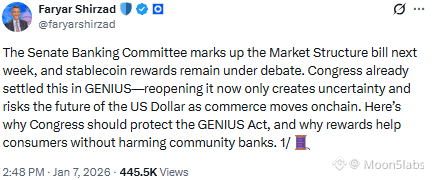
Coinbase counters that stablecoin rewards help protect the dollar’s global dominance. Chief Policy Officer Faryar Shirzad pointed out that China has already begun testing interest-bearing digital yuan, signaling future global competition.
Trump’s Administration Backed Crypto — but the Bill Is Stalling
Trump’s second term has been crypto-friendly. The GENIUS Act brought the first nationwide rules for stablecoin issuers, prompting even traditional financial firms — and Trump’s own family — to rush into the market. The USD1 stablecoin, launched by World Liberty Financial, debuted just before the law came into force.
Despite this, the broader crypto legislation is now hitting resistance. The battle over rewards has split bipartisan support, and Coinbase’s threat to withdraw adds real pressure to an already fragile process.
Bloomberg Intelligence analyst Nathan Dean now estimates that the likelihood of passing the bill before June 2026 has dropped below 70%.
Seeking Compromise: Regulation Might Become Selective
One compromise under discussion would allow only federally chartered or licensed institutions to offer stablecoin rewards.
Five crypto firms have already secured preliminary approval from the Office of the Comptroller of the Currency (OCC) to become national trust banks — but traditional banking groups strongly oppose this, claiming it undermines the purpose of a charter and poses systemic risks.
Even if restrictions pass, industry insiders believe crypto firms will find new workarounds.
“There’s no world where we can’t reward users for actions inside apps,” said William Gaybrick, president of technology and commerce at Stripe. “If you’re holding stablecoins in an app, that app will find a way to credit you — one way or another.”
Conclusion: Lawmakers Trapped Between Dollar Stability, Banks, and Crypto Innovation
Congress is now caught between pressure from the White House, economic lobbying from crypto companies, and resistance from traditional banks — and the clock is ticking.
Whether lawmakers can deliver a balanced bill that protects consumers, fosters innovation, and preserves the dollar’s strength, remains uncertain.
#coinbase , #Stablecoins , #USDC , #DigitalAssets , #CryptoRegulation
Stay one step ahead – follow our profile and stay informed about everything important in the world of cryptocurrencies!
Notice:
,,The information and views presented in this article are intended solely for educational purposes and should not be taken as investment advice in any situation. The content of these pages should not be regarded as financial, investment, or any other form of advice. We caution that investing in cryptocurrencies can be risky and may lead to financial losses.“