

Introduction to cryptocurrency 🤝
Cryptocurrency, or cryptocurrency, is a type of virtual currency designed to improve financial transparency and inclusivity. Unlike traditional currencies, which are governed, issued, and supported by governments worldwide, cryptocurrencies are stateless and are not backed by any central bank, political party, or individual.
Cryptocurrencies use concepts from cryptography, mathematics, and computer science to offer a decentralized, peer-to-peer monetary system. This system is based on clearly defined and transparent rules rather than centralized authority and trust.
While some dismiss cryptocurrency as a passing fad, others hail it as a revolutionary breakthrough.
One thing is clear: the potential of cryptocurrencies to redefine the ways we connect and transact can have a lasting impact on every person's life.
Cryptocurrency explained 🔍
Cryptocurrencies are digital currencies that leverage cryptography, computer science, and economics to create a decentralized and highly secure payment system. These three disciplines work together to ensure the integrity and efficiency of cryptocurrency transactions.
Cryptographic techniques protect crypto transaction data.
Computer science preserves the consistency of this data between all participants.
Economic incentives encourage everyone to follow the rules for the benefit of the network.
A simple way to grasp the advantages of cryptocurrency and decentralized finance over the traditional financial system is to compare them to physical letters and digital emails.
Sending a transaction through the traditional financial system is similar to sending a physical letter through the postal service. It is generally slow, expensive, and requires multiple intermediaries at each stage of the process to reach its final destination.
In contrast, transferring value with cryptocurrencies is more like sending an email. Depending on the cryptocurrency used, transaction fees can be minimal or even negligible. Payments are also processed in seconds, rather than hours or weeks, and no centralized intermediary is needed to facilitate the transfer.
This is a significant point, but somewhat abstract to grasp. Cryptocurrency allows individuals to send value directly to each other, without the need for centralized intermediaries like governments or banks.
This allows individuals to retain greater ownership not only of their finances, but also of their information and privacy.
Some of the largest and most popular cryptocurrencies include Bitcoin , Ethereum , Tether , Solana , and USD Coin .
What cryptocurrencies are not 🚫
Cryptocurrency is often misunderstood. Despite its growing presence in the financial world, many misconceptions still obscure its true nature.
Common misconceptions include:
Misconception: Only used for criminal purposes
Truth: The vast majority of transactions are legitimate. A recent report from Chainalysis shows that less than 0.5% of all cryptocurrency transactions are fraudulent or criminal.
Misconception: Completely anonymous
Truth: Most cryptocurrency owners are pseudonymous, not anonymous. While transactions on the blockchain are visible, linking them to specific individuals can be extremely difficult.
Misconception: Harmful to the environment
Truth: Although some cryptocurrencies, such as Bitcoin, have been criticized for their energy consumption, many new cryptocurrencies are adopting more energy-efficient methods such as proof-of-stake.
Misconception: Guaranteed by nothing
Truth: Although physical assets or governments do not back cryptocurrencies, their value stems from factors such as limited supply, practical use cases, and the functionality of the underlying technology.
Misconception: Operated by banks or governments
Truth: Cryptocurrencies are decentralized, meaning they operate independently of central authorities like banks or governments.
Misconception: All cryptocurrencies are exactly like Bitcoin
Truth: Not all cryptocurrencies are Bitcoin clones. A large majority of altcoins have unique characteristics, objectives, and technologies, offering a diverse range of use cases.
Misconception: The same thing as a blockchain
Truth: Blockchain is the digital ledger technology that underpins cryptocurrencies, but it has a wide range of applications beyond just digital currencies.
Few things in the world are so misunderstood and yet so fiercely debated as cryptocurrencies. It's important to dispel the myths and understand the facts.
What can you do with cryptocurrencies? 📝
Cryptocurrencies do not all function in the same way, nor do they all pursue the same objective. Here are some of the uses of the most popular cryptocurrencies currently on the market:
Sending valuables from one country to another — quickly and cheaply.
To hold a self-sovereign reserve of value.
Buying goods and services peer-to-peer.
Funding individuals and charitable causes without censorship
Create and use decentralized applications.
Vote on proposals that shape the future of cryptocurrency.
Earn rewards for securing the protocol through staking.
Join a cryptocurrency mining pool.
Directly support your favorite content creators.
Establishing ownership of digital assets.

How does cryptocurrency work? ⚙️
One of the main characteristics of the cryptocurrency market is its decentralization. However, when no one is "responsible" for something as important as the transfer of value between individuals, how can a system function without some kind of oversight?
The solution involves two main components: blockchain technology and a global distributed computer network.
Blockchain technology
Blockchains act as a public ledger, tracking and recording all kinds of information. This is made possible by highly secure and censorship-resistant rules. These rules are coded directly into the protocols and are generally available for anyone in the world to view.
Each participant in the network (called a node) maintains its own copy of the blockchain database and helps the entire network reach a consensus on newly added data before it is validated in the blockchain.
Consensus mechanisms
Rather than relying on a single individual to determine whether information is true or false, blockchains require nodes to collectively approve or reject pending transaction data submitted to the ledger. The community can then assess the facts and collectively agree on approval or rejection.
To learn more about nodes and the important role they play in blockchain networks, see our article What are blockchain nodes and clients?
This process of reaching an agreement between all nodes is known as reaching a "consensus".
Blockchains use various consensus mechanisms , such as proof of work and proof of stake , to achieve this. These mechanisms often include incentives and penalties to encourage honest behavior and discourage malicious activity.
Security and integrity
Blockchains get their name from the way they "chain" together "blocks" of information (such as transaction details) by including information from the previous block in each new block.
The header of each new block contains the hash of the previous block, among other data, serving as a unique fingerprint for that block. This creates an immutable chain that anyone can self-verify.
This process is what makes blockchain ledgers tamper-proof, because changing even a single transaction within a block would radically alter its unique digital fingerprint. Attackers would also need to gain majority control of the network (more than 50% of all staking or mining power) to manipulate the order of new blocks and potentially spend funds twice.
This process of linking blocks and ensuring data integrity is a key aspect of blockchain technology and relies on advanced cryptographic techniques. This is also why these decentralized networks are known as "blockchains".
To learn more about these techniques, you can explore how cryptocurrencies use cryptography .
Given the degree of coordination, the amount and the processing power that this would entail, these attacks have become almost impossible to carry out on widely adopted blockchains like Bitcoin or Ethereum.
How to buy cryptocurrency 🧑💻
Just as you don't need to be a mechanic to drive a car, you don't need to be a crypto expert to use cryptocurrency. All you need is an internet connection and a device, such as a smartphone, laptop, tablet, or desktop computer.
Once you have that, you have several options to choose from when deciding to buy crypto :
Step 1: Create an account
Many believe that the safest and easiest way to buy popular cryptocurrencies is to use a cryptocurrency trading platform like Binance.
These platforms function like digital exchanges, allowing you to buy and sell cryptocurrencies directly with other users. When you create an account, the platform automatically sets up a crypto wallet for you, providing a secure place to store your funds.
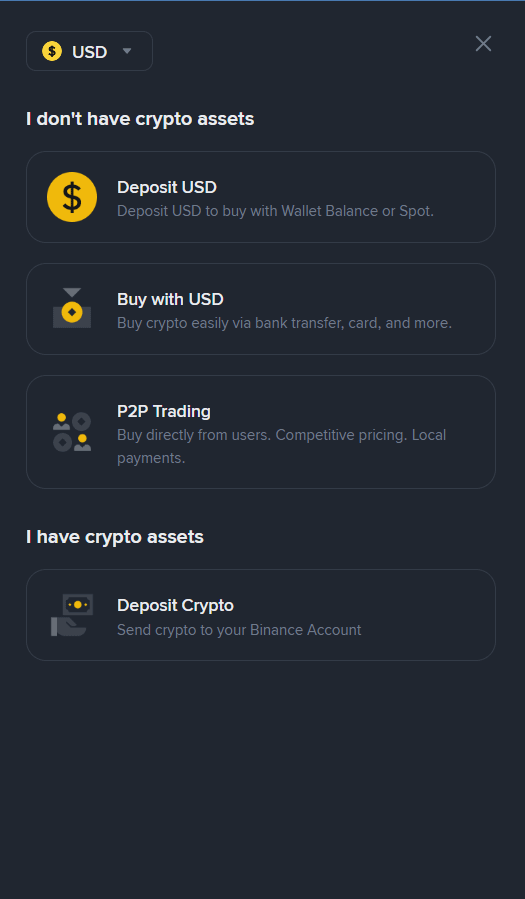
Step 2: Deposit funds into your account
After creating and complete identity verification (KYC), you can add funds via your preferred payment method. Then, navigate to the "Buy Crypto" section, choose your desired cryptocurrency, and follow the instructions on the screen to complete your crypto purchase.
How to Buy Cryptocurrencies Using Bank Transfer?
To buy cryptocurrencies using a bank transfer on Binance, select the "Bank Transfer" option in the "Buy Crypto" section, follow the instructions to link your bank account, and complete your purchase.
How to Buy Cryptocurrencies with a Credit Card?
On Binance, you can buy cryptocurrencies using a credit card by selecting the "Credit/Debit Card" option in the "Buy Crypto" section. Next, enter your card details, choose your coin, and complete the transaction in minutes.
Key takeaways 🔑
Cryptocurrency is a digital currency that uses cryptography, computer science, and economic principles to establish a decentralized and secure financial system.
Cryptocurrency uses blockchain technology, a decentralized ledger that securely records transactions.
Securing your cryptocurrency involves choosing the right type of wallet and practicing good security habits to protect your assets.