
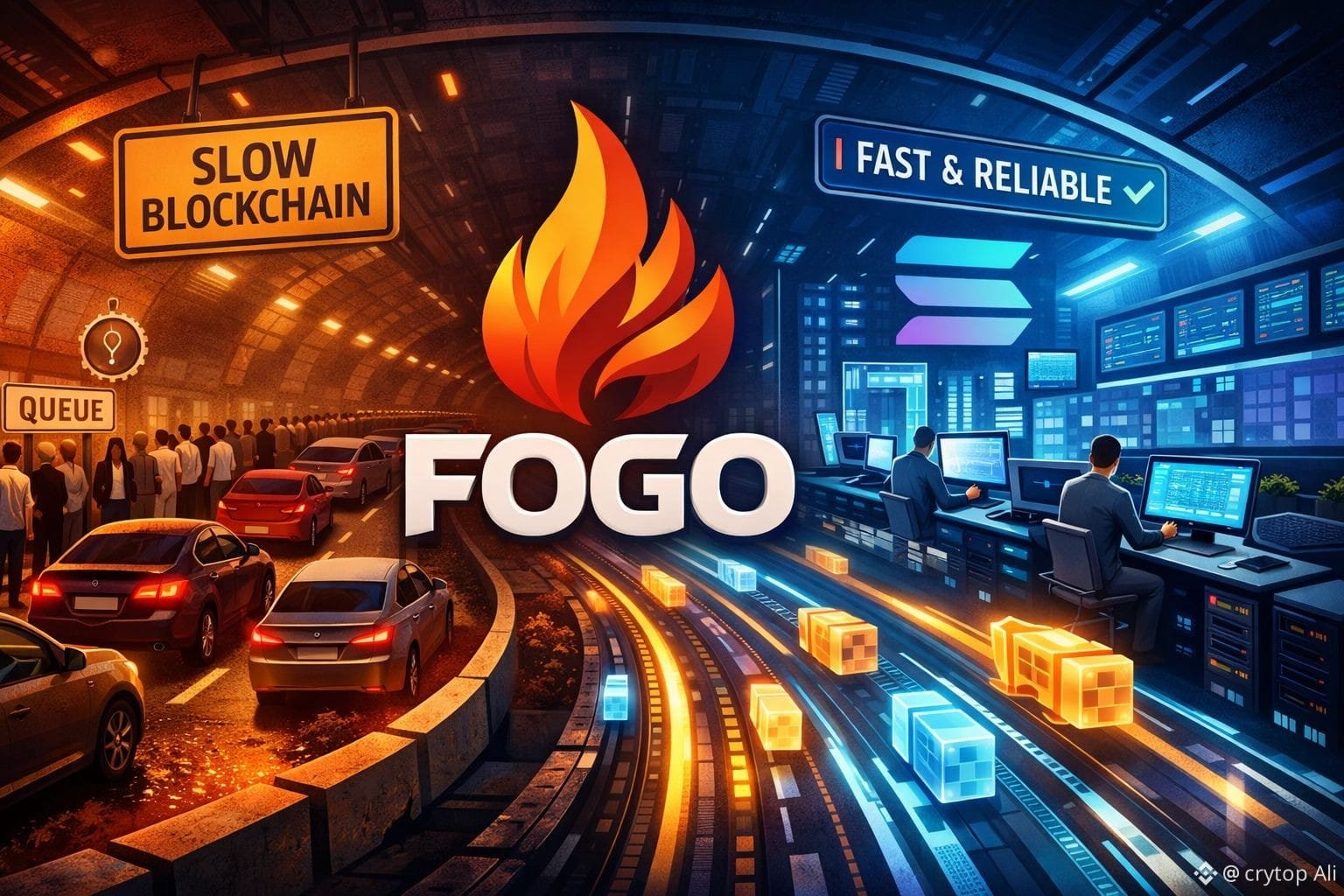
In the early decades of the internet, the systems that ultimately prevailed were not those that made the loudest promises, but those that delivered the most consistent performance. Reliability quietly outcompeted spectacle. Protocols that could guarantee packet delivery, maintain synchronization, and preserve uptime became the invisible scaffolding upon which digital civilization was built. Today, blockchain infrastructure finds itself at a similar crossroads. The industry has spent years optimizing for visibility—transaction-per-second claims, headline-grabbing benchmarks, and theoretical scalability projections. Yet a growing countercurrent argues that the future will be decided by something far less glamorous: execution.
Within this emerging paradigm, predictability is becoming the new measure of technological maturity. It is not enough for a system to be fast in ideal conditions or scalable under controlled benchmarks. Financial infrastructure demands something stricter. It requires determinism, disciplined validation, and the minimization of variance. In this context, the philosophy behind FOGO represents a notable shift in emphasis. Rather than competing in the theater of maximum throughput or narrative dominance, it positions itself around the more austere principle of execution certainty.
To understand the significance of this shift, one must first consider the historical trajectory of blockchain design. Early networks prioritized decentralization above all else. Their architecture resembled loosely coordinated constellations—robust against censorship, yet inherently unpredictable in performance. As adoption grew and financial applications proliferated, a tension emerged between openness and operational reliability. Markets, unlike social networks or gaming platforms, cannot tolerate ambiguity in settlement outcomes. A delayed confirmation in a messaging app is an inconvenience; in a financial system, it is risk.
This distinction explains why variance has become one of the most critical yet under-discussed metrics in blockchain infrastructure. Variance refers not merely to average performance but to the consistency of that performance. Two networks may both claim a one-second finality time, yet if one occasionally spikes to ten seconds under congestion, the difference is profound. In trading, payments, and derivatives markets, unpredictability translates directly into exposure. Traders hedge against latency. Payment systems build costly buffers to accommodate uncertainty. Institutions hesitate to integrate infrastructure that cannot guarantee execution stability.
Seen through this lens, the notion of deterministic finality takes on broader significance. Determinism is not simply a technical property; it is a foundation for institutional trust. When a transaction is finalized with mathematical certainty within a defined timeframe, it transforms blockchain from an experimental settlement layer into a credible financial substrate. The distinction is subtle but crucial. Deterministic systems reduce the cognitive load required to operate within them. They allow participants to act with confidence rather than contingency planning.
Validator discipline plays an equally central role in this architecture. In many blockchain systems, validator behavior is probabilistic and loosely coordinated. Consensus emerges through distributed negotiation, often involving complex fallback mechanisms to resolve conflicts. While this approach maximizes resilience, it introduces variability into execution outcomes. FOGO’s emphasis on validator discipline suggests an alternative philosophy: one in which coordination is structured more tightly, and performance standards are enforced more rigorously.
This approach evokes a broader metaphor of technological evolution. Early blockchain networks resemble open frontiers—vast, decentralized, and unpredictable. Systems focused on execution predictability resemble urban infrastructures—engineered environments where flows are regulated, latency is controlled, and outcomes are reliably repeatable. Neither model is inherently superior; each reflects different priorities. Yet as blockchain increasingly intersects with global finance, the urban paradigm appears increasingly relevant.
Latency control further illustrates this transition from experimental networks to financial-grade infrastructure. In traditional markets, latency is treated as a systemic variable requiring constant management. High-frequency trading firms invest billions in physical fiber routes to shave milliseconds from transaction times. Payment networks engineer redundant pathways to ensure uninterrupted operation. In this context, blockchain latency cannot remain an emergent property of decentralized coordination; it must become an engineered parameter.
FOGO’s focus on controlling latency rather than merely minimizing it represents a subtle but important distinction. Minimization seeks to push performance boundaries under ideal conditions. Control seeks to ensure stability across all conditions. The latter aligns more closely with financial system requirements, where consistency often outweighs peak performance. A system that guarantees two-second finality is often more valuable than one that oscillates between half a second and fifteen seconds.
Yet the pursuit of predictability introduces its own philosophical tensions. Blockchain was born from a vision of radical decentralization—a mesh of autonomous nodes operating without centralized coordination. Systems that prioritize deterministic execution and validator discipline may inevitably introduce elements of structural hierarchy. The challenge lies in balancing reliability with the foundational ethos of distributed governance.
This tension raises broader questions about the evolution of blockchain networks. As the industry matures, it appears to be undergoing a process of functional specialization. Some chains may continue to serve as experimental arenas, optimizing for permissionless innovation and maximal decentralization. Others may evolve into execution layers tailored for financial stability. Rather than competing directly, these systems may federate into an interconnected mesh of chains, each optimized for distinct operational priorities.
In such a federated ecosystem, predictability could emerge as a defining characteristic of base-layer financial infrastructure. Much as the internet relies on stable core protocols beneath dynamic application layers, the blockchain ecosystem may converge around a stratified architecture. Execution-focused chains would provide the deterministic settlement foundation upon which more flexible and experimental layers operate.
Still, skepticism remains warranted. History offers numerous examples of technologies that prioritized reliability at the expense of adaptability. Systems engineered for strict predictability can become rigid, struggling to evolve in response to unforeseen demands. The financial industry itself provides cautionary precedents, where overly deterministic infrastructures proved vulnerable to systemic shocks precisely because they lacked flexibility.
Moreover, the pursuit of low variance may encounter inherent limits within decentralized environments. Unlike centralized systems, distributed networks must contend with heterogeneous hardware, geographic dispersion, and fluctuating network conditions. Absolute predictability may remain an aspirational ideal rather than an achievable endpoint. The challenge is not to eliminate variance entirely but to reduce it to levels acceptable for financial risk tolerance.
There is also a deeper sociotechnical dimension to consider. Infrastructure does not merely shape performance metrics; it shapes human behavior. Systems that offer predictable outcomes encourage participation by reducing uncertainty. They enable institutions to integrate new technologies without redesigning entire risk management frameworks. In this sense, the design philosophy embodied by execution-focused chains may play a pivotal role in bridging the gap between blockchain experimentation and mainstream adoption.
Yet trust in technology extends beyond deterministic algorithms. It involves perception, governance, and collective confidence. Financial systems function not solely because they are technically reliable, but because participants believe in their reliability. This belief emerges through consistent performance over time, transparent governance, and resilience under stress.
As blockchain continues its transition from speculative innovation to infrastructural backbone, the emphasis on execution predictability may signal a broader maturation of the industry. The narrative focus may gradually shift away from revolutionary rhetoric toward operational credibility. The most transformative systems may ultimately be those that attract the least attention—networks that operate quietly, reliably, and without dramatic fluctuations.
In this sense, the evolution of blockchain infrastructure mirrors a recurring pattern in technological history. The early phases of innovation are characterized by exuberant experimentation and bold claims. The later phases are defined by refinement, standardization, and the pursuit of reliability. What begins as a frontier eventually becomes infrastructure.
FOGO’s philosophy reflects this transitional moment. It embodies an argument that the next stage of blockchain evolution will be determined not by theoretical capabilities but by execution discipline. The future of digital finance may depend less on which network can achieve the highest peak throughput, and more on which can deliver consistent outcomes under real-world conditions.
Ultimately, the question at stake is not merely technical but philosophical. Trust has always been the invisible currency of financial systems. It cannot be engineered solely through cryptographic guarantees or consensus algorithms. It emerges from the sustained alignment between expectation and outcome. Predictability, in this context, becomes a form of technological integrity—the capacity of a system to do exactly what it promises, no more and no less.
As humanity continues to build the blueprint for an internet of value, the most profound challenge may not lie in creating ever more complex architectures. It may lie in cultivating infrastructures that people can rely upon without constant vigilance. In the end, technology fulfills its highest purpose not when it astonishes us, but when it fades into the background—quietly sustaining the trust upon which collective systems depend.
@Fogo Official $FOGO #fogo